Portrét Franz Xaver Winterhalter

100 nejslavnějších obrazů autora Franz Xaver Winterhalter, výběr z galerie

Aktualizováno listopad 2026 · seřazeno podle našeho skóre popularity (vyhledávání, návštěvy a objednávky u každého díla) · 368 děl umělce Franz Xaver Winterhalter v našem katalogu

Stručně řečeno

Z všech originálů, které Franz Xaver Winterhalter zanechal, je nejslavnější Císařna Eugénie ve společnosti svých dam přes družky (1855), který se nachází ve sbírce Musée National du Château de Compiègne, Compiègne. Hned za ním následují Florinda (1853) a The Royal Family in 1846 (1846). Náš katalog obsahuje 368 děl umělce Franz Xaver Winterhalter; galerie si zachovala 100 děl, která obdivuje celý svět, přičemž každé je znázorněno s datem vzniku, názevem muzea a jeho příběhem.

1805 – 1873, Menzenschwand Akademická sztuka Nejvíce děl: Royal Collection

10 nejlepších obrazů umělce Franz Xaver Winterhalter: výběr galerie

1
Císařna Eugénie ve společnosti svých dam přes družky (1855) od Franz Xaver Winterhalter

Císařna Eugénie ve společnosti svých dam přes družky

1855 · Olej na plátně · Musée National du Château de Compiègne, Compiègne

Plátno s technikou olej na plátně s názvem Císařna Eugénie ve společnosti svých dam přes družky bylo dokončeno v roce 1855 německým umělcem Franz Xaver Winterhalter. Tento portrét byl zcommissionován císařnou Eugénií de Montijo s cílem zachytit její přítomnost na císařském dvoře. Dílo představuje formální shromáždění panovnice a jejího nejbližšího okruhu.

2
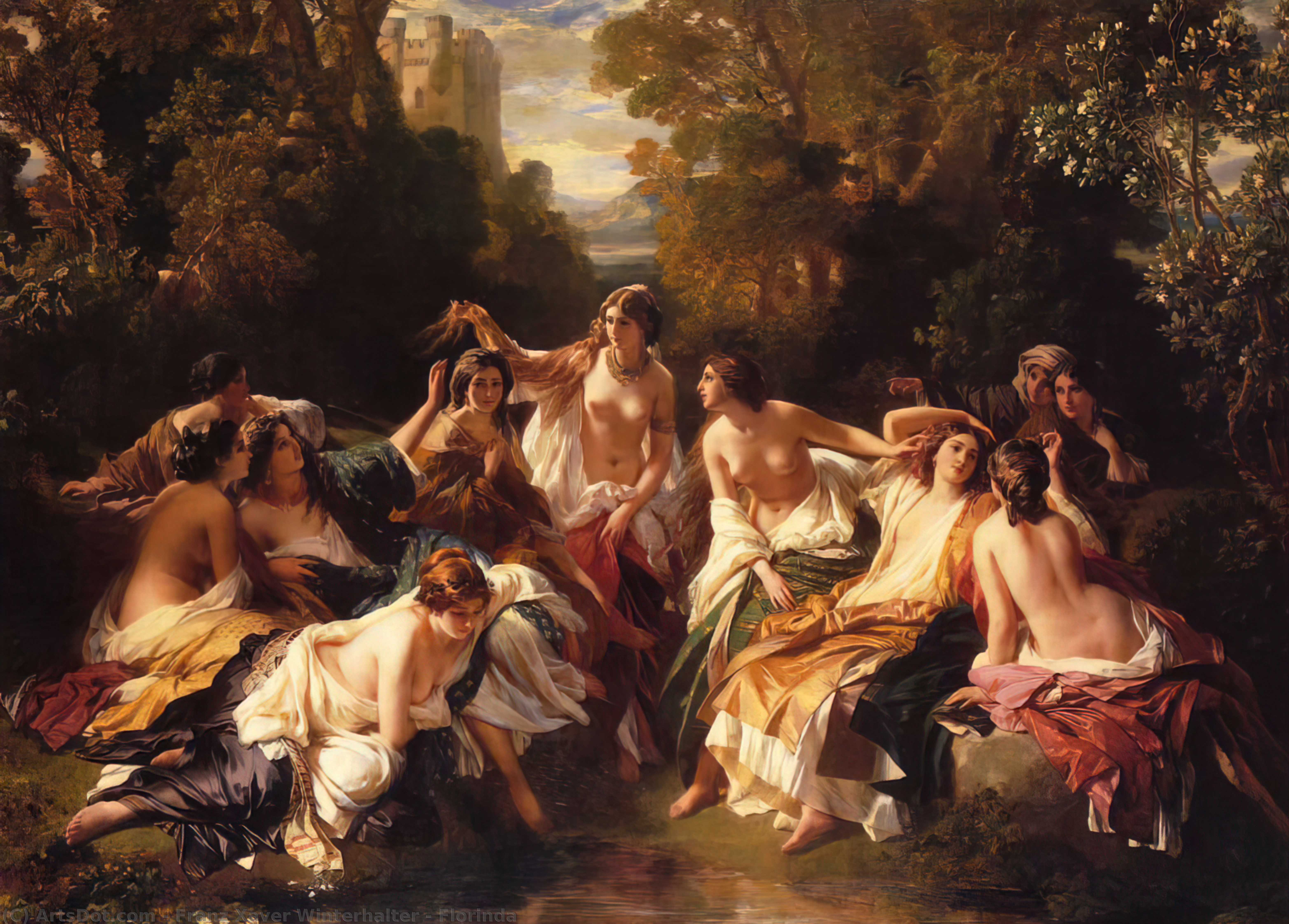
Florinda (1853) od Franz Xaver Winterhalter

Florinda

1853 · Olej na plátně · Metropolitan Museum of Art, New York

Úžasný pohled do světa Winterhalterovy Florindy Franz Xaver Winterhalterova "Florinda" z roku 1853 je mnohem víc než jen obraz; je to okno do elegantního a rozkošného světa 19. století, kde se setkávají královská moc a umělecká dokonalost. Tento dílo, zachycující skupinu mladých žen v idylickém prostředí, nabízí pohled na radost, přátelství a jemnou krásu, které Winterhalter mistrovsky dovedl do života na plátně. Původní obraz, nyní uložený v Metropolitan Museum of…

3
The Royal Family in 1846 (1846) od Franz Xaver Winterhalter

The Royal Family in 1846

1846 · Oil On Canvas · Royal Collection, Londýn

Franz Xaver Winterhalter’s “The Royal Family in 1846” is more than just a portrait; it’s a meticulously crafted snapshot of an era, a testament to the burgeoning power and refined sensibilities of Victorian Britain. Executed in 1846, this oil on canvas masterpiece – measuring a substantial 317 x 250 cm – offers a rare glimpse into the lives of Queen Victoria and her immediate family, frozen in a moment of…

4
Queen Victoria (1819-1901) (1845) od Franz Xaver Winterhalter

Queen Victoria (1819-1901)

1845 · Oil On Canvas · Royal Collection, Londýn

In this 1845 portrait, we encounter a young Queen Victoria, captured in a moment of poised authority. The composition is a vertical three-quarter length study, positioning her slightly off-center to create a sense of movement within her stillness. She is draped in a gown of luminous white and cream, which contrasts sharply against the deep royal blue of her sash. This sash cuts a structured line across her torso, anchoring…

5
Queen Victoria (1819-1901) (1844) od Franz Xaver Winterhalter

Queen Victoria (1819-1901)

1844 · Oil On Canvas · Royal Collection, Londýn

In this 1844 portrait, we encounter a young woman captured in a moment of quiet, formal elegance. The composition is an intimate profile, focusing on the head and shoulders against a neutral, textured background that allows the subject to emerge with clarity. There is a certain stillness here, a sense of a person poised between the private self and the public weight of her station. The lighting is soft and…

6
Queen Victoria with the Prince of Wales (1846) od Franz Xaver Winterhalter

Queen Victoria with the Prince of Wales

1846 · Oil On Canvas · Royal Collection, Londýn

The portrait presents Queen Victoria and the young Prince of Wales within a formal, vertical composition. The Queen is positioned slightly off-center, wearing a gown of deep pink and purple silk. A blue sash crosses her torso, and the fabric of her dress features intricate lace and floral patterns. Beside her, the young Prince of Wales is depicted in a smaller scale, creating a sense of maternal presence. The background…

7
Prince Albert, Prince Consort (1819-1861) (1844) od Franz Xaver Winterhalter

Prince Albert, Prince Consort (1819-1861)

1844 · Oil On Canvas · Royal Collection, Londýn

Prince Albert stands before us in a moment of poised, vertical stillness. He is captured in a three-quarter view, his gaze meeting the viewer with a composed and steady expression. The light, descending from the upper left, carves the contours of his face and the sharp tailoring of his military tunic, creating a sense of tangible depth. He wears a scarlet tunic, its color deep and saturated, accented by the…

8
Count Jenison-Walworth (1837) od Franz Xaver Winterhalter

Count Jenison-Walworth

1837 · Oil On Canvas · Neue Pinakothek, Mnichov

To stand before Franz Xaver Winterhalter's portrait of Count Jenison-Walworth is to step directly across the threshold of mid-nineteenth-century European high society. This painting is far more than a mere likeness; it is a meticulously constructed tableau of status, wealth, and profound dignity. The subject himself commands attention, positioned with an inherent gravitas that speaks volumes about his station in life. Winterhalter, the master chronicler of royalty and aristocracy, captures…

9
Portrait of Prince Albert (1843) od Franz Xaver Winterhalter

Portrait of Prince Albert

1843 · Oil On Canvas · Royal Collection, Londýn

To stand before this magnificent depiction of Prince Albert is to step directly into the gilded salons of mid-nineteenth-century European royalty. Franz Xavier Winterhalter, a master whose brushstrokes seemed capable of capturing not just likenesses, but entire epochs, presents us here with an image radiating unparalleled opulence and structured dignity. The subject, arrayed in regal finery, commands attention; his posture is one of inherent authority, emphasized by the weight of…

10
Portrait of a lady with a fan (1850) od Franz Xaver Winterhalter

Portrait of a lady with a fan

1850 · Painting

To stand before a portrait such as this is to step directly into the opulent drawing rooms of the mid-nineteenth century. The subject, captured with exquisite detail, embodies the refined spirit of an era obsessed with propriety and visible splendor. The lady, seated upon what appears to be a plush couch, commands attention not through overt drama, but through an almost breathtaking stillness. Her posture speaks volumes of her station—a…

Výběr umělce Franz Xaver Winterhalter pokračuje, od 11 do 100

11Portrait of Empress Maria Alexandrovna (1857) od Franz Xaver WinterhalterPortrait of Empress Maria Alexandrovna1857 · Státní Ermitáž 12Prince Albert (1819-61) (1850) od Franz Xaver WinterhalterPrince Albert (1819-61)1850 · Royal Collection 13Queen Victoria (1819–1901) (1864) od Franz Xaver WinterhalterQueen Victoria (1819–1901)1864 · Doncaster Mansion House 14Queen Victoria (1819-1901) (1856) od Franz Xaver WinterhalterQueen Victoria (1819-1901)1856 · Royal Collection 15The Empress Eugénie (1854) od Franz Xaver WinterhalterThe Empress Eugénie1854 · Metropolitan Museum of Art 16Prince Albert of Saxe Coburg Gotha (replica of an original of 1859 by the artist) (1867) od Franz Xaver WinterhalterPrince Albert of Saxe Coburg Gotha (replica of an original of 1859 by the artist)1867 17Queen Victoria (1819-1901) with her Four Eldest Children (1845) od Franz Xaver WinterhalterQueen Victoria (1819-1901) with her Four Eldest Children1845 · Royal Collection 18Portrait of Empress Alexandra Feodorovna (1856) od Franz Xaver WinterhalterPortrait of Empress Alexandra Feodorovna1856 · Státní Ermitáž 19Eugenie, Empress of the French od Franz Xaver WinterhalterEugenie, Empress of the French 20PORTRAIT DU ROI LOUIS PHILIPPE od Franz Xaver WinterhalterPORTRAIT DU ROI LOUIS PHILIPPELouvre 21Princess Mary, Duchess of Gloucester (1776-1857) (1850) od Franz Xaver WinterhalterPrincess Mary, Duchess of Gloucester (1776-1857)1850 · Royal Collection 22Augusta of Saxe-Weimar, Queen of Prussia & German Empress (1811-1890) (1853) od Franz Xaver WinterhalterAugusta of Saxe-Weimar, Queen of Prussia & German Empress (1811-1890)1853 · Royal Collection 23Princess Helena (1846-1923) (1865) od Franz Xaver WinterhalterPrincess Helena (1846-1923)1865 · Royal Collection 24Victoria, Duchess of Kent (1786-1861) (1843) od Franz Xaver WinterhalterVictoria, Duchess of Kent (1786-1861)1843 · Royal Collection 25Augusta of Saxe-Weimar, Princess of Prussia, later Queen of Prussia and German Empress (1811-90) (1846) od Franz Xaver WinterhalterAugusta of Saxe-Weimar, Princess of Prussia, later Queen of Prussia and German Empress (1811-90)1846 · Royal Collection 26Princess Helena (1846-1923) (1849) od Franz Xaver WinterhalterPrincess Helena (1846-1923)1849 · Royal Collection 27Princess Gouramma (1841-1864) (1852) od Franz Xaver WinterhalterPrincess Gouramma (1841-1864)1852 · Royal Collection 28Princess Louise (1848-1939) (1851) od Franz Xaver WinterhalterPrincess Louise (1848-1939)1851 · Royal Collection 29Prince Philip of Saxe-Coburg-Gotha (1844-1921) (1848) od Franz Xaver WinterhalterPrince Philip of Saxe-Coburg-Gotha (1844-1921)1848 · Royal Collection 30Princess Alice (1843-78) (1845) od Franz Xaver WinterhalterPrincess Alice (1843-78)1845 · Royal Collection 31Christian Frederick, Baron Stockmar (1787-1863) (1847) od Franz Xaver WinterhalterChristian Frederick, Baron Stockmar (1787-1863)1847 · Royal Collection 32Ernest, Prince of Hohenlohe-Langenburg (1794-1860) (1853) od Franz Xaver WinterhalterErnest, Prince of Hohenlohe-Langenburg (1794-1860)1853 · Royal Collection 33Prince Arthur (1848-1942) (1852) od Franz Xaver WinterhalterPrince Arthur (1848-1942)1852 · Royal Collection 34Prince Leopold of Saxe-Coburg-Gotha (1824-1884) (1850) od Franz Xaver WinterhalterPrince Leopold of Saxe-Coburg-Gotha (1824-1884)1850 · Royal Collection 35Pedro V, King of Portugal (1837-61) (1854) od Franz Xaver WinterhalterPedro V, King of Portugal (1837-61)1854 · Royal Collection 36Frances, Countess of Gainsborough (1814-1885) (1851) od Franz Xaver WinterhalterFrances, Countess of Gainsborough (1814-1885)1851 · Royal Collection 37Queen Isabella II and her daughter the Princess of Asturias (1852) od Franz Xaver WinterhalterQueen Isabella II and her daughter the Princess of Asturias1852 · Královský palác v Madridu 38Grand Duchess Alexandra Iosifovna of Russia (1830-1911) (1859) od Franz Xaver WinterhalterGrand Duchess Alexandra Iosifovna of Russia (1830-1911)1859 · Royal Collection 39Prince Alfred (1844-1900) (1846) od Franz Xaver WinterhalterPrince Alfred (1844-1900)1846 · Royal Collection 40Feodora, Princess of Hohenlohe-Langenburg (1807-72) (1872) od Franz Xaver WinterhalterFeodora, Princess of Hohenlohe-Langenburg (1807-72)1872 · Royal Collection 41Frederick William, Crown Prince of Prussia (1831-88) (1867) od Franz Xaver WinterhalterFrederick William, Crown Prince of Prussia (1831-88)1867 · Royal Collection 42Frederick William, Grand Duke of Mecklenburg-Strelitz (1819-1904) (1853) od Franz Xaver WinterhalterFrederick William, Grand Duke of Mecklenburg-Strelitz (1819-1904)1853 · Royal Collection 43Edward VII (1841-1910) when Prince of Wales (1864) od Franz Xaver WinterhalterEdward VII (1841-1910) when Prince of Wales1864 · Royal Collection 44Portrait of Countess Olga Shuvalova (1858) od Franz Xaver WinterhalterPortrait of Countess Olga Shuvalova1858 · Státní Ermitáž 45Prince Leopold (1853-1884), later Duke of Albany (1853) od Franz Xaver WinterhalterPrince Leopold (1853-1884), later Duke of Albany1853 · Royal Collection 46Alexandrine, Duchess of Saxe-Coburg-Gotha (1820-1904) (1842) od Franz Xaver WinterhalterAlexandrine, Duchess of Saxe-Coburg-Gotha (1820-1904)1842 · Royal Collection 47Victoire of Saxe-Coburg-Gotha, Duchesse de Nemours (1822-1857) (1840) od Franz Xaver WinterhalterVictoire of Saxe-Coburg-Gotha, Duchesse de Nemours (1822-1857)1840 · Royal Collection 48Victoria, Duchess of Kent (1786-1861) (1861) od Franz Xaver WinterhalterVictoria, Duchess of Kent (1786-1861)1861 · Royal Collection 49Princess Adelaide of Hohenlohe-Langenburg (1835-1900) (1853) od Franz Xaver WinterhalterPrincess Adelaide of Hohenlohe-Langenburg (1835-1900)1853 · Royal Collection 50Portrait of a Lady (1850) od Franz Xaver WinterhalterPortrait of a Lady1850 · Minneapolis Institute of Art 51Princess Beatrice (1857-1944) (1859) od Franz Xaver WinterhalterPrincess Beatrice (1857-1944)1859 · Royal Collection 52Portrait of Juliane, Princess of Saxe-Coburg-Saalfield (1848) od Franz Xaver WinterhalterPortrait of Juliane, Princess of Saxe-Coburg-Saalfield1848 · Royal Collection 53Prince Philip of Württemberg (1838-1917) (1841) od Franz Xaver WinterhalterPrince Philip of Württemberg (1838-1917)1841 · Royal Collection 54Queen Adelaide (1792-1849) (1849) od Franz Xaver WinterhalterQueen Adelaide (1792-1849)1849 · Royal Collection 55Elizabeth, Marchioness of Douro (1820-1904) (1848) od Franz Xaver WinterhalterElizabeth, Marchioness of Douro (1820-1904)1848 · Royal Collection 56Prince Leopold (1853-1884) (1854) od Franz Xaver WinterhalterPrince Leopold (1853-1884)1854 · Royal Collection 57Prince Louis of Hesse, later Grand Duke Louis IV of Hesse (1837-1892) (1861) od Franz Xaver WinterhalterPrince Louis of Hesse, later Grand Duke Louis IV of Hesse (1837-1892)1861 · Royal Collection 58Jane, Marchioness of Ely (1821-1890) (1856) od Franz Xaver WinterhalterJane, Marchioness of Ely (1821-1890)1856 · Royal Collection 59Edouard Andre (1857) od Franz Xaver WinterhalterEdouard Andre1857 · Musée Jacquemart-André 60Portrait of Frédéric Kuhlmann (1869) od Franz Xaver WinterhalterPortrait of Frédéric Kuhlmann1869 · Palais des Beaux-Arts de Lille 61Gaston, Comte D'Eu (1842-1922) (1846) od Franz Xaver WinterhalterGaston, Comte D'Eu (1842-1922)1846 · Royal Collection 62Edward VII (1840-1910) when Albert Edward, Prince of Wales (1843) od Franz Xaver WinterhalterEdward VII (1840-1910) when Albert Edward, Prince of Wales1843 · Royal Collection 63Leopold, Duke of Brabant (1835-1909) (1844) od Franz Xaver WinterhalterLeopold, Duke of Brabant (1835-1909)1844 · Royal Collection 64Prince Arthur (1850-1942) (1851) od Franz Xaver WinterhalterPrince Arthur (1850-1942)1851 · Royal Collection 65George, Duke of Cambridge (1819-1904) (1852) od Franz Xaver WinterhalterGeorge, Duke of Cambridge (1819-1904)1852 · Royal Collection 66Count Alexander of Mensdorff-Pouilly (1813-71) (1847) od Franz Xaver WinterhalterCount Alexander of Mensdorff-Pouilly (1813-71)1847 · Royal Collection 67Luigi Lablache (1794-1858) (1852) od Franz Xaver WinterhalterLuigi Lablache (1794-1858)1852 · Royal Collection 68Princess Feodora of Hohenlohe-Langenburg (1839-1872) (1855) od Franz Xaver WinterhalterPrincess Feodora of Hohenlohe-Langenburg (1839-1872)1855 · Royal Collection 69Charles, Prince of Leiningen (1804-1856) (1850) od Franz Xaver WinterhalterCharles, Prince of Leiningen (1804-1856)1850 · Royal Collection 70Prince Frederick William of Prussia (1831-88) (1851) od Franz Xaver WinterhalterPrince Frederick William of Prussia (1831-88)1851 · Royal Collection 71The Family of Crown Prince and Crown Princess Frederick William of Prussia (1862) od Franz Xaver WinterhalterThe Family of Crown Prince and Crown Princess Frederick William of Prussia1862 · Royal Collection 72Prince Christian of Schleswig-Holstein (1831-1917) (1866) od Franz Xaver WinterhalterPrince Christian of Schleswig-Holstein (1831-1917)1866 · Royal Collection 73Princess Louise (1848-1939), later Duchess of Argyll (1865) od Franz Xaver WinterhalterPrincess Louise (1848-1939), later Duchess of Argyll1865 · Royal Collection 74Portrait of Zofia Odescalchi (1850) od Franz Xaver WinterhalterPortrait of Zofia Odescalchi1850 · Národní muzeum ve Varšavě 75FRANCOIS HORACE, COMTE SEBASTIANI, MARECHAL DE FRANCE (1772 1851) od Franz Xaver WinterhalterFRANCOIS HORACE, COMTE SEBASTIANI, MARECHAL DE FRANCE (1772 1851)Opera House 76CARMEN AGUADO, DUCHESSE DE MONTMORENCY od Franz Xaver WinterhalterCARMEN AGUADO, DUCHESSE DE MONTMORENCY 77Philip, Count of Flanders (1837-1905) (1844) od Franz Xaver WinterhalterPhilip, Count of Flanders (1837-1905)1844 · Royal Collection 78Louise, Queen of the Belgians with Leopold, Duke of Brabant, later Leopold II, King of the Belgians (1838) od Franz Xaver WinterhalterLouise, Queen of the Belgians with Leopold, Duke of Brabant, later Leopold II, King of the Belgians1838 · Royal Collection 79Isabella, Queen of Spain (1852) od Franz Xaver WinterhalterIsabella, Queen of Spain1852 · Augustiner Museum 80Louis Philippe, King of the French (1773-1850) (1845) od Franz Xaver WinterhalterLouis Philippe, King of the French (1773-1850)1845 · Royal Collection 81Louis, Duke of Oporto, later Louis I, King of Portugal (1838-1889) (1854) od Franz Xaver WinterhalterLouis, Duke of Oporto, later Louis I, King of Portugal (1838-1889)1854 · Royal Collection 82Prince Albert (1819-1861) (1845) od Franz Xaver WinterhalterPrince Albert (1819-1861)1845 · Royal Collection 83Elisabeth Kaiserin von Österreich (1865) od Franz Xaver WinterhalterElisabeth Kaiserin von Österreich1865 84Portrait of Maximilian I of Mexico od Franz Xaver WinterhalterPortrait of Maximilian I of MexicoMuseo Nacional de Historia 85Prince Leopold (1853-1884) (1859) od Franz Xaver WinterhalterPrince Leopold (1853-1884)1859 · Royal Collection 86Prince Arthur (1850-1942) (1859) od Franz Xaver WinterhalterPrince Arthur (1850-1942)1859 · Royal Collection 87Victoria, Duchess of Kent (1786-1861) (1849) od Franz Xaver WinterhalterVictoria, Duchess of Kent (1786-1861)1849 · Royal Collection 88Contemplation (1847) od Franz Xaver WinterhalterContemplation1847 · Royal Collection 89Karl Josef Berkmuller (1830) od Franz Xaver WinterhalterKarl Josef Berkmuller1830 90Princess Mary of Cambridge (1833-1897) (1846) od Franz Xaver WinterhalterPrincess Mary of Cambridge (1833-1897)1846 · Royal Collection 91Prince Leopold (1853-84) (1855) od Franz Xaver WinterhalterPrince Leopold (1853-84)1855 · Royal Collection 92Helene Louise Elizabeth de Mecklembourg Schwerin, Duchess D'Orleans with Prince Louis Philippe Albert D'Orleans, Comte de Paris od Franz Xaver WinterhalterHelene Louise Elizabeth de Mecklembourg Schwerin, Duchess D'Orleans with Prince Louis Philippe Albert D'Orleans, Comte de ParisOpera House 93Prince Augustus of Saxe-Coburg-Gotha (1845-1907) (1849) od Franz Xaver WinterhalterPrince Augustus of Saxe-Coburg-Gotha (1845-1907)1849 · Royal Collection 94Victoria, Princess Royal, Princess Alice, Princess Helena, and Princess Louise (1849) od Franz Xaver WinterhalterVictoria, Princess Royal, Princess Alice, Princess Helena, and Princess Louise1849 · Royal Collection 95Countess Varvara Alekseyevna Musina-Pushkina od Franz Xaver WinterhalterCountess Varvara Alekseyevna Musina-PushkinaStátní Ermitáž 96Countess Varvara Alekseyevna Musina-Pushkina od Franz Xaver WinterhalterCountess Varvara Alekseyevna Musina-Pushkina 97Portrait of the Marquise de Villers in White Ball Attire (1831) od Franz Xaver WinterhalterPortrait of the Marquise de Villers in White Ball Attire1831 98Female Portrait with Pink Bow on the Dress (1831) od Franz Xaver WinterhalterFemale Portrait with Pink Bow on the Dress1831 99Portrait of a Lady with Fan (1831) od Franz Xaver WinterhalterPortrait of a Lady with Fan1831 100Portrait of a Lady with Pearls in Her Hair (1831) od Franz Xaver WinterhalterPortrait of a Lady with Pearls in Her Hair1831

Slavná díla Franz Xaver Winterhalter podle jednotlivých období

Motivy, které zaujaly Franz Xaver Winterhalter

Čtyři témata, která se v těchto originálech nejčastěji objevují, z nichž každé má svůj nejlepší příklad.

Muzea, v nichž jsou vystavena originálna umělce Franz Xaver Winterhalter

8 muzea, v nichž je umístěno nejvíce obrazů z této stránky.

Muzeum Město Díla autora Franz Xaver Winterhalter Obrazy z tohoto seznamu
Royal Collection, LondýnRoyal Collection Londýn 111 The Royal Family in 1846, Queen Victoria (1819-1901), Queen Victoria (1819-1901)
Státní Ermitáž, Sankt-PetěrburgStátní Ermitáž Sankt-Petěrburg 11 Portrait of Empress Maria Alexandrovna, Portrait of Empress Alexandra Feodorovna, Portrait of Countess Olga Shuvalova
Opera House, VersaillesOpera House Versailles 11 FRANCOIS HORACE, COMTE SEBASTIANI, MARECHAL DE FRANCE (1772 1851), Helene Louise Elizabeth de Mecklembourg Schwerin, Duchess D'Orleans with Prince Louis Philippe Albert D'Orleans, Comte de Paris
Metropolitan Museum of Art, New YorkMetropolitan Museum of Art New York 4 Florinda, The Empress Eugénie
Augustiner Museum, FreiburgAugustiner Museum Freiburg 6 Isabella, Queen of Spain
Musée National du Château de Compiègne, CompiègneMusée National du Château de Compiègne Compiègne 5 Císařna Eugénie ve společnosti svých dam přes družky
Národní muzeum ve Varšavě, VaršavaNárodní muzeum ve Varšavě Varšava 5 Portrait of Zofia Odescalchi
Louvre, PařížLouvre Paříž 2 PORTRAIT DU ROI LOUIS PHILIPPE

Franz Xaver Winterhalter dekáda po dekádě: originální díla, která definují každou z nich

Díla podle dekád

Vyberte si dekádu a prohlédněte si originál, který ji definuje.

Otázky sběratelů o obrazech umělce Franz Xaver Winterhalter

Kterým dílem je Franz Xaver Winterhalter nejznámější?Odhalit odpověď

Císařna Eugénie ve společnosti svých dam přes družky (1855), Musée National du Château de Compiègne, Compiègne. Následují Florinda (1853) a The Royal Family in 1846 (1846).

Kolik let bylo Franz Xaver Winterhalter, když bylo vytvořeno dílo Císařna Eugénie ve společnosti svých dam přes družky?Odhalit odpověď

50 let: dílo Císařna Eugénie ve společnosti svých dam přes družky pochází z roku 1855 a Franz Xaver Winterhalter se narodil/a v roce 1805.

Kterých deset nejslavnějších obrazů má Franz Xaver Winterhalter?Odhalit odpověď

Císařna Eugénie ve společnosti svých dam přes družky, Florinda, The Royal Family in 1846, Queen Victoria (1819-1901), Queen Victoria (1819-1901), Queen Victoria with the Prince of Wales, Prince Albert, Prince Consort (1819-1861), Count Jenison-Walworth, Portrait of Prince Albert a Portrait of a lady with a fan. Hodnocení výše uvádí rok a muzeum pro každé z nich.

Kolik obrazů zanechal(a) Franz Xaver Winterhalter?Odhalit odpověď

Náš katalog obsahuje 368 děl umělce Franz Xaver Winterhalter z let 1830 až 1872.

Ve kterých muzeích jsou vystavena díla mistrovská umělce Franz Xaver Winterhalter?Odhalit odpověď

Většinou v Royal Collection (Londýn), Státní Ermitáž (Sankt-Petěrburg) a Opera House (Versailles). V tabulce muzeí výše jsou vypsány všechny.

V jakých letech namaloval Franz Xaver Winterhalter svá nejznámější díla?Odhalit odpověď

V období 1850s: 40 z celkem 100 děl na této stránce vzniklo právě tehdy, z toho Císařna Eugénie ve společnosti svých dam přes družky z nich.

Jaká jsou první a poslední slavná originální díla umělce Franz Xaver Winterhalter?Odhalit odpověď

Na této stránce je nejstarší dílo z Karl Josef Berkmuller (1830) a nejnovější z Feodora, Princess of Hohenlohe-Langenburg (1807-72) (1872).

Jaká témata si Franz Xaver Winterhalter vybíral nejčastěji?Odhalit odpověď

Woman (40), Lace (33) a Portrait (27) napříč 100 díly na této stránce.

Kterou techniku používal(a) Franz Xaver Winterhalter nejčastěji?Odhalit odpověď

Oil On Canvas, u 84 z 100 děl na této stránce.

K kterému uměleckému směru patří Franz Xaver Winterhalter?Odhalit odpověď

Akademická sztuka, podle originálů na této stránce.

Která díla umělce Franz Xaver Winterhalter jsou vystavena v Royal Collection?Odhalit odpověď

The Royal Family in 1846, Queen Victoria (1819-1901) a Queen Victoria (1819-1901): muzeum Royal Collection, Londýn má v obsluze 70 děl z této stránky.

Franz Xaver Winterhalter: život a dílo

Early Life, Family and Training

The Black Forest village of Menzenschwand provides the setting for the birth of Franz Xavier Winterhalter on 20 April 1805. He enters the world as the son of Fidel Winterhalter, a farmer and resin producer, and Eva Meyer. The household is one of practical labor, yet the creative impulse runs deep within the family. His brother, Hermann Winterhalter, also pursues a life as a painter, establishing a familial connection to the visual arts.

Training begins in Freiburg, where the young artist develops his skills as a graphic artist. This early grounding in drawing and engraving provides the technical foundation for his later precision. The path leads from the rural landscapes of Germany to the academic rigor of Munich. He enrolls at the Academy of Arts, seeking to refine his talent within a formal structure. The transition from a graphic artist to a painter marks a significant shift in his technical development.

A crucial shift occurs between 1833 and 1834. A travel stipend carries him to Italy. This period of study allows him to engage with the artistic circles of the time, moving him beyond his initial training toward the international stage. He leaves the classroom behind to face the realities of the European art scene.

The Rise to Royal Favor in Baden

The transition from student to court professional occurs in 1828. Winterhalter enters the inner circles of the aristocracy when he is appointed drawing master to Sophie, Margravine of Baden, at Karlsruhe. This position provides more than mere instruction; it offers a direct conduit to the grand-ducal court. His presence in Karlsruhe marks the beginning of a professional relationship with the ruling family of Baden.

His reputation grows through direct service to the sovereign. He is appointed painter to the grand-ducal court of Baden, a role that demands both technical precision and an understanding of dynastic image. His brush captures the likenesses of Grand Duke Leopold of Baden and his wife, cementing his status within the regional power structure. These commissions move him beyond the realm of a simple graphic artist and into the specialized world of court portraiture.

Success and Commissions in Paris

Paris in 1836 becomes the center of Winterhalter's professional orbit. His arrival marks a shift from the regional courts of Germany to the high-stakes atmosphere of the French capital. At the Salon of 1836, his genre scene Il dolce Farniente attracts immediate notice, signaling his ability to navigate the competitive Parisian art scene. This moment transitions him from a talented newcomer into a figure of interest within the French artistic landscape.

The momentum builds as he enters the inner circle of King Louis-Philippe. Under the protection of the King, Winterhalter secures a massive undertaking: commissions to paint portraits of the entire royal family. This position cements his status as a premier court painter. His influence does not end with the July Monarchy; he later finds himself at the court of Napoleon III, maintaining his position at the heart of French power and imperial politics.

  • Il dolce Farniente (1836)

The Victorian Era and British Royalty

The year 1841 marks a shift in Winterhalter’s trajectory. Queen Victoria summons him to the English court, a move that pulls the German painter into the intimate orbit of the British monarchy. He arrives in England in 1842, beginning a long-standing relationship with the royal household. His presence in the palace is constant. He does not merely paint official likenesses; he documents the growing family of Queen Victoria and Prince Albert. His brush captures the private and public faces of the dynasty, producing at least 120 works for the Royal Collection.

The work is prolific. He moves between the formal requirements of the throne and the personal needs of the royals, creating a visual record of the Victorian era. His portraits of the royal family provide a sense of personality and emotion that goes beyond simple representation. These paintings become the primary way the world perceives the British monarchy during this period.

Patrons and Imperial Commissions

The reach of Winterhalter’s brush extends into the most guarded corridors of power. In France, Empress Eugénie becomes a central figure in his orbit, seeking his hand to define the visual identity of her court. This pattern of imperial patronage repeats across borders. In 1857, he turns his attention to the Russian court to paint the Tsarina Maria Alexandrovna. His ability to navigate these high-stakes environments makes him a fixture in the private lives of the era's most powerful figures.

The 1860s see his influence crossing the Atlantic. He captures the likenesses of the Imperial couple of the Second Mexican Empire, documenting a regime far from the European centers he usually inhabits. Even as political landscapes shift, his presence in the halls of power remains constant. In 1865, he moves to the Austrian court to paint Empress Elisabeth of Austria, a commission that places him at the heart of the Habsburg dynasty.

  • Portrait of Empress Elisabeth of Austria (1865)
  • Portrait of Tsarina Maria Alexandrovna (1857)

Technique and Artistic Style

Winterhalter’s early technical approach centers on a smooth, enamel-like surface. He achieves this through meticulous layering, creating a polished finish that defines his academic compositions. This precision extends to his ability to render the specific textures of silk, velvet, and fine lace. He often works directly on the canvas, frequently bypassing preliminary studies to capture his subjects. This directness allows for an immediate connection between the artist's hand and the material. His skill in lithography further demonstrates a technical versatility that complements his oil painting.

As his career progresses, the rigid precision of his early years gives way to a newfound freedom of brushwork. This shift introduces a certain Romantic charm to his later works. He masters the art of blending realism with flattery, presenting his sitters with an idealized grace that remains recognizably themselves. He does not merely record a likeness; he constructs an image of status and refinement. This ability to navigate the fine line between accurate representation and the social requirements of the aristocracy ensures his subjects appear both dignified and approachable.

Key Works and Masterpieces

The year 1841 marks a significant shift as Winterhalter captures the French monarch, Louis Philippe I. The portrait places the king within the Galerie des Batailles at Versailles, presenting him in the uniform of a major general. He rests his hand upon architectural plans, a composition that celebrates the reopening of the palace as a museum. This work functions as a visual statement of the king's role in the restoration of French history.

In 1852, the artist moves toward a different atmosphere with Florinda. This work offers a sense of sun-drenched escapism, depicting figures in a landscape where the boundaries between humanity and nature dissolve. The composition relies on an organic harmony, utilizing a warm palette of gold, ochre, and deep forest greens to create a rhythmic flow of lines and textures along a riverbank sanctuary.

The mid-century reaches a peak of formal grandeur in 1855 with Empress Eugénie Surrounded by her Ladies in Waiting. This monumental oil on canvas depicts the Empress seated with regal composure. She is positioned centrally, flanked by twelve ladies-in-waiting arranged in carefully considered groupings. The painting emphasizes the social hierarchy of the Second French Empire through meticulous rendering of fabrics and light.

Later, in 1865, the focus shifts to the Austrian court. The Portrait of Franz Joseph I depicts the Emperor in the uniform of a field marshal. He wears the Order of Maria Theresa and the Order of the Golden Fleece. This portrait, created during a period of intense diplomatic and social shifts in Europe, captures the ruler in a highly formalized, decorated state.

Where to See the Works Today

The physical remnants of Winterhalter’s presence in the royal courts are scattered across the major cultural hubs of Europe and beyond. In London, the National Portrait Gallery holds his depictions of the British monarchy. Across the channel, the Musée d’Orsay in Paris and the Musée National du Château de Compiegne preserve his large-scale academic compositions, including his monumental depiction of Empress Eugénie and her ladies. These canvases remain in the spaces that once mirrored the grandeur of the Second French Empire.

The reach of his brush extends into the imperial collections of the East and the grand galleries of Central Europe. The Hermitage Museum in Saint Petersburg houses his portraits of the Russian aristocracy, while the Kunsthistorisches Museum in Vienna contains his depictions of the Austrian imperial family. In the United States, the Metropolitan Museum of Art in New York maintains his presence in the Western hemisphere, holding works like Florinda.