Olejová malba
 Vše o díle Dráždění







































 U děl nebo reprodukcí, u nichž je jakákoliv strana větší než 105 cm (přibližně 41 palců), bude rám dodán jako sestava v rozloženém stavu. Tato metoda zajišťuje bezpečné doručení a chrání dílo před poškozením během přepravy.


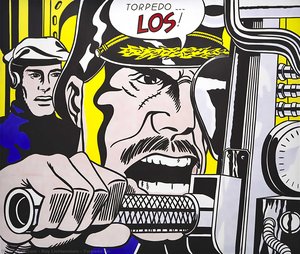
The Grip: A Bold Statement of Mid-Century Modern Aesthetics
‘The Grip,’ created in 1962, stands as an undeniable cornerstone of Roy Lichtenstein’s revolutionary contribution to Pop Art. This striking work immediately captivates the viewer with its dramatic cropping – a hand firmly grasping a trumpet against a vibrant crimson backdrop—a decision that prioritizes form and color above representational accuracy. Lichtenstein doesn't merely depict an object; he transforms it into a symbol brimming with potential meaning, embodying the dynamism and energy characteristic of the era’s artistic fervor.Pop Art & The Mimicry of Commercial Reproduction
Lichtenstein deliberately employs techniques reminiscent of commercial printing processes, mirroring the visual language of comic books and advertisements prevalent in the 1960s. This wasn't a mere stylistic choice but a conscious effort to blur the boundaries between “high” art and popular culture. The artwork’s flat planes of color—a masterful use of red—bold outlines, and crucially, the visible halftone pattern—those tiny dots meticulously crafted to simulate tone—perfectly replicate the aesthetic conventions of mass-produced imagery. This deliberate appropriation challenged traditional notions of artistic value, elevating a commonplace subject through scale and stylistic refinement. The stark contrast between the white hand and trumpet against the intense red amplifies this effect, creating an instant visual impact designed to provoke contemplation.Symbolism & Exploring Themes of Mechanical Reproduction
Despite its apparent simplicity, ‘The Grip’ invites multiple interpretations. The hand's resolute grip on the trumpet can be seen as representing control, mastery—perhaps even a striving for physical perfection—a preoccupation common in post-war art and culture. Simultaneously, the trumpet itself serves as a potent symbol of music, communication, and expressive potential. Scholars have argued that Lichtenstein’s interest lay in examining themes of mechanical reproduction and the artist's role within an increasingly industrialized world; the almost robotic quality of the hand and instrument reinforces this conceptual underpinning. It speaks to a broader anxiety about achieving idealized forms—a visual echo of societal pressures during the period.Technique: Halftone Dots & Stylized Graphic Design
The artwork’s distinctive aesthetic is defined by Lichtenstein's masterful manipulation of halftone dots – a technique borrowed directly from printing processes. These minuscule dots create the illusion of shading and texture, mimicking the appearance of printed images with remarkable precision. Thick angular lines delineate the contours of both the hand and trumpet, contributing to an overall sense of clarity and directness—a stylistic hallmark of Lichtenstein’s oeuvre. The geometric shapes – circles and rectangles – further enhance this impression of stylized graphic design, prioritizing visual impact over nuanced detail. Lighting is uniform across the image, minimizing shadows and emphasizing the flatness of the composition. Perspective is deliberately absent; the artwork presents a frontal view devoid of depth, focusing instead on conveying immediacy and arresting visual presence.Concluding Impression: A Legacy of Bold Color & Conceptual Innovation
Ultimately, ‘The Grip’ transcends mere representation, becoming a powerful statement about artistic innovation and its engagement with contemporary culture. Lichtenstein's decision to distill an everyday subject into a symbol ripe with potential meaning—coupled with his masterful execution of halftone dots and bold color palettes—solidifies his place as one of the most influential figures in Pop Art history. It remains a testament to the transformative power of art to challenge conventions and provoke reflection on societal values.Otázky a odpovědi
Je dílo Dráždění ručně malované, nebo jde o tisk?
Ručně malováno: zkušený malíř přetvoří Dráždění v olejomalbu na lněném plátně.
Jakou velikost si mám vybrat pro Dráždění?
Velikosti se pohybují od 31.6 x 31.6 cm (Kč4367) až po 239.6 x 239.6 cm (Kč45217); v tabulce na této stránce jsou uvedeny jednotlivé varianty a jejich ceny.
Jak dlouho trvá doručení?
Doručení trvá 4 až 5 týdnů a zahrnuje bezplatnou expresní přepravu po celém světě; na této stránce je k dispozici i možnost urgentní výroby. Dílo můžete vrátit během 100 dnů s plným vrácením peniędzy, bez jakýchkoliv podmínek.
Jakou techniku použil/a Roy Lichtenstein pro dílo Dráždění?
Olej na plátně
 Náhled v interiéru

 Sdílet
 Sdílet
 Podrobnosti o díle
 Informační list pro studenty


 Stáhnout
 Podobné položky
 Rentgenové snímky
 Slideshow
 Otázky a odpovědi

 Statistiky