Pop Art · 1962
Dráždění (Roy Lichtenstein, 1962)
Roy Lichtenstein (1923–1997) vytvořil dílo Dráždění. Pochází z roku 1962. Patří k hnutí Pop Art. Je vyrobeno z Olej na plátně.
- 1962
- Olej na plátně

 Náhled v interiéru

 Ručně malovaná olejná reprodukce
 Sdílet
 Sdílet
 Informační list pro studenty


 Stáhnout
 Podobné položky
 Rentgenové snímky
 Slideshow
 Otázky a odpovědi

 Statistiky
Dráždění v kostce
- Název díla
- Dráždění
- Autor
- Roy Lichtenstein (1923–1997)
- Rok narození umělce
- Manhattan, Spojené státy americké
- Datum vytvoření
- 1962
- Technika
- Olej na plátně
- Pohyb
- Pop Art
- Období
- Modernismus
- Motiv
- hand, trumpet, red background, halftone pattern, mechanical reproduction, control
Co przedstawuje dílo Dráždění?
The Grip: A Bold Statement of Mid-Century Modern Aesthetics
‘The Grip,’ created in 1962, stands as an undeniable cornerstone of Roy Lichtenstein’s revolutionary contribution to Pop Art. This striking work immediately captivates the viewer with its dramatic cropping – a hand firmly grasping a trumpet against a vibrant crimson backdrop—a decision that prioritizes form and color above representational accuracy. Lichtenstein doesn't merely depict an object; he transforms it into a symbol brimming with potential meaning, embodying the dynamism and energy characteristic of the era’s artistic fervor.Pop Art & The Mimicry of Commercial Reproduction
Lichtenstein deliberately employs techniques reminiscent of commercial printing processes, mirroring the visual language of comic books and advertisements prevalent in the 1960s. This wasn't a mere stylistic choice but a conscious effort to blur the boundaries between “high” art and popular culture. The artwork’s flat planes of color—a masterful use of red—bold outlines, and crucially, the visible halftone pattern—those tiny dots meticulously crafted to simulate tone—perfectly replicate the aesthetic conventions of mass-produced imagery. This deliberate appropriation challenged traditional notions of artistic value, elevating a commonplace subject through scale and stylistic refinement. The stark contrast between the white hand and trumpet against the intense red amplifies this effect, creating an instant visual impact designed to provoke contemplation.Symbolism & Exploring Themes of Mechanical Reproduction
Despite its apparent simplicity, ‘The Grip’ invites multiple interpretations. The hand's resolute grip on the trumpet can be seen as representing control, mastery—perhaps even a striving for physical perfection—a preoccupation common in post-war art and culture. Simultaneously, the trumpet itself serves as a potent symbol of music, communication, and expressive potential. Scholars have argued that Lichtenstein’s interest lay in examining themes of mechanical reproduction and the artist's role within an increasingly industrialized world; the almost robotic quality of the hand and instrument reinforces this conceptual underpinning. It speaks to a broader anxiety about achieving idealized forms—a visual echo of societal pressures during the period.Technique: Halftone Dots & Stylized Graphic Design
The artwork’s distinctive aesthetic is defined by Lichtenstein's masterful manipulation of halftone dots – a technique borrowed directly from printing processes. These minuscule dots create the illusion of shading and texture, mimicking the appearance of printed images with remarkable precision. Thick angular lines delineate the contours of both the hand and trumpet, contributing to an overall sense of clarity and directness—a stylistic hallmark of Lichtenstein’s oeuvre. The geometric shapes – circles and rectangles – further enhance this impression of stylized graphic design, prioritizing visual impact over nuanced detail. Lighting is uniform across the image, minimizing shadows and emphasizing the flatness of the composition. Perspective is deliberately absent; the artwork presents a frontal view devoid of depth, focusing instead on conveying immediacy and arresting visual presence.Concluding Impression: A Legacy of Bold Color & Conceptual Innovation
Ultimately, ‘The Grip’ transcends mere representation, becoming a powerful statement about artistic innovation and its engagement with contemporary culture. Lichtenstein's decision to distill an everyday subject into a symbol ripe with potential meaning—coupled with his masterful execution of halftone dots and bold color palettes—solidifies his place as one of the most influential figures in Pop Art history. It remains a testament to the transformative power of art to challenge conventions and provoke reflection on societal values.Vysokorozlišené fotografie díla Dráždění
Chráněno autorským právem: tyto soubory slouží pouze pro osobní prohlídku, nikoliv jako licence k opětovnému zveřejnění.
Roy Lichtenstein, Dráždění (1962).
Odpovědi na otázky k dílu Dráždění
V jakém roce vzniklo dílo „Dráždění“ od Roy Lichtenstein?
Dílo "Dráždění" pochází z roku 1962. Toto datum situuje dílo do období tvůrčí činnosti Roy Lichtenstein i do jeho dobové kontextu.
V jaké technice je vytvořeno dílo „Dráždění“ od Roy Lichtenstein?
Roy Lichtenstein pro dílo „Dráždění“ použil/a techniku Olej na plátně. Tato technika definuje materiální podstatu originálního díla.
Co zachycuje dílo "Dráždění"?
„Dráždění“ od Roy Lichtenstein zobrazuje: hand, trumpet, red background, halftone pattern, mechanical reproduction, control, performance.
Lze obraz díla „Dráždění“ od Roy Lichtenstein volně reprodukovat?
Co se týče autorských práv, dílo "Dráždění" spadá do stále chráněno autorským právem.
Kdo vytvořil "Dráždění"?
Dílo "Dráždění" vytvořil/a Roy Lichtenstein. Informace na této stránce popisují originální dílo umělce Roy Lichtenstein.
K jakému stylu patří „Dráždění“?
Dílo „Dráždění“ od Roy Lichtenstein patří k období směru Pop Art, který dílu dodává jeho stylistický kontext.
Do jaké fáze tvůrčího rozvoje Roy Lichtenstein patří dílo „Dráždění“?
V rámci kariéry umělce Roy Lichtenstein spadá dílo „Dráždění“ do období Mature Period. Tato fáze umožňuje jeho srovnání s dalšími díly tohoto umělce.
Kolik let bylo Roy Lichtenstein, když v roce 1962 vytvořil(a) dílo „Dráždění“?
Roy Lichtenstein vytvořil/a dílo „Dráždění" ve věku 39 let. Umělec/ka se narodil/a v roce 1923 a dílo je datováno na 1962.
Patří dílo „Dráždění“ od Roy Lichtenstein do volného užití, a proč?
Autorskoprávní status díla „Dráždění“ – stále chráněno autorským právem – vyplývá ze smrti umělce v roce 1997.
O umělci, Roy Lichtenstein

1923–1997, Spojené státy americké
Roy Lichtenstein
Život Roy Lichtenstein Manhattan, New York, 27. října 1923. Roy Lichtenstein přichází na svět jako syn Miltona a Beatrice. Urbanistická energie metropole tvoří kulisy života, který v budoucnu zpochysobí hranice hrubého umění.
O umělci Roy Lichtenstein Významná díla umělce Roy Lichtenstein
Také od autora Roy Lichtenstein
 Whaam!1963
 Podívej se, Mickey1961
 Drowned Girl1963
 Dívka s míčem1961
Eseje k tématu Dráždění
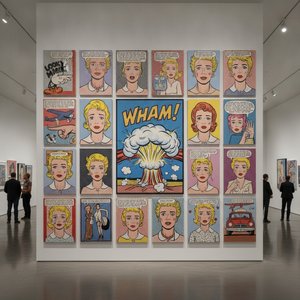 25 Iconic Roy Lichtenstein Masterpieces That Defined Pop ArtImmerse yourself in the vibrant world of Pop Art with our curated guide to Roy Lichtenstein's top 25 masterpieces. From iconic Ben-Day dots…
 Rhythms of Pop Art: Deconstructing Form and Musicality in Roy Lichtenstein’s The ViolinExplore the Cubist roots and Ben-Day dot technique in Lichtenstein's The Violin. Discover the rhythm of Pop Art mastery now.
 The Psychology of the Palette: Decoding Roy Lichtenstein's Bold Color TheoryExplore the psychological depth of Roy Lichtenstein's color theory. An expert analysis for art students and collectors on Ben-Day dots, pri…