Expressionism · 1936
Max Beerbohm (Reginald Grenville Eves, 1936)
Reginald Grenville Eves (1876–1941) vytvořil dílo Max Beerbohm. Pochází z roku 1936. Patří k hnutí Expressionism. Je vyrobeno z Oil On Canvas.
- 1936
- Oil On Canvas

 Náhled v interiéru

 Ručně malovaná olejná reprodukce
 Sdílet
 Sdílet
 Informační list


 Stáhnout
 Podobné položky
 Rentgenové snímky
 Slideshow
 Otázky a odpovědi

 Statistiky
Max Beerbohm v kostce
- Název díla
- Max Beerbohm
- Autor
- Reginald Grenville Eves (1876–1941)
- Rok narození umělce
- Londýn, Spojené království
- Datum vytvoření
- 1936
- Technika
- Oil On Canvas
- Pohyb
- Expressionism
- Období
- Modern
- Motiv
- man, portrait, hat, book, black and white, face
Co przedstawuje dílo Max Beerbohm?
Portrait of Max Beerbohm by Reginald Grenville Eves
The gaze of Sir Max Beerbohm meets the viewer from within this striking portrait, captured by the hand of Reginald Grenville Eves about 1936. The subject sits in a moment of quiet contemplation, his presence filling the frame with a sense of gravity. He holds a hat and a small book or notepad, objects that suggest a man caught in a pause between thoughts. There is a subtle melancholy in his expression, a hint of introspection that lingers in the shadows of his face. The atmosphere feels heavy with the weight of a life lived through intellect and observation.
Reginald Grenville Eves, born in London, United Kingdom, brings a focused intensity to this depiction. The artist, who passed away in 1941, focuses his attention entirely on the character of the sitter. The background recedes into deep, dark tones, pushing the figure of Beerbohm forward into the light. This dramatic contrast isolates the subject, making the study of his features the singular purpose of the work. Every line and shadow works to define the contours of his face and the texture of his clothing, creating a portrait that feels immediate and alive.
Composition and Visual Elements of the Portrait
The composition centers tightly on the subject, pulling the viewer into an intimate encounter with his face and upper body. He fills most of the frame, leaving little room for the world beyond his immediate presence. His gaze drifts slightly off-center, a subtle movement that suggests a mind occupied by thoughts elsewhere. This slight deviation from a direct stare creates a sense of quiet observation, as if we have caught him in a private moment of contemplation.
A stark, grayscale palette governs the entire scene, stripping away the distraction of color to focus purely on form and light. The visual field exists in a world of extreme tonal shifts, ranging from the deepest, impenetrable blacks to the brightest, piercing whites. This high contrast defines the contours of his features and the folds of his clothing, creating a dramatic interplay between light and shadow. The background recedes into a deep, heavy shadow, pushing the subject forward and ensuring that nothing interrupts the focus on his character.
Technique and Artistic Style of the Work
The oil paint clings to the surface in thick, expressive layers, creating a palpable texture that invites the eye to trace every ridge. These visible brushstrokes are loose and energetic, carving out the contours of the face, the unruly hair, and the heavy folds of the clothing. The surface feels rough and uneven, suggesting a spontaneous application where the artist's hand moves with immediate, unblinking intent. This impasto approach gives the portrait a physical presence, as if the paint itself is still settling into its final form.
Light and shadow engage in a dramatic struggle across the subject. A strong, unseen light source strikes the face, pulling features into sharp relief while casting the rest of the composition into deep, heavy darkness. This stark contrast creates a sense of gravity and weight, pulling the viewer into a quiet, contemplative moment. The style carries echoes of Impressionism through this emphasis on capturing a fleeting, atmospheric instant, yet the grayscale palette strips away the typical color to focus entirely on the interplay of light and form.
The Artistic Style of Reginald Grenville Eves
Reginald Grenville Eves moves through the history of 20th-century British art with a refined and steady hand. His training at the Slade School of Fine Art between 1891 and 1895 shapes a technique that prioritizes the essence of the individual. He possesses a remarkable ability to capture a quiet dignity in those he paints, avoiding the loud or the theatrical in favor of a restrained, observational grace. This subtle approach allows the inner character of a sitter to emerge through careful tonal variations and a mastery of light and shadow.
His technical precision earned him significant recognition on the international stage, including a silver medal at the Paris Salon in 1924 and a gold medal in 1926. These accolades reflect a skill for rendering volume and texture that feels both real and atmospheric. During the tensions of 1940, his role as an official war artist for the War Artists' Advisory Committee brought his observational eye to the realities of conflict, documenting the presence of military leaders during a tumultuous era.
The permanence of his contribution is felt in the halls of the Tate Gallery and the National Portrait Gallery, where his works remain held in prestigious collections. He approaches the canvas with a sense of purpose, seeking to reveal the human spirit through a sophisticated command of form. His legacy is one of elegance and psychological depth, captured in the steady, deliberate application of paint.
Vysokorozlišené fotografie díla Max Beerbohm
Reginald Grenville Eves, Max Beerbohm (1936). Veřejná doména
Odpovědi na otázky k dílu Max Beerbohm
V jakém roce vzniklo dílo "Max Beerbohm"?
Dílo "Max Beerbohm" pochází z roku 1936. Toto datum situuje dílo do období tvůrčí činnosti Reginald Grenville Eves i do jeho dobové kontextu.
V jaké technice je vytvořeno dílo „Max Beerbohm“ od Reginald Grenville Eves?
Reginald Grenville Eves pro dílo „Max Beerbohm“ použil/a techniku Oil On Canvas. Tato technika definuje materiální podstatu originálního díla.
Co zachycuje dílo "Max Beerbohm"?
Motivy díla „Max Beerbohm“ jsou man, portrait, hat, book, black and white, face, clothing.
Je dílo „Max Beerbohm“ volné z autorských práv?
Dílo „Max Beerbohm“ od Reginald Grenville Eves spadá do v rámci volného užití – autorská práva vypršela. Tento stav určuje pravidla pro reprodukci obrazu tohoto díla.
Kdo je autorem díla "Max Beerbohm"?
Dílo "Max Beerbohm" se připisuje autorovi Reginald Grenville Eves.
K kterému uměleckému směru patří „Max Beerbohm“ od Reginald Grenville Eves?
Umělecký směr, ke kterému patří dílo „Max Beerbohm“ od Reginald Grenville Eves, je Expressionism. Tato klasifikace toto dílo umísťuje mezi související umělce a další umělecká díla.
Do které období tvorby Reginald Grenville Eves patří dílo „Max Beerbohm“?
Dílo „Max Beerbohm“ pochází z období Mature Period v tvorbě umělce Reginald Grenville Eves. Tato klasifikace dílo zasazuje do kontextu vývoje jeho tvůrčí dráhy.
Kolik let bylo Reginald Grenville Eves, když v roce 1936 vytvořil(a) dílo „Max Beerbohm“?
Reginald Grenville Eves vytvořil/a dílo „Max Beerbohm“ v возрасте 60 let. Umělec se narodil/a v 1876 a dílo je datováno na 1936.
Patří dílo „Max Beerbohm“ od Reginald Grenville Eves do volného užití, a proč?
Dílo „Max Beerbohm“ od Reginald Grenville Eves spadá do v rámci volného užití – autorská práva vypršela. Autorská práva se počítají od roku úmrtí autora; Reginald Grenville Eves zemřel(a) v roce 1941.
O umělci, Reginald Grenville Eves

1876–1941, Spojené království
Reginald Grenville Eves
Reginald Grenville Eves: Portrétista své doby Reginald Grenville Eves (1876–1941) představuje významnou, byť často opomíjenou postavu britského umění 20. století. Narodil se v Londýně v roce 1876 jako syn Williama Henryho Evese, mírového soudce, a jeho umělecká cesta začala formálním vzděláním na University College School a později na prestižní Slade School of Fine Art v letech 1apo 1891 až 1895. Pod vedením vlivných umělců, jako byli Alphonse Legros, Frederick Brown a Henry Tonks, Eves pilně trénoval své schopnosti v kresbě a malbě, čímž položil základy pro svou budoucí kariéru portrétisty.
O umělci Reginald Grenville Eves Významná díla umělce Reginald Grenville Eves
Také od autora Reginald Grenville Eves
 Self Portrait
 A Nymph Beside a Pool1910
 Sir Ernest Henry Shackleton (1874–1922)1921
 Thomas Hardy1923
Eseje k tématu Max Beerbohm
 British contemporary realist paintersContemporary Realism painters from the UK like Frederick William Elwell and Frank O. Salisbury. Find museum-quality art reproductions on Or…
 The Art of the Gaze: A Collector's Guide to Mastering Portrait Composition and Emotional DepthMaster the nuances of portrait composition with our expert guide for collectors. Discover how light, gaze, and texture create emotional dep…
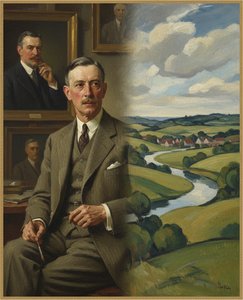 Reginald Grenville Eves: Bridging Portraiture & Modern British Landscape PaintingExplore the life & work of Reginald Grenville Eves, a leading British portraitist who transitioned to captivating landscape painting. Disco…