
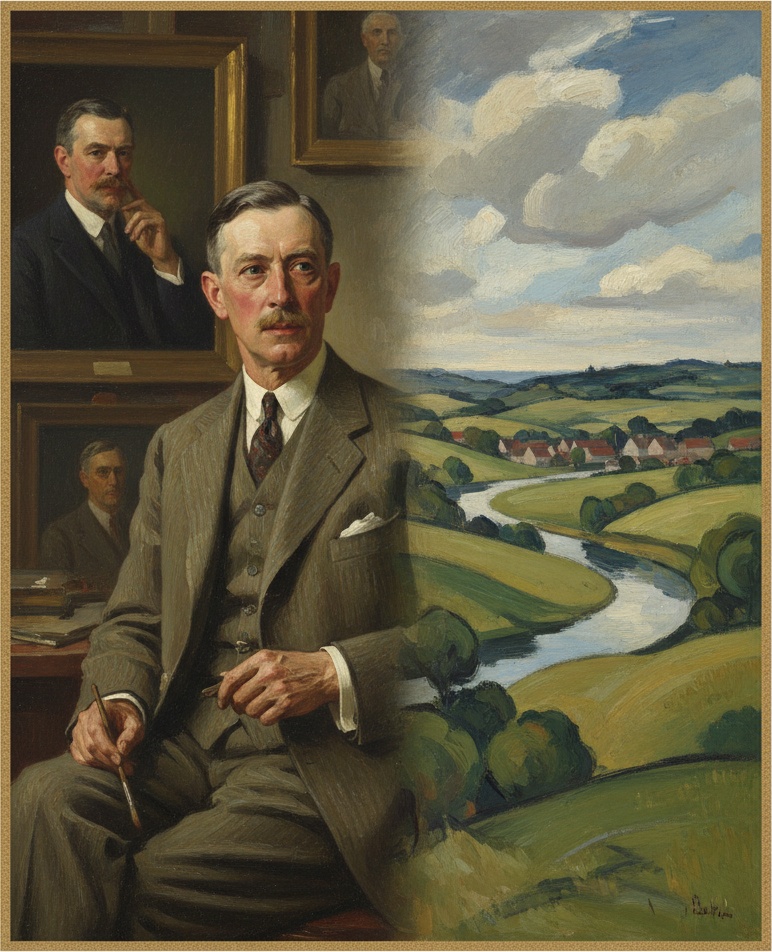
Early Life & Artistic Foundations: Eves’s Slade Training and Initial Yorkshire Period
Reginald Grenville Eves, a name perhaps less immediately recognizable than some of his contemporaries, occupies a fascinating niche in the transition from late Victorian academic painting to the burgeoning modernism of the interwar period. Born in London in 1876, Eves’s artistic journey began with formal training at the prestigious Slade School of Fine Art between 1891 and 1895. This foundational education, under the tutelage of luminaries like Alphonse Legros, Frederick Brown, and Henry Tonks, instilled within him a rigorous understanding of draftsmanship and composition – skills that would serve as cornerstones throughout his career. The Slade’s emphasis on direct observation and anatomical accuracy provided Eves with a solid technical base, yet it was his subsequent five-year sojourn in Yorkshire that began to shape his distinctive artistic sensibility.
The rugged beauty of the Yorkshire landscape offered a stark contrast to the urban environment of London. This period wasn’t merely geographical; it represented a shift in focus for the young artist. While portraiture would ultimately become his métier, these formative years immersed him in the subtleties of light and atmosphere, fostering an appreciation for rural life that subtly permeated even his most formal commissions. It was a time of quiet observation, honing his eye for detail and developing a nascent understanding of how to capture the essence of a place – qualities that would later distinguish his landscape work.
The Rise of a Portraitist: Capturing Prominent Figures Between the Wars
 Reginald Grenville Eves
Reginald Grenville Eves (1876-1941) was a British portrait painter renowned for capturing prominent figures between the wars – military leaders, politicians & cultural icons. Official War Artist. Works in Tate & NPG.
Upon returning to London, Eves steadily built a reputation as a skilled portrait painter. His breakthrough came with his first exhibition at the Royal Academy in 1901, marking the beginning of a prolific period dedicated to capturing the likenesses of prominent figures. The interwar years were particularly fertile ground for portraiture, and Eves quickly established himself as a sought-after artist amongst military leaders, politicians, and cultural icons. He possessed an uncanny ability to convey not just physical resemblance but also the character and inner life of his sitters.
Subjects included literary giants like Thomas Hardy, whose penetrating gaze Eves rendered with remarkable sensitivity, and explorers such as Sir Ernest Shackleton, embodying resilience and determination. His portraits weren’t simply exercises in technical skill; they were insightful studies of personality, reflecting the changing social landscape of Britain between the two World Wars. The demand for his work grew exponentially, solidifying his position within London's artistic elite.
Eves's Landscape Paintings: A Shift in Focus and Rural Beauty
 March Day, Sussex
Discover "March Day, Sussex" by Reginald Grenville Eves – a stunning 1943 landscape painting capturing rural beauty. Fine art print available.
While celebrated as a portraitist, Eves’s landscapes reveal a quieter, more contemplative side to his artistry. Though less frequently exhibited than his portraits, these works demonstrate a profound connection to the natural world – a legacy of his Yorkshire years. Paintings like “March Day, Sussex” (1943) exemplify this shift in focus, capturing the delicate beauty of the English countryside with a nuanced palette and atmospheric perspective. The subtle interplay of light and shadow, the gentle undulation of the hills, and the sense of tranquility evoke a deep emotional resonance.
These landscapes weren’t merely depictions of scenery; they were imbued with a sense of place and memory. Eves's technique in these works often involved a looser brushstroke than his meticulously detailed portraits, allowing for a greater expression of mood and atmosphere. He wasn’t striving for photographic realism but rather an emotional interpretation of the landscape – a distillation of its essence.
Official War Artist: Documenting Conflict Through Portraiture (1940)
The outbreak of World War II brought about a new role for Eves: Official War Artist. Amongst the first artists commissioned by the War Artists’ Advisory Committee (WAAC), he, along with Barnett Freedman, Edward Ardizzone and Edward Bawden, was dispatched to France in 1940 with the British Expeditionary Force. This commission wasn't about grand battle scenes; it focused on documenting the human experience of war through portraiture.
Based at a hotel in Arras, Eves primarily painted portraits of officers and soldiers, capturing their stoicism, anxiety, and quiet courage. The circumstances were challenging – limited time with sitters, the constant threat of danger – yet his ability to convey character remained undiminished. These wartime portraits offer a poignant glimpse into the lives of those who served, providing a valuable historical record alongside a testament to Eves’s artistic skill.
Style & Technique: Brushwork, Composition, and the Influence of Tradition
Eves's style represents a fascinating blend of academic training and emerging modern sensibilities. His portraits are characterized by meticulous detail, refined brushwork, and a keen understanding of light and shadow – hallmarks of his Slade education. However, he wasn’t simply replicating traditional techniques; he infused them with a subtle psychological depth that set him apart.
His compositions were carefully balanced, often employing classical arrangements to create a sense of dignity and gravitas. In his landscapes, the brushwork became looser and more expressive, allowing for greater freedom of interpretation. While he experimented with techniques like painting over photographs (a practice that drew some criticism at the time), it’s clear that Eves was always striving to capture not just the likeness of his subjects but also their inner essence – a testament to his artistic vision.
Legacy and Collections: Eves’s Place in British Art History
Reginald Grenville Eves died prematurely in 1941, leaving behind a substantial body of work that continues to captivate audiences today. Though perhaps overshadowed by some of his more avant-garde contemporaries, his contribution to British art history is significant. He bridged the gap between Victorian academic painting and the modern era, demonstrating a remarkable versatility and sensitivity.
His works are held in prestigious collections such as the Tate and the National Portrait Gallery, serving as enduring reminders of his talent and artistic vision. Eves’s portraits offer invaluable insights into the lives of prominent figures during a pivotal period in British history, while his landscapes reveal a deep connection to the natural world – qualities that continue to resonate with viewers today. Discovering the work of Reginald Grenville Eves is an invitation to appreciate a master portraitist and landscape painter whose legacy deserves wider recognition. Explore available prints and reproductions of his captivating works at OriginalUniqueArt.com.



