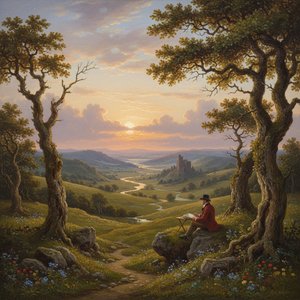
Biografie umělce
John Crome (1768–1821): Norfolk Son, Pioneer of Romantic Landscape
John Crome, affectionately known as “Old Crome” to distinguish him from his artist son, stands as a pivotal figure in British art history—a founder and leading light of the celebrated Norwich School. Born in Norwich, United Kingdom (1768), Crome’s journey was one of remarkable self-education and dedication, rising from humble beginnings to become a respected landscape painter who captured the very essence of his beloved East Anglian countryside. His father, a weaver, instilled a strong work ethic, but it was an apprenticeship with house, coach, and sign painter Francis Whisler that first nurtured Crome’s artistic inclinations, providing him with foundational skills in design and color. This practical training proved invaluable as he began to explore his passion for depicting the natural world around him. A formative friendship with Robert Ladbrooke, a fellow aspiring artist, further fueled his development; together they sketched en plein air, honing their observational abilities and sharing a burgeoning enthusiasm for art.
Early Influences and Artistic Training
Crome’s artistic education began modestly, yet it proved profoundly influential. His apprenticeship under Whisler instilled discipline and technical proficiency—skills that would serve him well throughout his career. Crucially, he encountered Thomas Harvey of Old Catton, whose expansive art collection exposed him to the masterpieces of Gainsborough and Hobbema. These artists became models for composition, light, and atmosphere, shaping Crome’s artistic sensibilities from an early age. Furthermore, Sir William Beechey and John Opie offered invaluable guidance within the broader artistic community, cementing his connection to established traditions and fostering a collaborative spirit. It was this confluence of influences that laid the groundwork for Crome's distinctive style—a style characterized by meticulous detail and a palpable sense of place.
The Birth of the Norwich School
In 1803, John Crome achieved artistic renown by co-founding the Norwich Society of Artists with Robert Ladbrooke. This bold initiative marked the formal commencement of the Norwich School—a groundbreaking movement that championed direct observation of nature and sought to portray the Norfolk landscape in a manner radically different from prevailing trends originating in London. Rejecting academic conventions, the Norwich School artists prioritized capturing the immediacy of experience, prioritizing tonal harmonies and atmospheric perspective. Crome’s leadership within the society solidified his position as a visionary innovator—a figure who recognized the potential for artistic expression rooted in authentic engagement with one's surroundings. He wasn’t merely painting landscapes; he was conveying a profound appreciation for the beauty and character of Norfolk.
A Painter's Vision: Style and Technique
Crome’s artistic style is instantly recognizable—marked by loose brushwork, subtle gradations of tone, and an unwavering commitment to capturing the nuances of light and color. He meticulously studied plant life, accurately depicting tree species with unprecedented precision—a testament to his keen botanical eye and dedication to scientific observation. Unlike many of his contemporaries who relied on idealized representations, Crome embraced imperfection, allowing for textural variations and atmospheric haze that conveyed a sense of realism. His canvases pulsate with vitality, reflecting the dynamism of Norfolk’s seasons and conveying an emotional resonance that transcends mere visual depiction. He skillfully employed watercolor and oil mediums, blending them harmoniously to achieve breathtaking effects—a testament to his mastery of technique and artistic vision.
Legacy and Enduring Influence
John Crome's contribution extended far beyond his prolific output of paintings. The Norwich School he spearheaded fostered a distinct regional artistic identity, nurturing generations of painters who followed in his footsteps. Despite initial skepticism from the London art establishment—a reaction fueled by stylistic differences—Crome gained national recognition through thirteen exhibitions at the Royal Academy between 1806 and 1818. His etchings, though unpublished during his lifetime, revealed another facet of his talent—demonstrating a versatility that cemented his place as one of Britain’s most celebrated landscape artists. A posthumous exhibition showcasing over 100 of his works underscored the esteem in which he was held by his peers and solidified his enduring legacy. Today, Crome's paintings continue to inspire admiration for their quiet beauty, evocative atmosphere, and unwavering connection to the heart of Norfolk—a testament to a life dedicated to artistic excellence and a profound appreciation for the natural world.

 Přepnout na tisk
 Zobrazit více







































 U děl nebo reprodukcí, u nichž je jakákoliv strana větší než 105 cm (přibližně 41 palců), bude rám dodán jako sestava v rozloženém stavu. Tato metoda zajišťuje bezpečné doručení a chrání dílo před poškozením během přepravy.


 Náhled v interiéru
 Sdílet
 Sdílet
 Podrobnosti o díle
 Průvodce

 Stáhnout
 Podobné položky
 Rentgenové snímky
 Slideshow
 Otázky a odpovědi
 Statistiky