Přepnout na tisk
 Zobrazit více







































 U děl nebo reprodukcí, u nichž je jakákoliv strana větší než 105 cm (přibližně 41 palců), bude rám dodán jako sestava v rozloženém stavu. Tato metoda zajišťuje bezpečné doručení a chrání dílo před poškozením během přepravy.


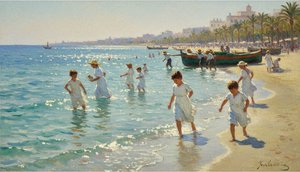
The Essence of a Moment: Joaquín Sorolla’s “Clotilde on the Beach”
Joaquín Sorolla’s “Clotilde on the Beach,” painted in 1904, isn't merely a depiction of a seaside scene; it’s an immersion into the heart of Spanish summer – a vibrant distillation of light, color, and the quiet joy of family life. Sorolla, a master of *plein air* painting, captures a fleeting moment with breathtaking immediacy, transporting the viewer to the warm sands of Valencia's Playa de El Cabanyal. The canvas breathes with an almost palpable warmth, radiating the golden hues of late afternoon sunlight filtering through the sea and sky.
The central figures – Sorolla’s wife, Clotilde García del Castillo, and their young daughter Maria – are rendered with a remarkable sense of naturalism and intimacy. They aren't posed dramatically; instead, they exist within a relaxed, almost dreamlike state, suggesting an effortless connection to each other and the surrounding environment. Clotilde’s posture, leaning slightly forward, hints at movement and engagement, while Maria’s subtle turn towards the viewer creates a direct, engaging gaze – inviting us into their private world.
A Symphony of Light and Color: Sorolla's Technique
Sorolla’s genius lies in his masterful manipulation of light. He employs a broken brushstroke technique—a series of short, distinct strokes—to build up layers of color, creating an illusion of shimmering luminosity. The sea isn’t painted with smooth gradients; instead, it's composed of countless tiny dabs of blue, turquoise, and green, reflecting the sky and capturing the movement of the waves. The white of Clotilde’s dress and parasol is not a flat color but a complex interplay of yellows, pinks, and blues, mimicking the way sunlight dances on fabric.
He expertly utilizes *sfumato*, a technique borrowed from Renaissance masters, to soften edges and create atmospheric depth. The background fades gently into the distance, blurring the horizon line and emphasizing the immediacy of the scene. The use of complementary colors – particularly the juxtaposition of blue and orange – further intensifies the vibrancy of the painting.
Historical Context: Spain in the Age of Leisure
“Clotilde on the Beach” was painted during a period of significant social and cultural change in Spain. The late 19th and early 20th centuries witnessed a growing emphasis on leisure, travel, and the enjoyment of life – particularly among the upper classes. Sorolla’s painting reflects this shift, capturing the spirit of *la dolce vita*—the sweet life—that was becoming increasingly popular in Spain. The beach itself, once a place for fishermen and laborers, was transforming into a fashionable resort destination.
Furthermore, Sorolla's work aligns with the broader artistic trends of the time – Impressionism and *plein air* painting. He embraced these innovations, adapting them to his own unique style and incorporating elements of Spanish realism and color theory. The painting’s focus on capturing fleeting moments of beauty and light echoes the core tenets of Impressionist art.
Symbolism and Emotional Resonance
Beyond its technical brilliance, “Clotilde on the Beach” is rich in symbolism. The beach itself represents a sanctuary—a place of escape from the pressures of urban life. The family’s relaxed posture and shared enjoyment of the moment convey a sense of harmony and contentment. The parasol, a symbol of protection from the sun, also suggests a desire for privacy and intimacy.
Ultimately, “Clotilde on the Beach” is more than just a beautiful painting; it’s a poignant meditation on family, light, and the fleeting beauty of life. It evokes a feeling of warmth, nostalgia, and a deep appreciation for the simple pleasures of summer – an enduring testament to Sorolla's artistic vision.
Otázky a odpovědi
Lze dílo „Clotilde on the Beach“ od Joaquín Sorolla, které je uloženo v Sorolla Museum, legálně reprodukovat?
Dílo „Clotilde on the Beach“ od Joaquín Sorolla se nachází ve sbírce Sorolla Museum a spadá do v rámci volného užití – autorská práva vypršela. Tento stav určuje, zda lze vytvářet reprodukce tohoto obrazu.
Jsou barvy v díle „Clotilde on the Beach“ od Joaquín Sorolla syté, nebo tlumené?
Nasycení barevné palety díla "Clotilde on the Beach" je na úrovni Muted.
Jakým způsobem se dílo „Clotilde on the Beach“ zapojuje do témat a stylu umělce Joaquín Sorolla?
V rámci tvorby umělce Joaquín Sorolla se dílo „Clotilde on the Beach“ řadí do stylu Sorolla Impressionism a doplňuje tak motivy en plein air, light, realism, spanish leisure, coastal life, family portrait, domestic scene, sorolla’s signature style”.
 Náhled v interiéru
 Sdílet
 Sdílet
 Podrobnosti o díle
 Průvodce

 Stáhnout
 Podobné položky
 Rentgenové snímky
 Slideshow
 Otázky a odpovědi
 Statistiky