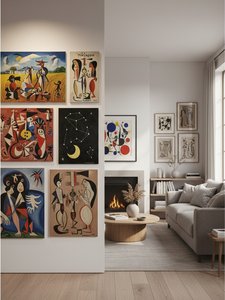
Náhled v interiéru
 Sdílet
 Sdílet
 Podrobnosti o díle
 Průvodce

 Stáhnout
 Podobné položky
 Rentgenové snímky
 Slideshow
 Statistiky
Para David Fernández Miró

 Zobrazit více
Umělecké dílo zobrazené na této stránce je chráněno autorským zákonem, což znamená, že nemůžeme legálně vytvářet ani prodávat jeho identickou reprodukci. Tato ochrana je vymáhána na základě mezinárodních dohod, jako například Berberská úmluva a národními zákony, včetně těch stanovených v Americký autorský zákon – Díl 17. Všechna práva vyhrazena.
Tato metoda je plně v souladu s autorským právem, protože nezahrnuje kopírování ani duplikování chráněného díla. Jde o kreativní reinterpretaci – nový obraz, který je inspirován originálem, ale není s ním identický.
Giclée / Umělecký tisk
Giclée nebo plátěný tisk muzeální kvality s rychlou výrobou a širokou nabídkou povrchových úprav. ( Koupit ručně malovaný obraz Přepnout na digitální obraz)




P118B Kč10

P118H Kč10

P118W Kč10

P438Z Kč10

P508JH Kč12

P508YH Kč12

P805H Kč10

P805Z Kč10

P919BZ Kč10

P919G Kč10

P919XJ Kč10

P959ZH Kč10

P968JZ Kč12

W106C Kč8

W218G Kč10

W218JH Kč8

W218Y Kč10

W307PJ Kč10

W316G Kč10

W316PJ Kč8

W316Y Kč10

W398PJ Kč8

W4111J Kč10

W500HY Kč15

W500JH Kč15

W692G Kč12

W849H Kč8

W940BG Kč15

W953PJ Kč8




Vyberte si z našich přednastavených velikostí, které odpovídají původním proporcím díla.

Zadejte šířku a výšku, které potřebujete pro váš rám nebo stěnu. Tisk lze pouze oříznout, nikdy však nelze zvětšit obraz nad jeho původní rozměr, proto při výběru jiného formátu dochází ke ztrátě části obrazu. Před samotným tiskem vám zašleme digitální náhled k schválení. Obraz zobrazený na této stránce nenabízí skutečný výřez — ten uvidíte pouze v náhledu.
Celosvětové doručení () do 2 týdnů namísto standardních 4/5 týdnů. (26 říjen)

Zdarma celosvětová expresní doprava

Vysoce kvalitní lněné plátno

Kompletní pojištění přepravy

Záruka vrácení celního poplatku

Záruka věrného barevného souladu

100dení lhůta pro vrácení zboží (pouze při vadách výroby)

100% záruka vrácení peněz

Sleva při více objednávkách
 Skleněná varianta je dostupná pouze u rozměrů menších než 110 cm

Para David Fernández Miró
Giclée / Umělecký tisk
Rozměry reprodukce
-


Celková cena za vybrané možnosti reprodukcí
Kč 1712
Introduction: A Dreamscape Unveiled – ‘Para David Fernández Miró’
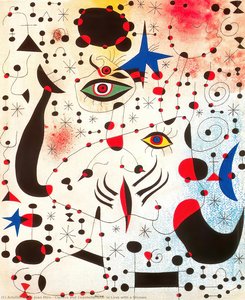
Joan Miró's 'Para David Fernández Miró', painted in 1964, isn’t merely a depiction of fish swimming through an ocean; it’s a portal into the artist’s subconscious, a vibrant embodiment of Surrealist principles and Catalan identity. This oil painting, brimming with color and imbued with a dreamlike quality, invites viewers to lose themselves within its swirling forms and playful symbolism. Miró, deeply influenced by the organic architecture of Gaudí and the rugged landscapes of his homeland, crafted this piece as a personal gift for David Fernández, a close friend and fellow artist – a testament to their shared artistic spirit and a window into Miró’s intensely private world.
The composition immediately captivates with its seemingly chaotic yet meticulously balanced arrangement. At least twelve fish, rendered in an astonishing array of hues—cerulean blues, fiery oranges, emerald greens, and deep violets—dance across the surface of a rich, ultramarine blue ocean. These aren’t realistic representations; they are abstracted symbols, each possessing a unique character and contributing to the overall sense of movement and fluidity. The fish don't swim in a linear fashion but rather drift and swirl, suggesting an underwater ballet governed by unseen forces – a direct reflection of Miró’s fascination with the irrational and the unpredictable.
The Language of Abstraction: Style and Technique
Miró’s signature style is powerfully evident in ‘Para David Fernández Miró’. He employs bold, gestural brushstrokes, creating a textured surface that pulsates with energy. The forms are deliberately ambiguous, resisting precise definition and inviting multiple interpretations. This abstraction isn't random; it’s rooted in a deep understanding of color theory and composition. The use of oil paint allows for incredible depth and luminosity, capturing the shimmering quality of water and the iridescent sheen of the fish scales. Notice how light seems to emanate from within the painting, creating an otherworldly glow.
Miró’s technique is a masterful blend of spontaneity and control. He began with loose sketches and intuitive gestures, allowing his subconscious to guide his hand. However, he then refined these initial marks, adding details and shaping forms with careful precision. This interplay between improvisation and deliberate execution results in a work that feels both deeply personal and remarkably polished.
Symbolism and the Catalan Soul
Beyond its purely aesthetic qualities, ‘Para David Fernández Miró’ is rich in symbolism, reflecting Miró's unique worldview and his connection to Catalonia. The fish themselves are frequently interpreted as symbols of fertility, abundance, and transformation – recurring motifs in Miró’s oeuvre. Their vibrant colors evoke the Mediterranean Sea, a defining element of Catalan identity and a source of endless inspiration for the artist. The scattered arrangement could also represent the fragmentation of memory or the fleeting nature of dreams.
Furthermore, the painting subtly incorporates elements of Catalan folklore and mythology. The swirling forms and organic shapes recall the intricate patterns found in traditional Catalan textiles and ceramics. Miró often drew upon these cultural traditions to create works that were both deeply personal and universally resonant. The overall effect is a potent distillation of Catalan spirit – a celebration of beauty, mystery, and the power of imagination.
A Legacy of Surrealism: Historical Context
‘Para David Fernández Miró’ stands as a significant example of Surrealist art, a movement that sought to liberate the mind from the constraints of reason and explore the depths of the unconscious. Miró embraced the principles of automatism – spontaneous creation without conscious control – but he infused his work with a distinctly personal style, rejecting the rigid dogma of the group. This painting exemplifies Miró’s ability to translate his inner world onto canvas, creating images that are both dreamlike and profoundly moving.
Miró's exploration of the subconscious aligns perfectly with the broader Surrealist project, which aimed to challenge conventional notions of reality and reveal the hidden truths beneath the surface. ‘Para David Fernández Miró’ is a testament to Miró’s enduring influence on 20th-century art, continuing to inspire artists today with its bold vision and captivating beauty. It's a piece that invites contemplation, sparking the imagination and reminding us of the power of art to transport us beyond the boundaries of our everyday experience.
Otázky a odpovědi
Působí dílo "Para David Fernández Miró" celkově spíše světle, nebo tmavě?
U díla „Para David Fernández Miró“ od Joan Miró je zaznamenána jasnost bright při luminanci Gentle Luminance.
Jakým způsobem se styl díla "Para David Fernández Miró" vztahuje k době svého tvůrce?
Dílo „Para David Fernández Miró“ od Joan Miró patří k享有 směrům Surrealist Movement, které charakterizovaly éru Modernismus svého autora.
Patří „Para David Fernández Miró“ od Joan Miró do volného tisku?
Dílo „Para David Fernández Miró“ od Joan Miró spadá do stále chráněno autorským právem. Tento stav určuje pravidla pro reprodukci obrazu tohoto díla.
Biografie umělce
A Catalan Visionary: The Life and Art of Joan Miró
Joan Miró i Ferrà, born in Barcelona in 1893, stands as one of the most significant figures in 20th-century art. His journey was not merely a progression through styles but an exploration of inner worlds, translating dreams, memories, and Catalan identity onto canvas with a uniquely poetic visual language. From humble beginnings marked by illness and initial parental reservations about his artistic pursuits, Miró persevered, driven by an innate need to express the intangible—the emotions, sensations, and subconscious currents that lie beneath the surface of reality. His early life was steeped in the traditions of Barcelona, a city brimming with architectural marvels thanks to Antoni Gaudí, whose organic forms would subtly influence Miró’s later abstractions. The goldsmithing profession of his father instilled an appreciation for meticulous craftsmanship, while the rugged Catalan landscape became a recurring motif and source of inspiration throughout his career.Early Influences and the Path to Surrealism
Miró's formal artistic training began at La Llotja in Barcelona, where he honed his skills in traditional techniques. However, it was exposure to the avant-garde movements sweeping through Paris that truly ignited his creative evolution. The vibrant colors of Fauvism and the fragmented forms of Cubism resonated deeply, prompting him to move to Paris in 1920. This period proved pivotal as he encountered artists like Pablo Picasso and began experimenting with increasingly abstract compositions. Yet, Miró didn’t simply adopt these styles; he synthesized them, forging a path toward his own distinctive aesthetic. He sought to distill forms to their essence, stripping away representational details in favor of symbolic shapes and evocative colors. This exploration led him to the Surrealist group in 1924, aligning him with artists such as Max Ernst and Salvador Dalí. While embracing the Surrealist interest in the subconscious, Miró maintained a unique sensibility—his work was less about shocking imagery or Freudian symbolism than it was about creating a world of playful forms and poetic suggestion. He believed that art should transcend rational thought and tap into the realm of dreams and intuition.The Catalan Landscape and Artistic Roots
Miró’s formative years were profoundly shaped by his surroundings. Growing up in Barcelona, he absorbed the influence of Gaudí's architectural innovations—the undulating curves and organic textures of Sagrada Familia and Parc Güell—which instilled within him a fascination for natural forms and patterns. The Catalan landscape—characterized by pine forests, rocky mountains, and azure seas—became a constant source of inspiration for his paintings and prints. These elements would reappear throughout his oeuvre, symbolizing resilience, freedom, and the enduring spirit of Catalan culture. His father’s profession as a goldsmith instilled in him an appreciation for precision and craftsmanship, shaping his artistic approach and contributing to his meticulous attention to detail.Key Works: A Surrealist Universe
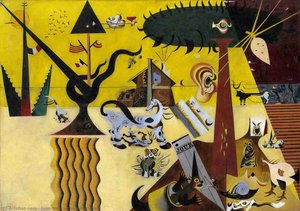
Miró's artistic output spanned decades, encompassing painting, sculpture, ceramics, printmaking, and collage—each medium serving as a vehicle for exploring his distinctive vision. The Farm (1922) stands as a seminal achievement, embodying the artist’s synthesis of Fauvist color palettes with Cubist fragmentation. It depicts a stylized Catalan landscape populated by fantastical creatures—birds, snails, and amorphous shapes—creating a dreamlike atmosphere that reflects Miró's preoccupation with subconscious imagery. The series *Dutch Interiors (1928)* demonstrated his ability to reinterpret the Old Masters through a modernist lens, transforming familiar domestic scenes into abstracted compositions infused with Surrealist symbolism. His collaborative efforts with Max Ernst on *Grattage* canvases—particularly *The Elephant Bird*—marked an important stage in his artistic experimentation and showcased his innovative techniques for revealing textures beneath layers of paint. Painting (1933) exemplifies Miró’s commitment to simplifying forms and prioritizing color, resulting in striking images that convey a sense of immediacy and emotional intensity.Legacy and Enduring Influence
Joan Miró's contribution to modern art is undeniable. He challenged conventional artistic norms and championed abstraction as a means of expressing inner experience—a legacy that continues to inspire artists today. His unwavering belief in the power of imagination and his refusal to compromise on his artistic vision solidified his place among the most influential figures of the 20th century. Miró established two foundations—the Fundació Joan Miró in Barcelona (1975) and the Fundació Pilar i Joan Miró in Palma de Mallorca (1981)—ensuring that his artistic legacy would endure, fostering creativity and promoting dialogue between art and society. His work remains a testament to the transformative potential of art—a vibrant celebration of Catalan identity and an enduring symbol of Surrealist innovation.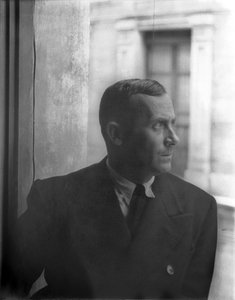
Joan Miró
1893 - 1983 , Španělsko
Rychlé informace o umělci
- Artistic Movement Or Style: Surrealismo
- Artists Or Movements Influenced By This Artist: ['Fauvismus']
- Artists Who Influenced This Artist:
- Pablo Picasso
- Cézanne
- Date Of Birth: 20 aprile 1893
- Date Of Death: 25 dicembre 1983
- Full Name: Joan Miró i Ferrà
- Nationality: Spagnolo
- Notable Artworks:
- La Poetisa
- Dům s palmy
- Tanečník s zrcadlem
- Place Of Birth: Barcelona, Spagna
Související články
Surrealismus v umění: Top 10 děl, které změnily pohled na realitu | OriginalUniqueArt.cz
Prozkoumejte 10 ikonických děl surrealismu od Dalího, Magrittea a dalších. Objevte příběhy za obrazy, techniky a inspiraci pro váš interiér s OriginalUniqueArt.cz – luxusní reprodukce umění online.

Wassily Kandinsky: Top 25 mistrovských děl abstrakce pro váš interiér | OriginalUniqueArt.com
Prozkoumejte 25 ikonických děl Wassily Kandinského – průkopníka abstraktního umění a expresionismu. Objevte příběhy za barevnými kompozicemi, Bauhaus styl a inspirujte se pro váš interiér s reprodukcemi nejvyšší kvality na OriginalUniqueArt.com.
Joan Miró: 25 mistrovských děl katalánského surrealismu pro váš domov | OriginalUniqueArt
Prozkoumejte 25 ikonických děl Joana Miró – katalánského mistra surrealismu. Objevte příběhy za abstraktními kompozicemi, živými barvami a jedinečným stylem. Reprodukce obrazů pro váš interiér na OriginalUniqueArt.com

Top 10 mistrovských děl abstraktního expresionismu | Umění a dekorace s OriginalUniqueArt.com
Prozkoumejte 10 ikonických děl abstraktního expresionismu od Pollocka, Rothka a dalších. Objevte příběhy za obrazy, techniky a barevné palety tohoto revolučního uměleckého hnutí. Reprodukce obrazů s OriginalUniqueArt.com – luxusní dekorace pro váš interiér. Prozkoumejte celou kolekci online!

Geometrická abstrakce: 10 mistrovských děl, které změnily umění | OriginalUniqueArt.cz
Prozkoumejte 10 ikonických děl geometrické abstrakce od Mondriana, Maleviče a Kandinského. Objevte příběhy umělců, techniky a historii tohoto revolučního hnutí. Najděte inspiraci pro moderní dekorace a luxusní reprodukce obrazů na OriginalUniqueArt.com.