Olejová verze
 Vše o Carnival







































 U děl nebo reprodukcí, u nichž je jakákoliv strana větší než 105 cm (přibližně 41 palců), bude rám dodán jako sestava v rozloženém stavu. Tato metoda zajišťuje bezpečné doručení a chrání dílo před poškozením během přepravy.


The Composition of Chaos
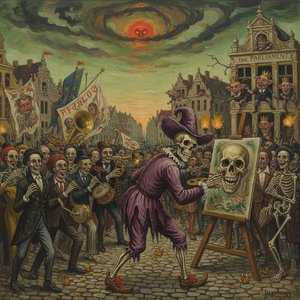
The canvas presents a dense arrangement of figures that occupy a shallow, crowded space. Within this composition, distorted faces and mask-like features emerge from a sea of movement. The palette relies on heavy applications of yellow, red, and white, which are set against dark outlines and deep shadows. Thick, jagged lines define the edges of the characters, creating a sense of physical friction between the overlapping forms. Ribbon-like shapes swirl through the frame, contributing to a flattened perspective where depth is difficult to discern.
The texture of the oil paint is tactile, with visible brushstrokes that remain prominent across the surface. These strokes follow organic, often irregular paths, reinforcing the movement of the crowd. Light falls unevenly across the scene, casting strange shadows upon the faces of the individuals. This lighting creates a theatrical effect, highlighting certain features while leaving others in murky obscurity. The figures themselves appear as a collection of grotesque and exaggerated shapes, their features rendered with a heavy, expressionistic hand.
Themes of Disguise and Social Unrest
The subject matter centers on a gathering of masked individuals, suggesting the atmosphere of a masquerade or a carnival. This choice of imagery draws from the artist's early life in Ostend, Belgium, where his parents operated a souvenir shop filled with shells and carnival masks. These objects provided a visual vocabulary for exploring themes of hidden identity and the fragility of outward appearances. The presence of these masks introduces an element of psychological tension, as the faces of the crowd are obscured by artificial layers.
The painting functions as a window into a nightmarish vision of social decay. Through the use of distorted anatomy and unsettling color contrasts, the work communicates a sense of profound unrest. The crowded nature of the composition mirrors the frantic energy of a festival, yet the underlying tone remains one of disorientation. By utilizing the medium of oil on canvas to create these heavy, textured forms, the artist captures a moment of intense, raw emotion that avoids traditional notions of beauty in favor of a more unsettling reality.
Otázky a odpovědi
Je dílo Carnival ručně malované, nebo jde o tisk?
Ručně malováno: zkušený malíř přetvoří Carnival v olejomalbu na lněném plátně.
Jakou velikost si mám vybrat pro Carnival?
Rozměry originálu jsou 66.7 x 83.2cm. Velikosti se pohybují od 28.2 x 35.4 cm (Kč10264) až po 196.4 x 246.1 cm (Kč44234); v tabulce na této stránce jsou uvedeny jednotlivé varianty a jejich ceny.
Jak dlouho trvá doručení?
Doručení trvá 4 až 5 týdnů a zahrnuje bezplatnou expresní přepravu po celém světě; na této stránce je k dispozici i možnost urgentní výroby. Dílo můžete vrátit během 100 dnů s plným vrácením peniędzy, bez jakýchkoliv podmínek.
Kde se nachází originál díla Carnival?
Originál se nachází ve sbírkách Harvard Art Museums, Cambridge.
Jakou techniku použil/a James Ensor pro dílo Carnival?
Oil On Canvas
 Náhled v interiéru

 Sdílet
 Sdílet
 Podrobnosti o díle
 Informační list


 Stáhnout
 Podobné položky
 Rentgenové snímky
 Slideshow
 Otázky a odpovědi

 Statistiky