Представи си го
 Изпрати
 Сподели
 Детайли

 Изтегляне
 Подобни
 Рентгенова снимка
 Слайдшоу
 Статистика
Meg


 Прочетете повече
Ръчно изработена маслена репродукция
Ръчно рисувана маслена картина върху платно във вашия размер и рамка, изработена по поръчка от нашите художници. ( Превключване към принт Превключване към дигитално изображение)




P118B $10

P118H $10

P118W $10

P438Z $10

P508JH $12

P508YH $12

P805H $10

P805Z $10

P919BZ $10

P919G $10

P919XJ $10

P959ZH $10

P968JZ $12

W106C $8

W218G $10

W218JH $8

W218Y $10

W307PJ $10

W316G $10

W316PJ $8

W316Y $10

W398PJ $8

W4111J $10

W500HY $15

W500JH $15

W692G $12

W849H $8

W940BG $15

W953PJ $8




Изберете от предварително зададените размери, които съответстват на оригиналните пропорции на произведението.

Можете да въведете свои собствени размери, за да пасне на конкретна рамка или пространство. Ако избраният от вас размер не съответства на пропорциите на оригиналното изображение, ние ще изрежем произведението или ще удължим картината с допълнителни ръчно рисувани елементи. Дигитален макет ще бъде изпратен за ваше одобрение преди започване на производството.
Моля, обърнете внимание, че прегледът на екрана не отразява действителното изрязване или разширяване. Само макетът ще покаже точно финалния състав.
Въпреки че са налични персонализирани размери, препоръчваме да изберете размер от предварително дефинирания списък, за да запазите оригиналните пропорции.
След поръчка, екипът на OriginalUniqueArt.com ще изпрати имейл на клиента за инструкции и ще предостави преглед на макет.
Доставка по целия свят () в рамките на 3/4 седмици вместо стандартните 5 седмици. (12 Септември). Без компромис с качеството.

Безплатна експресна доставка по целия свят

Висококачествено ленено платно

Пълно застраховане при доставка

Гаранция за възстановяване на митнически такси

Гаранция за цветова точност

Политика за връщане в рамките на 100 дни (само при дефекти)

100% Гаранция за връщане на парите

Предложение за отстъпка при поръчка на едро
 Стъклото е налично само в размери под 110 см

Meg
Репродукционен метод
Размер на репродукцията
-


Обща цена
$ 300
A Tempestuous Vision: Decoding Willem de Kooning’s “Meg”
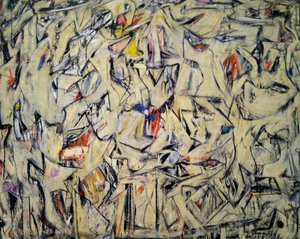
Willem de Kooning's 1955 work, “Meg,” is not a painting one simply *looks* at; it’s an experience. A swirling vortex of color and form rendered in oil, pastel, and collage on paper, “Meg” embodies the raw energy and emotional turbulence that define Abstract Expressionism. It's a piece that demands attention, pulling the viewer into its chaotic yet strangely harmonious depths. The painting eschews traditional representation, instead offering a fragmented glimpse into an internal landscape – a world of feeling rather than concrete imagery. While lacking a definitive subject in the conventional sense, hints of figuration emerge from the abstraction, suggesting perhaps a female form or interacting figures caught within a dynamic interplay of gesture and color.
The Birth of Abstraction: De Kooning’s Artistic Journey
To understand “Meg,” one must consider Willem de Kooning's remarkable journey. Born in Rotterdam in 1904, he immigrated to the United States in 1926, a pivotal move that would shape his artistic trajectory. Initially grappling with commercial art and realistic depictions of urban life, De Kooning gradually moved towards abstraction, influenced by encounters with fellow artists like Arshile Gorky and Jackson Pollock. The post-World War II era saw the rise of Abstract Expressionism in New York City, a movement that sought to express subjective emotional experience through spontaneous, automatic or subconscious creation. De Kooning became a central figure in this revolution, known for his bold brushwork and willingness to challenge conventional artistic boundaries. His earlier “Woman” series, though controversial for their aggressive depiction of the female form, paved the way for the more liberated abstraction seen in works like “Meg.” The year 1955 was particularly significant; it also saw the creation of "Interchange," another landmark painting demonstrating his evolving style and mastery of color.
Technique and Texture: A Symphony of Materials
“Meg” is a testament to De Kooning’s innovative technique. The layering of oil paint, pastel, and collage elements creates a rich, tactile surface that invites close inspection. The artist's characteristic brushstrokes – energetic, slashing, and often seemingly haphazard – build up layers of color and texture, generating a sense of movement and depth. The use of collage adds another dimension to the work, introducing fragments of paper that disrupt the smooth surface and further emphasize the painting’s fragmented nature. This isn’t about precise control; it's about embracing chance and allowing the materials to dictate aspects of the composition. The vibrant palette – a mix of reds, blues, yellows, greens, pinks, oranges, and whites – contributes to the painting’s emotional intensity, evoking feelings of both exhilaration and unease. The overall effect is one of controlled chaos, a carefully orchestrated explosion of color and form.
Emotional Resonance: A Window into the Subconscious
Ultimately, “Meg” transcends mere aesthetic appeal; it's a deeply emotive work that resonates with viewers on a visceral level. The painting’s ambiguity allows for multiple interpretations, inviting each individual to project their own feelings and experiences onto its surface. Some see echoes of human figures struggling within the abstract forms, while others perceive a landscape ravaged by emotional turmoil. Regardless of one's interpretation, “Meg” evokes a sense of raw energy, vulnerability, and the complexities of the human condition. It’s a powerful reminder that art can be more than just representation; it can be a direct expression of inner life, a window into the subconscious mind.
Биография на художника
A Life Forged in Abstraction
Willem de Kooning, a name synonymous with the raw energy and emotional depth of Abstract Expressionism, was born in Rotterdam, Netherlands, in 1904. His early life was marked by a familial split – his parents divorced when he was young – which perhaps instilled within him a sense of restless searching that would permeate his artistic journey. Leaving formal schooling at twelve, de Kooning apprenticed with a commercial art firm, laying the groundwork for his technical skill while simultaneously fueling a desire to break free from conventional constraints. Evening classes at the Academie van Beeldende Kunsten en Technische Wetenschappen in Rotterdam provided further foundational training, but it was a yearning for something more – a bolder, more expressive language – that ultimately propelled him towards America in 1926. His arrival wasn’t straightforward; he famously stowed away on a ship, embodying the spirit of an outsider seeking new horizons. New York City became his adopted home, and its vibrant, often gritty energy profoundly shaped his evolving style. He navigated various jobs – house painter, carpenter – all while relentlessly pursuing his artistic vision, absorbing the city’s pulse into his work.From Urban Scenes to Abstract Fury
De Kooning's early paintings reflected his immediate surroundings: urban landscapes and portraits that captured the dynamism of New York life. These works, often rendered in muted tones and characterized by a sense of movement, offered a glimpse into the burgeoning metropolis. However, these were merely stepping stones towards a more profound exploration of form and emotion. A pivotal moment came with his connection to Arshile Gorky, whose influence proved transformative. Gorky encouraged de Kooning’s experimentation with abstraction, fostering a willingness to dismantle traditional representation in pursuit of something deeper. De Kooning began to loosen his brushwork, layering colors and creating gestural marks that conveyed feeling rather than precise detail. This shift marked the beginning of a radical departure from representational art, laying the foundation for his later, more abstract works. The 1930s saw de Kooning engage with social realism and mural projects through the Works Progress Administration (WPA), a period that honed his skills but also highlighted the limitations of purely representational art. He found himself drawn to the work of Stuart Davis and John Graham, artists who were pushing boundaries in their own right, exploring new ways to capture the energy and complexity of modern life. This confluence of influences gradually steered him away from literal depiction and toward an increasingly abstract vocabulary.The Woman Series: A Landmark Achievement
Following World War II, de Kooning emerged as a central figure in the burgeoning Abstract Expressionist movement. This period marked a turning point, culminating in his iconic “Woman” series (1950-1953). These paintings – including the monumental *Woman I*, *Woman II*, and *Woman III* – are not merely depictions of female figures; they are visceral explorations of femininity, sexuality, and the complexities of human emotion. Characterized by aggressive brushstrokes, fragmented forms, and a jarring juxtaposition of colors, the “Woman” series challenged conventional notions of beauty and representation. They were controversial, even shocking to some, but their power lay precisely in their refusal to conform. De Kooning wasn’t interested in creating idealized images; he sought to capture the raw, untamed essence of his subjects. The figures are often distorted and unsettling, reflecting a deeper psychological landscape. Alongside this series, works like *The Glazier* and *Excavation* further demonstrated his dynamic approach to painting, showcasing a masterful command of texture, color, and composition. He didn't shy away from chaos or ambiguity; instead, he embraced them as integral components of his artistic language.Evolving Landscapes and Enduring Legacy
In the 1960s and beyond, de Kooning’s style underwent another significant evolution. While abstraction remained central to his work, landscape elements began to play a more prominent role, often rendered with a brighter palette and a looser, more fluid brushstroke. He continued to experiment relentlessly throughout his life, exploring different techniques and materials, never content to rest on his laurels. He revisited themes from earlier periods, incorporating them into new compositions with a renewed sense of freedom and experimentation. His later works – such as *Easter Monday* (1976) – demonstrate a remarkable ability to reinvent himself while remaining true to his core artistic principles. De Kooning’s historical significance is undeniable. He helped establish New York City as a global center for art, challenging the dominance of European traditions and paving the way for future generations of artists. His work continues to inspire awe and provoke debate, reminding us of the power of abstraction to convey profound emotional truths. Willem de Kooning passed away in 1997, leaving behind a vast and influential body of work that stands as a testament to his unwavering commitment to artistic innovation and his enduring legacy as one of the most important American artists of the 20th century. His paintings are not just objects; they are windows into a complex and intensely felt inner world.Key Influences
De Kooning’s artistic development was shaped by a diverse range of influences, both formal and personal. Early exposure to commercial art instilled in him a strong sense of technical skill and an understanding of visual communication. The work of European masters like Picasso and Matisse provided inspiration for his early explorations of form and color. However, it was the encounter with Arshile Gorky that proved particularly transformative, encouraging him to abandon traditional representation and embrace abstraction. Furthermore, the vibrant energy of New York City itself – its diverse population, its rapid pace of change, its gritty underbelly – served as a constant source of stimulation and inspiration. The works of Stuart Davis and John Graham also played a significant role in shaping his artistic vision, demonstrating the possibilities of capturing modern life through abstraction.
Уилям де Кунинг
1904 - 1997 , Нидерландия
Бързи факти
- Artistic Movement Or Style: Абстрактен експресионизъм
- Artists Or Movements Influenced By This Artist: ['New York School']
- Artists Who Influenced This Artist:
- Аршиле Горки
- Stuart Davis
- John Graham
- Date Of Birth: 24 април 1904
- Date Of Death: 19 март 1997
- Full Name: Willem de Kooning
- Nationality: Нидерландски-американец
- Notable Artworks:
- Woman I
- Marilyn Monroe
- Reclining Man (JFK)
- Excavation
- Place Of Birth: Роттердам, Нидерландия
Всички статии

Топ 25 шедьоври на Василий Кандински: Абстрактно изкуство за вашия дом | OriginalUniqueArt.com
Разгледайте топ 25 шедьоври на Василий Кандински – пионер на абстрактното изкуство и експресионизма. Открийте историите зад цветните композиции, техниките и вдъхновението му. Купете висококачествени репродукции на картини Кандински за вашия дом на OriginalUniqueArt.com!
Unveiling Abstraction: The Raw Power and Enduring Mastery of Pollock, Rothko, and De Kooning
Unveil the visceral power of Abstract Expressionism. Our expert exploration delves into the transformative legacies of Pollock, Rothko, and De Kooning, offering discerning collectors a profound understanding of the New York School’s enduring mastery and historical impact.

Топ 25 шедьоври на Франсиско Гоя: Изкуство, история и лукс за вашия дом
Разгледайте топ 25 шедьоври на Франсиско Гоя – от портрети до исторически картини. Открийте историите, техниките и емоциите зад неговите най-известни творби. Луксозни репродукции за вашия дом в OriginalUniqueArt.com!

Топ 10 шедьовъра на абстрактния експресионизъм – изкуство за вашия дом от OriginalUniqueArt.com
Разгледайте топ 10 шедьовъра на абстрактния експресионизъм – Полък, Ротко, де Кунинг и други. Открийте историите зад тези емблематични картини и преобразете дома си с изкуство от OriginalUniqueArt.com! Разгледайте пълната колекция онлайн.

Willem de Kooning: Abstraction, Gesture & the Evolution of Post-War American Painting
Explore the evolution of Willem de Kooning's iconic Abstract Expressionist paintings. Discover his signature style, key themes & investment potential with expert insights for discerning art collectors.