

 Преглед в реален мащаб
 Сподели
 Сподели
 Подробности
 Ръководство

 Изтегляне
 Подобни артикули
 Рентгенова снимка
 Слайдшоу
 Статистика
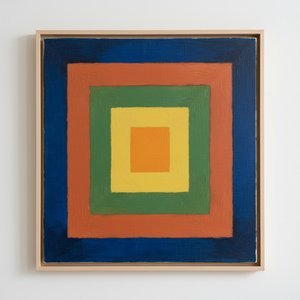
Multiplex D
 Acrylic On Canvas
- WallArt
- Geometric Abstraction
 1948
1948 22.0 x 30.0 cm
 De Young Музей
 Разгърни целия текст
Изкуството, представено на тази страница, е защитено от законите за авторско право, което означава, че не можем законно да създаваме или продаваме идентични репродукции. Тази защита се прилага съгласно международни споразумения като Бернска конвенция и от националното законодателство, включително разпоредбите на Закон за авторското право на САЩ – Раздел 17.
Като уважителна и законна алтернатива, ние предлагаме изработени по поръчка, ръчно рисувани произведения на изкуството, вдъхновени от оригинала. Нашите умени и професионални артисти внимателно изучават стила, настроението и артистичната същност на оригиналното произведение, за да създадат ново, уникално творческо произведение, което предизвиква същото чувство – оставайки в същото време самостоятелно оригинално творение.
Този метод е напълно съвместим с законите за авторско право, тъй като не включва копиране или дублиране на защитеното произведение. Вместо това става въпрос за творческа реинтерпретация – нова картина, която е вдъхновена от оригинала, но не е идентична с него.
Ръчно изработена маслена репродукция
Ръчно рисувана маслена картина върху платно във вашия размер и рамка, изработена по поръчка от нашите художници. ( Избор на принт Превключване към дигитално изображение)




P118B €10

P118H €10

P118W €10

P438Z €10

P508JH €12

P508YH €12

P805H €10

P805Z €10

P919BZ €10

P919G €10

P919XJ €10

P959ZH €10

P968JZ €12

W106C €8

W218G €10

W218JH €8

W218Y €10

W307PJ €10

W316G €10

W316PJ €8

W316Y €10

W398PJ €8

W4111J €10

W500HY €15

W500JH €15

W692G €12

W849H €8

W940BG €15

W953PJ €8




Изберете от нашите предварително зададени размери, които съответстват на оригиналните пропорции на произведението.

Въведете необходимата ширина и височина, за да паснат на вашата рамка или стена. Тъй като това е ръчна работа, при избор на размер с различен формат, художникът може да нарисува малко повече около картината или да отреже малко от периферията — вие избирате. Преди да започне рисуването, ще ви изпратим дигитален мок업 за одобрение. Картината, показана на тази страница, не е реалният резултат — само мок업ът го показва.
След получаване на поръчка, екипът на OriginalUniqueArt.com ще изпрати имейл до клиента с инструкции и ще предостави примерен макет за преглед.
Доставка по целия свят () в рамките на 3-4 седмици вместо стандартните 5 седмици. (23 Октомври). Без компромис с качеството.

Безплатна експресна доставка по целия свят

Висококачествено ленено платно

Пълно застраховане на доставката

Гаранция за възстановяване на митнически такси

Гаранция за пълно съответствие на цветовете

Политика за връщане в рамките на 100 дни (само при дефекти)

100% Гаранция за връщане на сумата

Отстъпка при поръчка на повече произведения
 Опцията със стъкло е налична само за размери под 110 см

Multiplex D
Техника на репродукция
Размер на репродукцията
-


Крайна цена
€ 263
Josef Albers’s Geometric Exploration of Color and Perception
Josef Albers's "Multiplex D," created in 1948, stands as a cornerstone of American Abstract Expressionism while simultaneously embodying the principles of Bauhaus design—a testament to his multifaceted artistic vision. This deceptively simple woodcut print showcases nine squares meticulously arranged on a rectangular canvas, each square subtly offset from its neighbors, creating an illusion of depth and movement that transcends mere visual representation. Albers’s masterful manipulation of tonal variations within the squares contributes significantly to this perceptual experience, prompting viewers to contemplate how color interacts with form and how individual perception shapes our understanding of reality.- Artist: Josef Albers (American (born Germany), Bottrop 1888–1976 New Haven, Connecticut)
- Medium: Woodcut on Paper
- Dimensions: Sheet: 9 × 12 1/16 in
- Date: 1948
The Bauhaus Influence and Geometric Precision
Albers’s formative years were deeply rooted in the Bauhaus school of art and design, where he absorbed the revolutionary ideas championed by Walter Gropius regarding functionalism and the unification of art and craft. This influence is palpable in “Multiplex D,” which rejects representational imagery in favor of geometric abstraction—a deliberate choice to prioritize form over content and to explore the fundamental properties of visual perception. The repetition of squares, a motif prevalent throughout Bauhaus aesthetics, underscores the school’s belief that simplified shapes could convey complex ideas effectively.Color Theory and Illusionistic Depth
“Multiplex D” exemplifies Albers's pioneering contributions to color theory—specifically his concept of simultaneous contrast. He understood that adjacent squares emit hues that appear differently depending on the surrounding colors, generating a dynamic interplay between perception and reality. This technique isn’t merely decorative; it serves as a conduit for investigating how our eyes perceive color and how these perceptions are influenced by context. The subtle gradations of tone within each square amplify this illusionistic depth, inviting contemplation about the nature of visual experience.Symbolism Beyond Surface Appearance
While seemingly devoid of narrative content, “Multiplex D” possesses a profound symbolic resonance. The squares themselves can be interpreted as representing stability and order—characteristics aligned with Bauhaus ideals—yet their overlapping positions suggest interconnectedness and the complexities inherent in human experience. Albers’s deliberate use of monochrome reinforces this notion, stripping away extraneous details to focus on the essential relationship between color and form. It encourages viewers to consider how visual elements communicate ideas beyond literal depiction.A Legacy of Influence
“Multiplex D” solidified Josef Albers's reputation as a visionary artist who reshaped the landscape of modern art. His meticulous attention to detail, coupled with his groundbreaking exploration of color perception, continues to inspire artists and designers globally. The print’s enduring appeal lies in its ability to provoke intellectual curiosity while simultaneously conveying an understated elegance—a reflection of Albers's unwavering commitment to artistic integrity and his profound understanding of the transformative power of visual art. Its inclusion in museums like The Metropolitan Museum of Art demonstrates its significance as a pivotal piece within American art history.Въпроси и отговори
Типична ли е „Multiplex D“ за това, което Йозеф Алберс обикновено създава?
Повторящите се теми в творчеството на Йозеф Алберс включват color exploration, geometric abstraction, bauhaus legacy, minimalist aesthetic, formal experimentation; „Multiplex D“ се фокусира върху squares, color theory, geometric forms, composition, minimalism, printmaking, bauhaus.
Към кое художествено направление принадлежи „Multiplex D“ на Йозеф Алберс?
„Multiplex D“ е произведение от Geometric Abstraction. Това направление определя художествената традиция, към която принадлежи творбата.
Има ли произведения, подобни на „Multiplex D“?
Произведения, подобни на „Multiplex D“ на Йозеф Алберс, са събрани на страницата Подобни произведения на произведението.
Биография на художника
A Life Forged in Material: The Early Years and Bauhaus Formation
Josef Albers’s artistic journey began not amidst the rarefied air of established academies, but within the pragmatic world of his father’s contracting business in Bottrop, Germany. Born in 1888, young Josef absorbed a deep respect for materials – carpentry, plumbing, house-painting – skills that would fundamentally shape his aesthetic sensibility. This wasn't merely vocational training; it was an immersion into the very essence of making, understanding how forms materialized and the inherent qualities within each medium. He spent his childhood observing the meticulous craftsmanship involved in building homes, a process that instilled in him a profound appreciation for detail and the tactile nature of materials. Before dedicating himself fully to art, Albers spent five years as a schoolteacher, honing patience and pedagogical skill—attributes that would later define his influential teaching career. Formal artistic training commenced at the Königliche Kunstschule in Berlin between 1913 and 1915, where he explored printmaking, painting, and, crucially, stained glass. His early commission, “Rosa Mystica Ora Pro Nobis” (1918), a stunning stained-glass window for a church in Munich, foreshadowed his lifelong fascination with the interplay of light and color, hinting at the abstract explorations to come. This initial work wasn’t simply decorative; it was an investigation into how light *transformed* material, a theme that would resonate throughout his career – a concept he would later codify through rigorous scientific observation. The experience of manipulating colored glass, understanding its refraction and interaction with light, proved pivotal in shaping his future artistic approach.The Bauhaus Crucible: Color as Subject
A pivotal moment arrived in 1922 when Albers joined the faculty of the Bauhaus, a revolutionary school seeking to unify all artistic disciplines under Walter Gropius’s visionary leadership. Initially tasked with teaching the preliminary course – *Werklehre* (workshop practice) – he immersed himself in its core principles: functionalism, geometric abstraction, and material exploration. This period proved transformative. Albers began a systematic investigation into color perception, moving away from representational art towards an increasingly abstract vocabulary. He wasn’t interested merely in *what* colors were, but *how* they interacted, how they influenced each other, and how our eyes perceived them. The influence of fellow Bauhaus masters like Paul Klee and Wassily Kandinsky is discernible in his early work, yet Albers charted a unique course, prioritizing empirical observation over metaphysical interpretation. He wasn’t seeking spiritual truths through color; he was meticulously documenting its physical effects – a scientific rigor that became the hallmark of his artistic method. This focus on perception, on how we *see*, rather than what is *seen*, set him apart and laid the groundwork for his future explorations. The Bauhaus environment fostered experimentation with unconventional materials and techniques, pushing Albers to explore new ways of manipulating color and form.Homage to the Square: A Laboratory of Perception
Following a period teaching at Black Mountain College – where he fostered a generation of American artists including Robert Rauschenberg and Cy Twombly – Albers embarked on what would become his most iconic series in 1949: “Homage to the Square.” This ongoing project consisted of paintings featuring nested squares within squares, each iteration exploring subtle variations in color relationships. It’s a deceptively simple premise, but one that belies an incredibly complex and rigorous investigation. Albers meticulously documented his experiments, revealing how colors aren't static entities but dynamic forces governing each other through internal logic – often misleading to the eye. A seemingly brighter square might appear to recede while a darker one advances, defying intuitive understanding. The series wasn’t intended as a celebration of geometry; rather, it was a laboratory for studying color perception. Albers’s goal was not to create aesthetically pleasing compositions but to reveal the underlying mechanisms of visual experience. This research culminated in his seminal book, “Interaction of Color” (1963), a foundational text still studied by artists and designers today – a testament to his belief that seeing is not passive, but an active process of interpretation. The book isn't a treatise on color theory; it’s a series of exercises designed to demonstrate how our perception of color is relative and contextual.Legacy and Enduring Influence
Josef Albers’s impact extends far beyond his paintings. His tenure as head of the design department at Yale University, from 1950 until his retirement in 1958, cemented his reputation as a profoundly influential teacher. He emphasized hands-on experimentation, critical observation, and relentless questioning of assumptions. Students weren't simply taught *what* to paint; they were taught *how* to see – to analyze, to deconstruct, and to understand the underlying principles governing visual experience. Albers’s teaching methodology fostered independent thinking and encouraged students to develop their own unique artistic voices. “Homage to the Square” remains iconic for its exploration of perceptual phenomena, demonstrating that even within seemingly simple forms, there exists an infinite complexity waiting to be discovered. He died on March 25, 1976, in New Haven, Connecticut, leaving behind a legacy that continues to inspire and challenge artists, designers, and educators alike – a testament to the power of observation, experimentation, and the enduring mystery of color.Notable Works
- Gray Instrumentation I Prospectus (1975): A minimalist monochrome painting exemplifying geometric balance and subtle tonal variations.
- Study for Homage to the Square – Beaming (Date Unknown): A classic example of Albers’s exploration of color interaction within nested squares, evoking a sense of calm and spatial depth.
- Rosa Mystica Ora Pro Nobis (1918): His early stained-glass commission, foreshadowing his lifelong fascination with light and color.

Йозеф Алберс
1888 - 1976 , Германия
Бързи факти
- Artistic Movement Or Style: Геометрична абстракция
- Artists Or Movements Influenced By This Artist:
- Minimalism
- Color Field Painting
- Artists Who Influenced This Artist:
- Paul Klee
- Wassily Kandinsky
- Date Of Birth: 19 март 1888
- Date Of Death: 25 март 1976
- Full Name: Josef Albers
- Nationality: Германо-американец
- Notable Artworks:
- Homage to the Square
- Gray Instrumentation I Prospectus
- Rosa Mystica Ora Pro Nobis
- Place Of Birth: Ботроп, Германия
Свързани статии
Josef Albers: A Homage to Color Interaction & the Foundations of Visual Perception
Explore Josef Albers's groundbreaking color theory & the 'Homage to the Square' series. Discover how his work revolutionized visual perception and influenced modern art movements like Minimalism & Op Art. Learn about his Bauhaus roots & lasting legacy.

Beyond Form & Color: Geometric Abstraction's Enduring Legacy in Art History
Explore the captivating world of geometric abstraction! Discover its origins, key artists like Malevich & Mondrian, and why this movement remains highly valued by art collectors today. Expert insights at OriginalUniqueArt.

Beyond Form & Color: Geometric Abstraction's Evolution in 20th/21st Century Art
Explore the evolution of geometric abstraction from Cubism to contemporary art. Discover key artists like Malevich & Mondrian, investment insights, and expert collecting advice at OriginalUniqueArt.

The Enduring Appeal of Geometric Patterns in Art: A Historical & Contemporary Exploration
Explore the captivating history of geometric abstraction in art, from ancient roots to contemporary masters. Expert insights for collectors & enthusiasts. Discover key artists, movements & investment potential.

Топ 10 шедьовъра на геометричната абстракция за Вашия дом | OriginalUniqueArt.com
Разгледайте топ 10 шедьовъра на геометричната абстракция – Кандински, Мондриан и други! Открийте историите зад тези емблематични картини и добавете елегантност към дома си с репродукции от OriginalUniqueArt.com. Разгледайте пълната колекция онлайн!