Маслено живопис
 Всичко за Stalingrad







































 За произведения на изкуството или репродукции, чийто размер е над 105 см (приблизително 41 инча) във всяка страна, рамката ще бъде изпратена в разглобен вид като комплект за сглобяване. Този метод гарантира безопасна доставка и предотвратява повреди по време на транспортиране.


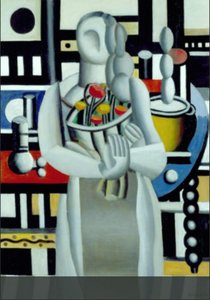
The Creation of Stalingrad by Fernand Léger
In 1924, Fernand Léger turned his gaze toward the heavy, rhythmic pulse of industrial labor. His painting, Stalingrad, emerged from this fascination with the intersection of man and machine. The canvas captures a moment of intense industrial collaboration, where the human form and the mechanical tool become inseparable. It is a scene of construction and movement, a study of how steel and muscle work in tandem to reshape a landscape.
The work is rooted in the language of Cubism, utilizing fragmented planes to organize the chaos of the machine age. At the same time, it carries the simplified, direct clarity often associated with Naïve Art. This duality allows the subject matter to remain grounded. The heavy machinery and the workers are not mere decorations; they are the structural bones of the composition. Fernand Léger sought to translate the energy of the modern era into a visual reality of intersecting lines and solid forms.
Steel pistons and heavy cranes define the space. The work exists in the tension between the organic and the manufactured. It is a quiet record of strength.
Artistic Movements and Stylistic Influences
The canvas is anchored in the fractured logic of Cubism. It follows the path cleared by the pioneers of the movement, breaking the world into a sequence of overlapping planes and geometric shards. This is not a soft dissolution of form, but a structural dismantling. The artist’s own hand developed a specific variation of this language, often called Tubism, which emphasizes cylindrical, tubular shapes. These rounded, mechanical volumes replace the organic curves of the natural world with the hard, rhythmic precision of the machine age.
There is a heavy, industrial pulse within these shapes. The work looks toward the future, acting as a forerunner to the Pop Art movement that would emerge decades later. By treating modern, mechanical subjects with such directness, the artist bridges the gap between fine art and the objects of a consumer society. The painting captures a moment where the human figure and the machine become inseparable parts of a single, moving mechanism. Steel and shadow define the new reality.
Въпроси и отговори
Нарисувана ли е на ръка Stalingrad или е принтирана?
Из판ен на ръка: професионален художник репродуцира Stalingrad с маслени бои върху ленен хол.
Какъв размер да изчам за Stalingrad?
Размерите на оригинала са 32 x 50 cm. Размерите варират от 29.9 x 33.4 cm (€224) до 217.2 x 242.6 cm (€1760); в таблицата на тази страница са изброени основните размери и техните цени.
Колко време отнема доставката?
Доставката отнема от 4 до 5 седмици с безплатна експресна доставка до цял свят; на тази страница е предлагана опция за спешно производство. Можете да върнете продукта в рамките на 100 дни за пълен възстановяване на сумата, без никакви условия.
Каква техника е използвал(а) Фернан Леже за Stalingrad?
Oil On Canvas
 Преглед в реален мащаб

 Изпрати
 Сподели
 Детайли
 Информационен лист


 Изтегляне
 Подобни артикули
 Рентгенова снимка
 Слайдшоу
 Въпроси и отговори

 Статистика