
 Преглед в реален мащаб
 Изпрати
 Сподели
 Детайли
 Ръководство

 Изтегляне
 Подобни артикули
 Рентгенова снимка
 Слайдшоу
 Въпроси и отговори
 Статистика
Daybreak


 Прочети повече
Жикле / Художествен принт
Giclée печат или принт върху платно с музейно качество, бързо производство и гъвкави опции за завършен вид. ( Купете ръчно рисувана картина Превключване към дигитално изображение)




P118B €10

P118H €10

P118W €10

P438Z €10

P508JH €12

P508YH €12

P805H €10

P805Z €10

P919BZ €10

P919G €10

P919XJ €10

P959ZH €10

P968JZ €12

W106C €8

W218G €10

W218JH €8

W218Y €10

W307PJ €10

W316G €10

W316PJ €8

W316Y €10

W398PJ €8

W4111J €10

W500HY €15

W500JH €15

W692G €12

W849H €8

W940BG €15

W953PJ €8




Изберете от нашите предварително зададени размери, които съответстват на оригиналните пропорции на произведението.

Въведете необходимата ширина и височина, за да паснат на вашата рамка или стена. Принтовете могат само да се изрязват, но никога не могат да бъдат по-големи от оригиналната картина, така че при размер с различен формат част от изображението ще бъде загубена. Преди да започнем печат, ще ви изпратим дигитален мок업 за одобрение. Изображението, показано на тази страница, не показва реалното изрязване — само мок업ът го показва.
Доставка по целия свят () в рамките на 2 седмици вместо стандартните 4/5 седмици. (14 Ноември)

Безплатна експресна доставка по целия свят

Висококачествено ленено платно

Пълно застраховане на доставката

Гаранция за възстановяване на митнически такси

Гаранция за пълно съответствие на цветовете

Политика за връщане в рамките на 100 дни (само при дефекти)

100% Гаранция за връщане на сумата

Оферта за отстъпка при поръчка на повече бройки
 Опцията със стъкло е налична само за размери под 110 см

Daybreak
Жикле / Художествен принт
Размер на репродукцията
-


Обща цена
€ 72
A Serene Dawn: Capturing Nature's Majesty
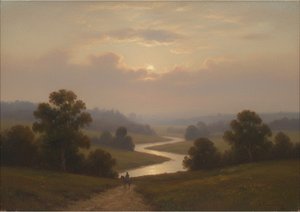
Dwight William Tryon’s "Daybreak" is a captivating depiction of sunrise over water, rendered in a style characteristic of American Tonalism. This evocative painting transports the viewer to a tranquil scene where the soft light of dawn gently illuminates the landscape. The composition features two boats resting peacefully on the water's surface – one closer to the left and another towards the right - with scattered figures adding a sense of human presence within this vast natural setting. Tryon masterfully uses subtle gradations of color, particularly in the sky’s cloud formations, creating a dramatic backdrop that enhances the overall serenity of the scene. The painting's atmosphere is one of quiet contemplation and peaceful awakening, inviting viewers to share in the stillness of the moment.Tonalism and Artistic Influences
"Daybreak," created around 1885, exemplifies the Tonalist movement prevalent in late 19th-century American art. This style prioritized mood and atmosphere over precise detail, emphasizing subtle color harmonies and soft edges to create a sense of tranquility and introspection. Tryon was significantly influenced by James McNeill Whistler, a leading figure in the Aesthetic Movement, who championed "art for art's sake" and emphasized harmonious color relationships. Unlike earlier landscape traditions that focused on dramatic narratives or heroic depictions of nature, Tonalism sought to capture the essence of a scene through its tonal qualities – the interplay of light and shadow, and the subtle nuances of color. Tryon’s work reflects this shift towards a more contemplative and atmospheric approach to landscape painting.Technique and Composition
Tryon's technique in "Daybreak" is characterized by his delicate brushwork and careful layering of paint. He employed thin glazes of oil paint to build up the luminous quality of the sky and water, creating a sense of depth and atmosphere. The composition is carefully balanced, with the boats acting as anchors in the foreground while the expansive sky draws the eye upwards. The placement of figures within the scene isn't about narrative detail but rather contributes to the overall feeling of peaceful solitude.- Color Palette: Predominantly soft blues, pinks, and grays create a harmonious and calming effect.
- Brushwork: Loose and blended brushstrokes contribute to the atmospheric quality of the painting.
- Light & Shadow: The subtle interplay of light and shadow defines forms and creates depth, emphasizing the tranquility of the scene.
Symbolism and Emotional Impact
Beyond its aesthetic beauty, "Daybreak" carries symbolic weight. Sunrises often represent new beginnings, hope, and renewal. The presence of boats suggests journeys and exploration, while the figures in the distance hint at human connection within the vastness of nature. The painting evokes a sense of peace, tranquility, and quiet contemplation. It invites viewers to pause, reflect, and appreciate the beauty of the natural world. "Daybreak" is more than just a landscape; it's an emotional experience that resonates with our innate desire for serenity and connection. The overall effect is one of gentle optimism and enduring beauty – qualities that make this painting a timeless treasure.Въпроси и отговори
Има ли информационен лист за „Daybreak“ на Дъгът Уилям Трайън, предназначен за ученици?
Страницата Информационен лист за „Daybreak“ на Дъгът Уилям Трайън предлага двустраничен информационен лист за принтиране: самото произведение с неговата идентификационна таблица, времева лента, поставяща го в периода от живота на художника, други творби на същия автор, измеримата цветова палитра и готови за копиране цитати в четири различни стила.
Колко души разглеждат "Daybreak"?
Страницата Статистика на „Daybreak“ на Дъгът Уилям Трайън представя статистика за публичните посещения: месечен брой прегледи на това произведение, сравнение с най-гледаните творби на автора и произход на посетителите.
„Daybreak“ на Дъгът Уилям Трайън светла или тъмна творба ли е?
По отношение на възприеманата яркост, „Daybreak“ на Дъгът Уилям Трайън е brilliant.
Биография на художника
Early Life and Artistic Beginnings
Dwight William Tryon, a name synonymous with serene American landscapes, was born in the heart of Connecticut on August 13, 1849, in Hartford. His early life, however, was marked by profound loss – his father tragically died in a hunting accident when Dwight was just a young boy. This event profoundly shaped his upbringing, leading to a childhood spent largely with his grandparents on their farm in East Hartford. It was here, amidst the rolling hills and quiet countryside, that he first developed an intimate connection with nature, a bond that would become the very foundation of his artistic vision. Remarkably, Tryon’s artistic journey began without formal training; instead, he cultivated his talent through self-study, frequenting a local bookstore where he not only worked but also devoured instructional manuals on drawing and painting. He diligently practiced sketching the surrounding landscape – the weathered barns, the winding river, and the ever-changing light—transforming observations into tangible representations of the world around him. His dedication culminated in his first sale in 1870, a modest beginning that nonetheless ignited his passion and signaled the emergence of a promising talent. His early exhibitions, though local, hinted at the skill he was developing, ultimately leading to acceptance into the prestigious National Academy of Design in 1873 – a significant milestone in his burgeoning career.European Influences and the Shaping of a Style
Driven by an ambition to refine his craft and immerse himself in the artistic currents of Europe, Tryon embarked on a transformative journey in 1876. He traveled to France, seeking formal training at the École des Beaux-Arts in Paris. His studies there were deeply influenced by the principles of Luminism, a style characterized by its emphasis on atmospheric effects and the radiant quality of light. However, Tryon’s artistic path soon diverged from this purely observational approach. He was particularly drawn to the Barbizon School—a movement that championed direct observation of nature and favored a more subdued palette. This shift reflected a desire for greater emotional depth and a more nuanced representation of the natural world. Crucially, Tryon sought guidance not just from instructors but also from leading artists of the time. He benefited immensely from the tutelage of luminaries like Jacquesson de la Chevreuse, Charles-François Daubigny, Henri Harpignies, and Jean Baptiste-Antoine Guillemet, absorbing their techniques and philosophies. These encounters broadened his artistic horizons and helped him to develop a distinctive style that blended observation with emotional resonance. The influence of Whistler is particularly notable; the tonalist painter’s emphasis on subtle color gradations and atmospheric mood profoundly shaped Tryon's approach to landscape painting.Mature Style and Atmospheric Landscapes
By the late 1880s, Dwight William Tryon had fully realized his iconic style – a signature approach that would define his legacy as a leading American Tonalist. His canvases often feature a distinctive composition: a grouping or broken row of trees positioned in the middle distance, acting as a visual bridge between a luminous sky above and a foreground marsh or pasture below. These scenes are frequently imbued with autumnal hues—russets, ochres, and browns—evoking a sense of tranquility, melancholy, and the passage of time. Tryon’s mastery lay not just in depicting these landscapes realistically but also in conveying their atmosphere – the subtle shifts in light, the delicate play of color, and the overall mood of a scene. He skillfully used tonal variations to create depth and suggest distance, drawing the viewer into the heart of the landscape. *Salt-Marsh, December*, which garnered first prize at the Tennessee Centennial Exposition in 1897, stands as a prime example of this skill—a breathtaking depiction of a winter marsh bathed in soft light. Beyond landscapes, Tryon also excelled at seascapes, capturing the vastness and power of the ocean with delicate pastel washes. His paintings were consistently exhibited nationally, gaining recognition at prestigious venues such as the Pennsylvania Academy of Fine Arts and the Montross Gallery, solidifying his position among America’s most respected landscape painters.Patronage, Recognition, and Lasting Legacy
The trajectory of Tryon’s career was significantly enhanced by his relationship with Charles Lang Freer, a discerning collector who became his most important patron. Freer acquired dozens of Tryon's works—including many of his most celebrated landscapes—and even collaborated with the artist on interior design projects for his Detroit home. This generous support allowed Tryon to fully dedicate himself to his art, enabling him to produce a substantial body of work that continues to captivate audiences today. Further recognition came in 1908 when he received the Carnegie Prize at the Carnegie Exhibition—a prestigious award that cemented his reputation as one of America’s leading artists. Throughout his career, Tryon remained an active member of several prominent art organizations, including the Society of American Artists, the American Watercolor Society, and the National Institute of Arts and Letters (now the American Academy of Arts and Letters). In 1887, he established a summer home in South Dartmouth, Massachusetts—a tranquil retreat where he continued to paint and refine his craft. Dwight William Tryon passed away peacefully in 1925 at his home in South Dartmouth, leaving behind a rich artistic legacy defined by his profound connection to nature, his masterful use of color and light, and his enduring contribution to American Tonalism. His works are now held in prominent collections such as the Smithsonian American Art Museum and the Freer Gallery of Art, ensuring that his vision continues to inspire and resonate with viewers for generations to come.
Дъгът Уилям Трайън
1849 - 1925 , САЩ
Бърза информация
- Artistic Movement Or Style: Тонализъм, Барбизон
- Artists Or Movements Influenced By This Artist: ['Барбизон']
- Artists Who Influenced This Artist:
- Джеймс Макнейл Уизлиър
- Жан Баптист-Антоин Гуилем
- Date Of Birth: 13 Август 1849
- Date Of Death: 1 Юли 1925
- Full Name: Dwight William Tryon
- Nationality: Американски
- Notable Artworks:
- Бряг на солена вода
- Пролет
- Хайстаки от Нюбъри
- Place Of Birth: Хартфорд, САЩ
Свързани статии

The Magic of Tonalism: Capturing Mood, Mist, and Atmospheric Emotion in Landscape Art
Discover the ethereal beauty of Tonalism. Explore how master artists use mist, soft light, and muted palettes to capture profound emotion and atmospheric mood in landscape painting. A deep dive into this quiet, introspective art movement for true connoisseurs.

Grant Wood & American Regionalism: Identity, Myth & the Rural Landscape
Explore the world of Grant Wood & American Regionalism with OriginalUniqueArt. Discover the symbolism behind 'American Gothic', recurring themes, and the movement's lasting impact on art history. High-quality reproductions available.
Atmospheric Visions: Exploring Tonalism in American Painting
Explore the captivating world of American Tonalism! Discover its history, key artists like Whistler & Inness, techniques, and lasting influence on art. Expert insights for collectors & enthusiasts.

Tonalism Explained: The Art of Mood, Mist, and Masterful Color in Landscape Painting
Discover the evocative world of Tonalism. Explore how masters like Whistler and Tryon used mist, shadow, and subtle color to capture profound mood and atmosphere in landscape art. An expert guide for fine art enthusiasts and collectors.

Evocations of Place: A Historical Journey Through Landscape Art
Explore the rich history of landscape art with OriginalUniqueArt. Discover renowned artists, movements like Impressionism & Romanticism, and expert guidance for collecting timeless pieces. Find your perfect serene escape today!