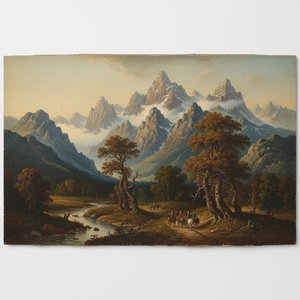
A Life Etched in the Slovak Landscape
Viliam Forberger, a name often echoed alongside his German counterpart Wilhelm and Hungarian Vilmos – aliases reflecting the complex cultural tapestry of 19th-century Slovakia – was more than just a painter; he was a chronicler of a nation’s beauty. Born on May 28, 1848, in the charming town of Kežmarok, nestled within the shadow of the majestic Tatra Mountains, Forberger's life became inextricably linked to the dramatic peaks and serene valleys that defined his homeland. His story is one of dedication not only to artistic expression but also to preserving the visual heritage of Slovakia through meticulous observation and skillful draftsmanship.
Forberger wasn’t merely a recorder of scenery; he was an interpreter, translating the raw power and subtle nuances of nature onto paper and canvas. He dedicated himself to capturing the essence of the Slovak mountains viewed from their villages, a perspective that imbued his work with both grandeur and intimacy. This focus stemmed not only from personal affection for the region but also from a growing national consciousness within Slovakia during his lifetime. His art became a visual testament to the unique character of the land, contributing to a sense of cultural identity.
The Path of an Artist-Restorer
While celebrated primarily as a painter and draftsman, Forberger’s artistic pursuits extended beyond creation. He was also a respected restorer and teacher, roles that reveal a deep understanding of art history and technique. This multifaceted career suggests a commitment to the broader artistic community, fostering not only his own skills but also those of others. His work as a restorer likely exposed him to a wide range of styles and influences, subtly shaping his own aesthetic sensibilities.
The details of Forberger’s formal training remain somewhat elusive, yet it is clear that he possessed a remarkable talent for detail. He honed this skill through countless studies of natural scenery, meticulously rendering the textures of rock, the play of light on water, and the delicate foliage of trees. His drawings, such as ‘Tatras from Lučivná’ (1926), are not simply representations of landscapes; they are intimate portraits, revealing a profound connection to the environment. The precision in his lines and shading speaks to a mastery of draftsmanship, while the overall composition evokes a sense of tranquility and awe.
Themes and Techniques
Forberger’s artistic output centered almost exclusively on landscape painting, specifically focusing on the Tatra Mountains and their surrounding villages. He wasn't interested in dramatic or idealized depictions; instead, he favored realism, striving to capture the mountains as they appeared – rugged, imposing, yet undeniably beautiful. His palette tended towards muted tones, reflecting the natural colors of the Slovak countryside. This restraint in color allowed him to emphasize form and texture, creating a sense of depth and atmosphere.
His technique involved careful observation and precise execution. He often worked directly from nature, sketching preliminary studies before developing more finished compositions. The resulting works are characterized by their attention to detail and their ability to convey the unique character of each location. Paintings like ‘Panorama Tatras from Kežmarok’ demonstrate his skill in capturing expansive vistas while maintaining a sense of intimacy and realism.
Legacy and Historical Significance
Viliam Forberger passed away on October 28, 1928, in Piešťany, Slovakia, leaving behind a body of work that continues to resonate with art enthusiasts today. While not widely known internationally, he holds a significant place within Slovak art history as one of the foremost landscape painters of his generation. His detailed studies of the Tatra Mountains provide valuable insights into the region’s natural beauty and cultural heritage.
His ranking among the top 1,000,000 artists on ArtFacts is a testament to the enduring quality of his work. More importantly, Forberger's paintings serve as a visual record of Slovakia during a period of significant social and political change. He captured not only the physical landscape but also the spirit of a nation striving for self-expression and cultural identity. His legacy lies in his ability to transform personal observation into enduring works of art that continue to inspire and captivate audiences.
问答详情
是否有Wilhelm Forberger, Vilmos Forberger作品的时间线?
艺术家的 作品时间轴 页面按年份顺序展示了 Wilhelm Forberger, Vilmos Forberger 的作品。
在哪里可以按主题查看Wilhelm Forberger, Vilmos Forberger的作品分布?
Wilhelm Forberger, Vilmos Forberger 的 主题图谱 是一个按主题对艺术家作品进行索引的页面。
Wilhelm Forberger, Vilmos Forberger 的哪些作品浏览量最高?
关于 Wilhelm Forberger, Vilmos Forberger 作品的相关统计数据,请参阅艺术家的 访问统计 页面。
是否有Wilhelm Forberger, Vilmos Forberger作品的完整列表?
您可以在 Wilhelm Forberger, Vilmos Forberger 的 全部作品 页面上浏览其在 本网站 上的所有作品。
我可以在虚拟博物馆中参观Wilhelm Forberger, Vilmos Forberger的作品吗?
您可以在Wilhelm Forberger, Vilmos Forberger的3D 博物馆页面中,通过3D展厅欣赏其艺术作品。
如何按特定媒介查找 Wilhelm Forberger, Vilmos Forberger 的所有作品?
全部媒介 页面按技法对 Wilhelm Forberger, Vilmos Forberger 的作品进行了分类。
Wilhelm Forberger, Vilmos Forberger 出生于哪个城市和国家?
Wilhelm Forberger, Vilmos Forberger 出生于 Slovakia 的 Kezmarok。
我可以通过关键词来探索 Wilhelm Forberger, Vilmos Forberger 的作品吗?
Wilhelm Forberger, Vilmos Forberger 的 按关键词检索 页面通过关键词对艺术家的作品进行了分类。