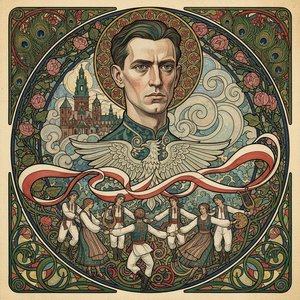
A Legacy in Bronze and Paint: The Life of Wacław Szymanowski
Wacław Szymanowski, born in Warsaw on August 23rd, 1859, was a Polish artist whose name became synonymous with both the romantic spirit of painting and the enduring power of sculpture. He lived through a period of immense national upheaval for Poland—a time when artistic expression often served as a powerful declaration of identity and cultural resilience. The son of Wacław Szymanowski, a respected journalist and writer, and later the father of physicist and politician Wacław Szymanowski, he inherited a legacy of intellectual engagement that undoubtedly shaped his own creative path. His early years were dedicated to capturing the beauty of Polish landscapes and its people, particularly the mountaineers and Hutsuls whose lives resonated with a sense of untamed freedom. These genre paintings, executed with meticulous detail and a warm palette, established him as a promising talent in the late 19th-century art scene.From Genre to Monument: A Shift in Artistic Focus
Around 1895, Szymanowski underwent a significant artistic transformation, turning his attention towards sculpture. This wasn’t merely a change of medium; it was a shift in ambition and scale. He embraced the Art Nouveau-Symbolist style that was sweeping across Europe, infusing his work with a sense of emotional depth and allegorical meaning. His sculptures moved beyond realistic representation, seeking to capture the essence of human experience and national pride. This period saw him undertake ambitious projects like the monument to Artur Grottger in Kraków (1907), a tribute to a fellow Polish artist whose works depicted the struggles of the nation. However, it was his commission for a statue honoring Frédéric Chopin that would ultimately define his artistic legacy. The idea for this monument arose in 1907, intended as a celebration of the composer’s centenary in 1910, but political obstacles and the looming shadow of World War I delayed its realization.The Chopin Monument: A Symbol of National Identity
The statue of Frédéric Chopin, finally cast and unveiled in Warsaw's Royal Baths Park (Łazienki Park) in 1926, is more than just a beautiful sculpture—it’s a potent symbol of Polish national identity. The bronze figure captures Chopin at the height of his creative power, lost in musical contemplation. Szymanowski skillfully conveyed not only the composer's likeness but also the emotional intensity and poetic spirit that characterized his work. The monument faced considerable controversy during its planning stages, with debates surrounding its design and placement reflecting the complex political landscape of Poland at the time. Despite these challenges, Szymanowski persevered, creating a masterpiece that continues to resonate with audiences today. It became an immediate landmark, a place for remembrance, reflection, and national pride—a testament to the enduring power of art to transcend political boundaries.Later Life and Artistic Contributions
Beyond the Chopin monument, Szymanowski continued to create significant works throughout his career. He designed numerous tomb monuments, including one honoring his father at Warsaw’s Powązki Cemetery, demonstrating a sensitivity to grief and remembrance. His portrait busts captured the likenesses of prominent figures, offering intimate glimpses into the lives of his contemporaries. While he initially gained recognition for his paintings of Polish mountaineers and Hutsuls, it was his sculptures that cemented his place in art history. He died in Warsaw on July 22nd, 1930, at the age of 70, leaving behind a body of work that continues to inspire and captivate. His legacy is not simply one of artistic skill but also of unwavering dedication to Polish culture and national identity—a testament to the power of art to reflect and shape the spirit of a nation.Historical Significance and Enduring Appeal
Wacław Szymanowski’s work occupies a unique position in Polish art history. He bridged the gap between Romantic painting and Symbolist sculpture, creating works that were both aesthetically beautiful and deeply meaningful. His sculptures, particularly the Chopin monument, became powerful symbols of national identity during a period of immense political and social change. His ability to capture the essence of human emotion, combined with his technical skill and artistic vision, ensured his lasting legacy. Today, Szymanowski’s works are celebrated for their beauty, historical significance, and enduring appeal—a reminder of the power of art to transcend time and inspire generations. He remains a pivotal figure in Polish sculpture, whose contributions continue to be studied and admired by artists and scholars alike.问答详情
Wacław Szymanowski 的艺术风格是如何随时间演变的?
Wacław Szymanowski 的艺术生涯在 艺术历程 页面上按时期逐一展开:以横向时间轴的形式呈现作品,并按创作时期划分为不同的篇章。
是否有Wacław Szymanowski作品的时间线?
您可以在Wacław Szymanowski的作品时间轴页面上按时间顺序查看其作品。
Wacław Szymanowski 的创作时期属于哪个历史阶段?
Wacław Szymanowski 的创作活跃于 19th Century 时期,这一时期确立了艺术家在艺术史上的地位。
目前目录中共有多少件 Wacław Szymanowski 的作品可供浏览?
您可以在 全部作品 页面浏览由 Wacław Szymanowski 创作的 9 件作品 件作品。