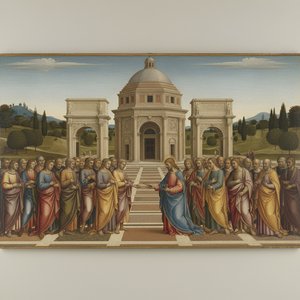
The Renaissance Spirit of Vincenzo Civerchio
In the heart of the Italian Renaissance, amidst the vibrant cultural flourishing of Lombardy, emerged the delicate and profound artistry of Vincenzo Civerchio. Born around 1470 in the serene town of Crema, Civerchio, often referred to by the evocative moniker Civercio, became a vital thread in the rich tapestry of the Brescia school of painting. His life, spanning from the late fifteenth century to the mid-sixteenth century, coincided with one of the most transformative eras in human history, a period where the rigid structures of the Middle Ages began to dissolve into the luminous realism and humanistic depth of the High Renaissance.
While the archival shadows of his early years remain somewhat elusive, the traces of his formative training suggest a deep immersion in the masters of his era. It is widely believed that Civerchio honed his skills under the guidance of Bernardino Butinone, a painter celebrated for his meticulous realism and a command over color that could breathe life into even the most static subjects. This early education provided him with a foundational mastery of light and form, which he would later weave into a style that felt both deeply rooted in tradition and strikingly modern for its time.
A Legacy Carved in Altarpieces
Civerchio’s artistic journey was inextricably linked to the city of Brescia, where his presence left an indelible mark upon the sacred spaces of churches and civic institutions. He became a master of the altarpiece, a genre that demanded not only technical precision but also a profound ability to convey spiritual narrative and emotional resonance. His works are characterized by a captivating synthesis of styles; one can observe the lingering grace of Byzantine influences, particularly in the rhythmic, heavy folds of drapery, harmoniously blended with the burgeoning Venetian realism that was sweeping through Northern Italy.
His technical prowess allowed him to navigate the complexities of religious iconography with ease, creating compositions that invited the faithful into a state of contemplation. Through his brush, the divine became tangible, rendered with a careful observation of nature that grounded celestial figures in a recognizable, earthly reality. This ability to bridge the gap between the transcendent and the human is perhaps his greatest achievement as a painter of the Lombard school.
Influences and Artistic Lineage
To understand Civerchio is to understand the lineage of masters that shaped his vision. He did not paint in isolation but rather as part of a continuous dialogue with the giants of his age. His work bears the unmistakable imprint of Vincenzo Foppa, the preeminent leader of the Early Lombard School, whose influence provided Civerchio with a sophisticated visual vocabulary. Furthermore, he is often described as an imitator and student of Bernardino Zenale, absorbing the structural clarity and atmospheric depth that defined the era's most significant works.
The continuity of his artistic legacy was further secured through his role as a mentor. By instructing pupils such as Luigi Donato of Como, Civerchio ensured that the specific nuances of the Brescia style—its unique blend of gravity and grace—would persist in the generations that followed. Today, his contributions are preserved in some of the world's most prestigious collections, including the National Gallery of Art in Washington D.C. and the Pinacoteca di Brera in Milan, serving as a testament to a life dedicated to capturing the eternal beauty of the Renaissance spirit.
问答详情
我可以通过色谱来探索 Vincenzo Civerchio 的作品吗?
色彩索引 页面按色彩对 Vincenzo Civerchio 的作品进行了分类整理。
Vincenzo Civerchio 出生于哪个国家和城市?
Vincenzo Civerchio 出生于 Italy 的 Crema。
Vincenzo Civerchio 的艺术风格是如何随时间演变的?
您可以在艺术家的 艺术历程 页面上查阅 Vincenzo Civerchio 作品的编年史,其作品按创作顺序分章节依次呈现。
如何按年份顺序浏览 Vincenzo Civerchio 的作品?
艺术家的 作品时间轴 页面按年份顺序展示了 Vincenzo Civerchio 的作品。