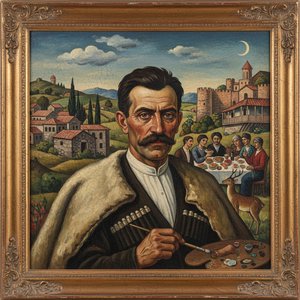
A Life Rooted in the Latvian Soil
Vilhelms Purvītis began his life far from the grand galleries of Europe, born into a family of millers in Zaube Parish. His early years were shaped by the quiet rhythms of rural Latvia and the labor of his father's mill. Before he ever held a professional brush, he spent two years working in metalwork to support his family. It was only after moving to the Vitebsk Governorate that a teacher noticed the boy's natural ability with a pencil. This recognition eventually led him to the Imperial Academy of Fine Arts in St. Petersburg, where he studied under the landscape painter Arkhip Kuindzhi.
His time in St. Petersburg was a period of intense growth and connection. He became part of a small circle of Latvian artists, including Janis Rozentāls and Johan Valter, and joined the "Rukis" organization. These years were not merely about technical training; they were about finding a way to bring the essence of his homeland to a wider stage. After graduating with a Grand Gold Medal, he traveled through Europe, exhibiting his work in cities like Paris, Munich, and Berlin. He even sought out the frozen landscapes of Spitzbergen to learn how to capture the specific weight and light of snow.
The Painter of Snow and Seasons
Purvītis earned the nickname "philosopher of snow" because of his ability to render the cold, crisp atmosphere of a northern winter. He did not simply paint white surfaces; he studied how light interacts with frost and how the landscape changes under a heavy sky. His style moved through several phases, beginning with Realism and later incorporating elements of Impressionism, Art Nouveau, and even influences from Cézanne and Munch. He had a particular way of using high horizon lines and earth compositions to create a sense of structure in his landscapes.
His work often focused on the seasonal shifts of the Latvian countryside. Whether it was the arrival of spring or the quiet of a winter evening, he sought to portray the local landscape with a sense of truth. Some of his notable subjects included:
- The ruins of Koknese Castle
- Spring landscapes and small courtyards
- The changing light of autumn in parks
- The heavy, textured presence of snow in winter scenes
A Legacy of Education and Loss
Beyond his individual paintings, Purvītis was a builder of institutions. He returned to Riga with a mission to formalize art education in the young Latvian state. He became the founder and first rector of the Art Academy of Latvia and served as the director of the Riga City Art Museum, which is known today as the Latvian National Museum of Art. Through these roles, he helped shape the direction of national painting for an entire generation of students.
The end of his life was marked by the profound tragedies of war and occupation. During the Battle of Jelgava in 1944, a devastating loss occurred when his house and workshop were destroyed, resulting in the loss of 500 of his paintings. This loss included many of his finest works that he had kept privately. Forced to flee to Germany as a refugee, he died in Bad Nauheim in 1945. Though much of his physical work was lost to history, his influence remains embedded in the Latvian identity, and the Purvītis Prize continues to honor the visual arts in his name.
问答详情
Vilhelms Purvītis 的艺术风格是如何随时间演变的?
Vilhelms Purvītis 的艺术生涯在 艺术历程 页面上按时期逐一展开:以横向时间轴的形式呈现作品,并按创作时期划分为不同的篇章。
Vilhelms Purvītis 出生于哪个国家和城市?
Vilhelms Purvītis 出生于 Latvia 的 Zaube Parish。
Vilhelms Purvītis 的创作时期属于哪个历史阶段?
Vilhelms Purvītis 的创作活跃于 Modern 时期,这一时期确立了艺术家在艺术史上的地位。
我可以在其所有作品中研究 Vilhelms Purvītis 对色彩的运用吗?
Vilhelms Purvītis 作品的色彩特征展示在艺术家的 色彩基因 页面上。