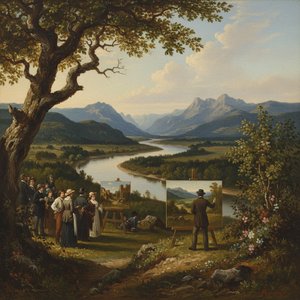
Talbot Hughes: A Victorian Painter of Costume and Romantic Idealism
Talbot Hughes (1869 – 1942) stands as a singular figure in British art history—a painter deeply invested in both artistic technique and the meticulous study of historical dress, creating works that resonate with an enduring fascination for Victorian aesthetics. Born into a family steeped in artistic tradition, Hughes’s father, William Hughes, was himself a still-life artist, fostering within him a foundational appreciation for observation and detail. His brother, Sir Herbert Hughes-Stanton, pursued landscape painting, providing another contrasting perspective on visual representation that undoubtedly shaped Hughes's artistic sensibilities. Hughes began his artistic journey at the remarkably young age of seventeen, exhibiting at the Royal Academy—a prestigious institution that would remain central to his career until 1913. This early exposure cemented his commitment to capturing the grandeur and elegance of the Victorian era, a period he meticulously documented through canvases infused with Romantic ideals and informed by the stylistic influence of Jean-Louis Ernest Meissonier, the celebrated French classicist painter known for his dramatic historical scenes. Hughes’s artistic vision prioritized not merely depicting subjects but elevating them—presenting idealized feminine beauty alongside explorations of passionate love narratives. Hughes's oeuvre spanned diverse genres, from allegorical and figurative compositions to meticulously rendered historical portraits and theatrical designs. He possessed an extraordinary ability to translate visual concepts into tangible form, achieving remarkable precision in portraying fabrics, textures, and surfaces – a skill particularly evident in his detailed depictions of costumes. This dedication to craftsmanship was further underscored by Hughes’s extensive collection of over 750 historical costumes and accessories, which served as invaluable studio props and fueled his artistic inspiration. Recognizing the significance of preserving these artifacts, he generously donated items to institutions like St Hugh's College and Dublin City Gallery The Hugh Lane, contributing to the broader understanding of Victorian fashion history. Hughes’s contributions to the Royal Academy included notable works such as “Temptation” (1899), “Fate Leads the Willing, and the Unwilling Drags” (1900) and “The Road of Love” (1900)—each demonstrating his mastery of Romantic painting techniques. Critiques from contemporaries like Marion Hepworth Dixon highlighted Hughes’s exceptional handiwork and his ability to convey emotion through nuanced visual storytelling. His artistic endeavors garnered considerable acclaim, culminating in an offer of £5,000 by an American department store for the sale of his entire costume collection—a testament to his enduring legacy as both a painter and collector. Talbot Hughes remains a compelling figure whose art continues to captivate audiences with its beauty, precision, and evocative portrayal of Victorian culture.问答详情
是否有关于 Talbot Hughes 的生平年表?
Talbot Hughes 的 艺术编年史 是一个随滚动条变化的艺术时间轴,按创作时期进行章节划分,并按时间顺序呈现艺术家的作品。
Talbot Hughes 的作品传达了怎样的情绪?
您可以在艺术家 Talbot Hughes 的 心情空间 页面上按心情浏览其作品,该页面根据作品所传达的情绪进行了分类整理。
在哪里可以查看 Talbot Hughes 作品的色彩风格?
您可以在Talbot Hughes的色彩基因页面上,深入研究其在本网站所列作品中的色彩运用。
如何按特定色调查找 Talbot Hughes 的作品?
您可以在Talbot Hughes的按色调分类页面上,按色调浏览其作品。
是否有关于Talbot Hughes所创作的所有主题的概览?
主题图谱 页面按主题对 Talbot Hughes 的作品进行了分类索引。
在哪里可以查看 Talbot Hughes 的所有作品?
您可以在 Talbot Hughes 的 全部作品 页面上浏览其在 本网站 上的所有作品。
目前目录中共有多少件 Talbot Hughes 的作品可供浏览?
您可以在 全部作品 页面浏览由 Talbot Hughes 创作的 5 件作品 件作品。
如何按年份顺序浏览 Talbot Hughes 的作品?
艺术家的 作品时间轴 页面按年份顺序展示了 Talbot Hughes 的作品。