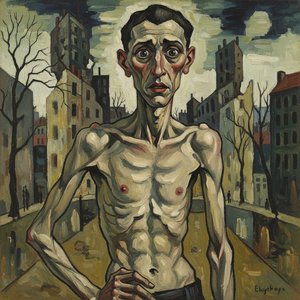
The Life of Rudolf Levy
Rudolf Levy was a German expressionist painter of Jewish ancestry. Born in Stettin, he grew up in Danzig after his family moved there during his childhood. Although he was apprenticed to a carpenter following his primary education, he pursued his passion for art by enrolling at the Academy of Fine Arts, Karlsruhe, in 1895. He later moved to Munich to open a studio with Hans Purrmann and continued his studies at the Academy of Fine Arts, Munich, under Nikolaus Gysis. He also studied plein aire painting with Heinrich von Zügel.
Levy's travels took him to Paris, where he established a circle of German-speaking artists at Le Dôme Café, and later to the south of France and Tunisia. During the First World War, he served as a German soldier in Artois and Flanders, earning the Iron Cross in 1915.
Later Years and Persecution
After the war, Levy settled in Berlin and married Eugennie Schindler. In 1928, he became a member of the Berlin Secession. Due to increasing persecution, he moved to Rapallo, Italy, and later visited Mallorca and New York. By 1937, his works were included on the Nazi list of Degenerate Art.
Following the outbreak of World War II, his residence permit was cancelled, forcing him to leave Ischia. He eventually found refuge in Florence, but after the German Army occupied Italy in 1943, he went underground. In December 1943, he was arrested by the Gestapo after being lured into a trap by agents pretending to be art buyers. He was imprisoned at Le Murate and placed on a transport to Auschwitz, where it is believed he died.
问答详情
Rudolf Levy 出生于何时何地?
Rudolf Levy 于 1875 出生于 Szczecin。
Rudolf Levy 的艺术生涯是如何划分为不同时期的?
您可以在艺术家的 艺术历程 页面上查阅 Rudolf Levy 作品的编年史,其作品按创作顺序分章节依次呈现。
Rudolf Levy 出生于哪个国家和城市?
Rudolf Levy 出生于 Poland 的 Szczecin。