A Life Between Borders
Robert Schwede lived his life within the shifting landscapes of the Baltic region and the Russian Empire. Born in Mõisaküla on 6 December 1806, he was a man of German-Baltic roots who found his professional home in Saint Petersburg. His path was shaped by the rigorous halls of the Imperial Academy of Fine Arts, where he studied the formal traditions of the era. It was here that he earned the title of free artist, a distinction that marked his official entry into the professional art community.
His family connections placed him within a small circle of creators. He was the cousin of Theodore Schwede, another painter associated with the Saint Petersburg Academy. This shared environment of study and practice meant that his early development was deeply rooted in the academic standards of the time. While some historical records suggest he passed away in 1870, others note 1871 as the year his life reached its end.
The Art of the Individual
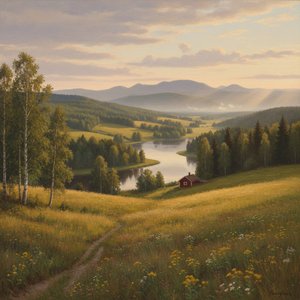
Schwede focused much of his energy on the study of people and the natural world. He specialized in portraiture and landscapes, using oil on canvas to capture the likenesses of those around him. His work often brought him into contact with the prominent figures of Russian society, including military officers and members of the high aristocracy. One notable example is his portrait of Pavel Petrovitch Melnikov, a man who served as a Major General and played a significant role in the development of the St Petersburg-Moscow railway.
His approach to painting was influenced by the techniques he learned during his training. While he was a contemporary and pupil of Karl Timoleon von Neff, he did not simply mimic the Raphael tradition. Instead, he adopted various methods to document the faces and settings of his era. His portraits, such as the one of Maria Miln held in the Latvian National Art Museum, remain among the most recognizable pieces of his output.
A Quiet Legacy
Much of what remains of Schwede's career is found in private collections or scattered across different regions. While many of his over thirty known works are held by the descendants of his family in Russia and Germany, his connection to Latvia remains a central part of his story. He is often remembered as a painter whose work bridged the gap between Baltic and Russian artistic identities.
The difficulty in studying his full body of work arises from the fact that many of his landscapes are known only through photographs. This makes it hard to fully grasp the breadth of his natural scenes. Nevertheless, his ability to capture the presence of historical figures through portraiture ensures his place in the history of nineteenth-century painting.
问答详情
Robert Schwede 最常使用的色彩有哪些?
您可以在Robert Schwede的色彩基因页面上,深入研究其在本站所列作品中的色彩运用。
在哪里可以按主题查看Robert Schwede的作品分布?
Robert Schwede 的 主题索引 旨在通过主题对艺术家的作品进行分类索引。
我可以通过艺术流派来浏览 Robert Schwede 的作品吗?
全部流派 页面按艺术流派对 Robert Schwede 的作品进行了分类。
Robert Schwede 的艺术风格是如何随时间演变的?
Robert Schwede 的 艺术历程 是一个随滚动条变化的艺术时间轴,按创作时期进行章节划分,并按时间顺序呈现艺术家的作品。