The Crucible of Experience
Robert Gwathmey’s journey into the heart of American Social Realism was forged in a crucible of profound personal loss. Born in 1903, his early years were shadowed by tragedy, as he witnessed the sudden deaths of both parents—his father lost to an industrial accident and his mother to a vehicular collision. This early encounter with the fragility of life instilled in him a deep-seated empathy for the vulnerable and the overlooked. His path to artistry was far from linear; after brief studies in business at North Carolina State College, he sought broader horizons, traveling aboard a freighter before refining his technique at the Maryland Institute Design and the prestigious Pennsylvania Academy of Fine Arts. It was here that the classical traditions of the past met the radical innovations of European modernism, setting the stage for a painter who would look at the world through a lens of both reverence and reconstruction.A Synthesis of Modernity and Tradition
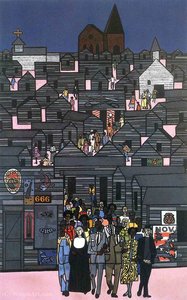
Gwathmey’s aesthetic was a masterful dialogue between the structured precision of geometric abstraction and the raw, emotive power of social realism. He did not merely depict his subjects; he distilled them. Drawing inspiration from the bold experimentation of Pablo Picasso, the vibrant palettes of Henri Matisse and Rufiona Tamayo, and the soulful textures of Vincent van Gogh, Gwathmey learned to simplify complex human experiences into powerful, symbolic forms. His work often utilized a unique vocabulary of shapes and colors to convey deeper social truths, transforming the mundane into the monumental.His artistic development was shaped by a diverse array of influences:
- The satirical edge of Honoré Daumier
- The grounded realism of Jean-François Millet
- The expressive colorism of Modernist masters
Capturing the Soul of Rural America
At the core of Gwathmey’s oeuvre lies a profound commitment to portraying the realities of rural America, particularly the lives of African American communities in the South. He possessed a rare ability to capture the quiet dignity of labor and the stillness of domestic life without descending into sentimentality. In works such as Man with Hoe (1944), he utilized earthy tones and bold, architectural lines to celebrate the strength of the laborer. Similarly, his 1945 masterpiece, Asleep at the Table, demonstrates a more lyrical side of his talent, where the boundaries between the human form and the domestic environment blur into a dreamlike state of peace.Gwathmey believed that an artist could never be truly separate from the world they inhabit. As he famously articulated, an artist must possess eyes that see the things that are almost forgotten. His legacy remains one of profound empathy, a visual testament to the beauty found in the struggles of ordinary people and the enduring dignity of the human condition.
问答详情
哪里可以浏览Robert Gwathmey的所有作品?
您可以在 Robert Gwathmey 的 全部作品 页面上浏览其在 本站 上的所有作品。
如何按特定媒介查找 Robert Gwathmey 的所有作品?
所有媒介 页面按媒介分类展示了 Robert Gwathmey 的作品。
在哪里可以按颜色分类查看Robert Gwathmey的艺术作品?
色彩索引 页面按色彩对 Robert Gwathmey 的作品进行了分类整理。
Robert Gwathmey 出生于何时何地?
Robert Gwathmey 于 1903 出生于 Manchester。