The Quiet Observer of the Natural World
Born in the coastal air of Halifax, Nova Scotia, Robert David Wilkie began to find his voice through the brush around 1849. His early years in the British colony provided a foundation for a life that would eventually find its center in the bustling artistic circles of the American East. By the middle of the nineteenth century, his hand was already busy contributing landscape views to publications like Gleason's Pictorial Drawing Room Companion. He was a man of many roles, moving through the world as a painter, a draftsman, and an educator, always seeking to capture the subtle nuances of the environment around him.
As the years passed, his residence shifted toward the urban energy of Boston and Roxbury, where he remained until the turn of the century. This period of his life saw him deeply embedded in the visual culture of the era. He did not merely paint for his own pleasure; he worked as a correspondent for Frank Leslie's Illustrated Weekly and collaborated with the lithographer Louis Prang. His ability to translate the world onto paper and canvas made him a vital part of the nineteenth-century visual landscape.
A Versatile Hand and Diverse Subjects
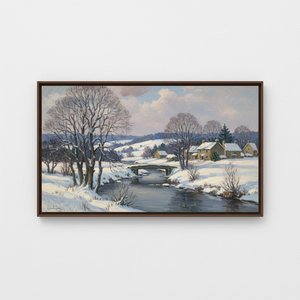
Wilkie possessed a curiosity that refused to be confined to a single subject. His studio was a place where the stillness of a still life met the movement of the wild. He moved between mediums with ease, applying oil, watercolor, ink, and chalk to his various pursuits. His repertoire was broad, reflecting a keen eye for both the grand and the minute:
- Landscape scenes that captured the breadth of the horizon.
- Genre paintings depicting moments of human life.
- Still life compositions that studied the play of light on objects.
- Detailed bird paintings that required a precise, observational touch.
One of his most notable achievements involved a deep engagement with literature. Between 1896 and 1899, he translated the written word into visual form by painting over a hundred watercolor scenes inspired by the novels of Charles Dickens. This work required a specific kind of empathy, a way to see the atmosphere of a story through color and line.
Legacy in Ink and Oil
The final years of his life were spent in Swampscott, Massachusetts, leaving behind a body of work that moved from the pages of periodicals to the walls of galleries. His presence in the art world was felt in the institutions that preserved his vision, including the Museum of Fine Arts in Boston and the Art Gallery of Nova Scotia. Even long after his passing, his works continued to find their way into the hands of collectors, such as when a large collection of his paintings was exhibited at the Vose Galleries in 1948.
His life was a steady progression of observation and translation. From the forests where he painted birds to the literary worlds of his watercolor studies, Robert David Wilkie remained a dedicated chronicler of the visible and the imagined. He left behind a record of the nineteenth century, captured through the careful application of pigment and a tireless commitment to his craft.
问答详情
Robert David Wilkie 的创作时期属于哪个历史阶段?
Robert David Wilkie 的创作活跃于 19th Century 时期,这一时期确立了艺术家在艺术史上的地位。
在哪里可以参观Robert David Wilkie作品的3D虚拟展厅?
您可以进行虚拟参观:在 Robert David Wilkie 的 3D 艺术展厅 页面中,您可以在三维画廊里欣赏艺术家的作品。
Robert David Wilkie 的艺术风格是如何随时间演变的?
Robert David Wilkie 的艺术生涯在 艺术历程 页面上按时期逐一展开:以横向时间轴的形式呈现作品,并按创作时期划分为不同的篇章。