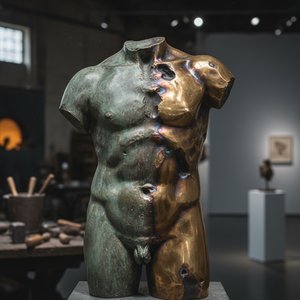
A Quiet Introspection: The Life and Art of Rachel Hutchinson
Rachel Hutchinson, a name perhaps less immediately recognizable than some of her Bloomsbury contemporaries, nevertheless occupies a vital space in the narrative of early 20th-century portraiture. Her work, characterized by a profound psychological depth and a delicate handling of form, offers a compelling counterpoint to the bolder, more overtly decorative styles often associated with the group. Born into a world on the cusp of immense change, Hutchinson’s artistic journey unfolded against a backdrop of shifting social norms, burgeoning modernism, and a growing awareness of the inner life. While biographical details remain somewhat sparse – a testament perhaps to her own preference for quiet contemplation over public display – the power of her paintings and sculptures speaks volumes about a sensitive artist deeply attuned to the complexities of human emotion. Her story is one of subtle rebellion, artistic dedication, and a lasting contribution to the representation of women and interiority in art.Early Influences and Artistic Development
Hutchinson’s connection to the Bloomsbury Group wasn't immediate but evolved through familial ties and shared intellectual circles. Exposure to the group’s emphasis on aestheticism, individual expression, and a rejection of Victorian conventions proved formative. While not a core member in the same vein as Vanessa Bell or Duncan Grant, she absorbed their spirit of experimentation and their commitment to capturing subjective experience. Early training likely included traditional academic methods, providing her with a solid foundation in draftsmanship and anatomy – skills that would later be subtly subverted by her focus on psychological nuance rather than precise realism.- Formal Training: While specific details are limited, it’s believed Hutchinson received classical training emphasizing anatomical accuracy.
- Bloomsbury Impact: Exposure to the group's aesthetic principles – particularly their focus on subjective experience and rejection of Victorian norms – significantly shaped her artistic direction.
- Early Works: Her initial paintings often depicted family members and close friends, serving as a laboratory for exploring portraiture’s potential beyond mere likeness.
The New York Years: A Blossoming Career
A pivotal moment in Hutchinson’s career came with her relocation to New York City in the 1920s. The city's vibrant art scene – a melting pot of European modernism and American innovation – provided fertile ground for her artistic development. Unlike many artists who sought fame and fortune, Hutchinson carved out a niche portraying members of New York’s intellectual elite and burgeoning social circles. She became known for her ability to capture not just the physical appearance of her sitters but also their inner lives—their anxieties, aspirations, and hidden vulnerabilities.- New York Arrival: The move to NYC in the 1920s proved transformative, exposing Hutchinson to a diverse artistic landscape.
- Portraiture Focus: She established herself as a sought-after portraitist among New York’s intellectual and social circles.
- Style Refinement: Her signature style – characterized by psychological depth, muted palettes, and delicate brushwork – fully matured during this period.
Themes and Symbolism in Hutchinson’s Work
Recurring themes within Hutchinson's oeuvre include the complexities of female identity, the search for self-discovery, and the quiet beauty of everyday life. Her portraits of women are particularly compelling, often depicting them as introspective figures grappling with societal expectations and personal desires. She frequently employed symbolism – a single flower, a partially obscured view, a carefully chosen piece of jewelry – to hint at hidden emotions or underlying narratives.- Female Identity: Hutchinson’s portraits often explore the complexities of womanhood and societal expectations.
- Interiority & Psychology: A central theme is the exploration of inner life, revealing character through subtle gestures and expressions.
- Symbolic Language: She skillfully used symbolism – flowers, obscured views, jewelry – to convey hidden emotions and narratives within her work.
Legacy and Historical Significance
While Rachel Hutchinson may not be a household name, her contribution to the history of portraiture is undeniable. She offered a compelling alternative to the more bombastic styles of her time, prioritizing psychological depth over superficial realism. Her work provides valuable insight into the lives and sensibilities of the early 20th-century elite, particularly women navigating a rapidly changing world. Her lasting influence can be seen in the work of subsequent artists who sought to capture the inner lives of their subjects with sensitivity and nuance. Hutchinson’s quiet introspection continues to resonate today, reminding us of the power of art to reveal the hidden depths of the human spirit. Her paintings and sculptures stand as a testament to her artistic dedication, her unwavering commitment to capturing subjective experience, and her enduring legacy as a Bloomsbury artist who dared to look beyond the surface.问答详情
可以按颜色对Rachel Hutchinson的作品进行排序吗?
色彩索引 页面按色彩对 Rachel Hutchinson 的作品进行了分类整理。
是否有关于Rachel Hutchinson作品的3D虚拟展厅巡览?
Rachel Hutchinson 的 3D 博物馆 是一个在虚拟三维展厅中展示艺术家作品的页面。
是否有关于Rachel Hutchinson所创作的所有主题的概览?
Rachel Hutchinson 的 主题图谱 是一个按主题对艺术家作品进行索引的页面。