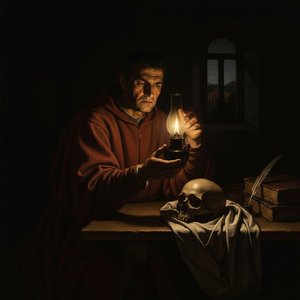
The Enigmatic Vision of Pieter Van Anraedt
Pieter Van Anraedt remains a figure shrouded in the mists of artistic history, a painter whose work evokes a profound sense of melancholy and spiritual yearning despite limited biographical detail. Born in an unknown location sometime around the mid-17th century – records are frustratingly sparse – he flourished primarily during the late Baroque period, though his style defies easy categorization. He wasn't part of any prominent academy or guild; instead, Van Anraedt appears to have operated on the periphery of established artistic circles, accepting commissions from a select clientele and cultivating a deeply personal aesthetic that set him apart. This isolation contributed to his relative obscurity during his lifetime, but has also fueled an enduring fascination with his oeuvre in modern times. What little is known suggests a life dedicated entirely to his art, eschewing public recognition for the pursuit of inner vision. He died sometime after 1720, leaving behind a small but powerfully evocative body of work that continues to captivate and intrigue.A Style Forged in Shadow: Influences and Development
Van Anraedt’s artistic development is difficult to trace with precision due to the lack of documented training or early works. However, scholars identify strong influences from several key sources. The dramatic chiaroscuro – the intense contrast between light and dark – characteristic of Caravaggio's paintings is undeniably present in Van Anraedt’s compositions, particularly his depictions of religious subjects. He also seems to have absorbed elements of Rembrandt van Rijn’s psychological realism, evident in the nuanced expressions and introspective gazes of his figures. The influence isn’t merely imitative; rather, Van Anraedt synthesized these Baroque masters with a distinctly Northern sensibility, incorporating a delicate precision in rendering detail reminiscent of Jan Vermeer. Early works – those tentatively attributed to him based on stylistic analysis – show a gradual shift from more conventional religious scenes towards increasingly intimate and symbolic portrayals. He moved away from grand narratives, focusing instead on solitary figures caught in moments of quiet contemplation or spiritual crisis. This evolution suggests a growing dissatisfaction with established artistic conventions and a desire to explore the complexities of human emotion and faith on a more personal level. His palette remained subdued throughout his career, dominated by earth tones, deep blues, and rich blacks, further enhancing the sense of mystery and introspection that permeates his paintings.Themes of Solitude and Spiritual Quest
The core themes explored in Van Anraedt’s work revolve around solitude, spiritual quest, and the fragility of human existence. Religious subjects are frequent, but rarely depict triumphant miracles or divine intervention. Instead, he focuses on moments of doubt, suffering, and quiet devotion. His paintings often feature a single figure – a penitent saint, a grieving widow, a scholar lost in thought – isolated against a dark background, bathed in a single shaft of light.- The Weight of Faith: Van Anraedt’s depictions of biblical figures are often imbued with a sense of profound melancholy, emphasizing the burden of faith and the struggle to reconcile belief with human suffering.
- Vanitas Symbolism: Recurring motifs such as skulls, decaying flowers, and extinguished candles serve as reminders of mortality and the transience of earthly pleasures. These elements aren’t presented in a morbid way, but rather as invitations to contemplate the deeper meaning of life.
- The Power of Inner Light: Despite the pervasive darkness, Van Anraedt's paintings are never entirely devoid of hope. The single source of light that illuminates his figures often symbolizes divine grace or the enduring power of the human spirit.
Major Achievements and Lasting Legacy
While Van Anraedt didn’t achieve widespread fame during his lifetime, several paintings are now recognized as masterpieces of Baroque art. "The Penitent Magdalene," currently housed in a private collection, is considered his most iconic work, showcasing his masterful use of chiaroscuro and psychological realism. The painting depicts Mary Magdalene lost in prayer, her face etched with sorrow and regret, yet radiating an inner strength that transcends her suffering. Another notable achievement is “Scholar at His Desk,” which exemplifies Van Anraedt’s ability to capture the complexities of human thought and emotion. The scholar isn't engaged in active study; instead, he appears lost in contemplation, his gaze fixed on some unseen point beyond the canvas. This painting speaks to the universal human desire for knowledge and understanding, as well as the inherent loneliness of intellectual pursuit. Van Anraedt’s historical significance lies not in his technical innovations – though his skill was considerable – but rather in his unique artistic vision. He rejected the prevailing emphasis on grandeur and spectacle, choosing instead to explore the depths of human emotion and spiritual experience with a rare degree of sensitivity and honesty. His work foreshadowed the Romantic movement's focus on individualism and introspection, making him a pivotal figure in the transition from Baroque art to a more personal and expressive style. Today, his paintings are sought after by collectors and scholars alike, serving as powerful reminders of the enduring power of art to illuminate the human condition.问答详情
在哪里可以按颜色分类查看Pieter Van Anraedt的艺术作品?
色彩索引 页面按色彩对 Pieter Van Anraedt 的作品进行了分类整理。
Pieter Van Anraedt 的艺术生涯是如何划分为不同时期的?
Pieter Van Anraedt 的 艺术历程 是一个随滚动条变化的艺术时间轴,按创作时期进行章节划分,并按时间顺序呈现艺术家的作品。
可以按心情浏览 Pieter Van Anraedt 的作品吗?
艺术家的 情境空间 页面按氛围分类展示了 Pieter Van Anraedt 的艺术作品。
可以按媒介类型浏览 Pieter Van Anraedt 的作品吗?
您可以在Pieter Van Anraedt的所有媒介页面上按媒介浏览其作品。