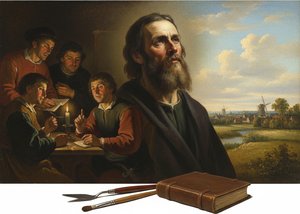
The Florentine Naturalist
Born in Florence in 1610, Orazio Fidani emerged from a city already steeped in the weight of its own artistic traditions. His early years were defined by a long, disciplined apprenticeship in the workshop of Giovanni Bilivert. For twelve years, he remained within that studio, absorbing the nuances of the Florentine style and eventually becoming a trusted collaborator to his master. This period of intense study provided the technical foundation that would support a career spanning both the sacred and the profane.
His brushwork reflected a specific tension common to the Seicento, blending the rigorous naturalism of the era with a certain softness. While the influence of Caravaggio was present in the era's broader movement, Fidani’s work often leaned toward the aesthetic sensibilities of Francesco Furini. He possessed a capacity to navigate between the heavy requirements of religious altarpieces and the more lyrical demands of mythological subjects, a versatility that allowed him to move through various circles of Tuscan art.
A Life of Diverse Subjects
Fidani’s output was marked by a refusal to be confined to a single genre. He moved between the intense spiritualism required by the churches of the Tuscan countryside and the more sensual, decorative themes favored by private collectors. His technical approach often utilized oil on canvas to achieve a specific sense of texture and light.
- Religious compositions, including his depiction of the Vision of St. Philip Neri.
- Mythological narratives, such as his 1652 work Eco and Narcissus.
- Allegorical figures, including his study of a woman at half length.
His professional relationships were as varied as his subject matter. He worked alongside Vincenzo Mannozzi and Felice Ficherelli, and he maintained a friendship with Francesco Furini. This network of artists helped shape his eclectic style, which sought to synthesize the traditions of the Renaissance with the evolving complexities of the Baroque.
The Final Years in Florence
The trajectory of Fidani's life took a quiet turn toward the end of his career. He eventually sought residence at the Florence Charterhouse, a move that coincided with a period of focused production. Even in these later years, his work remained prolific, consisting of both frescoes and canvas paintings. He died in Florence in 1656, leaving behind a body of work that captured the shifting visual language of seventeenth-century Italy.
问答详情
我可以在虚拟博物馆中参观Orazio Fidani的作品吗?
您可以进行虚拟参观:在 Orazio Fidani 的 3D 艺术展厅 页面中,您可以在三维画廊里欣赏艺术家的作品。
如何按特定媒介查找 Orazio Fidani 的所有作品?
若要查找Orazio Fidani在特定媒介下的所有作品,请访问艺术家的所有媒介页面。
Orazio Fidani 的作品传达了怎样的情绪?
艺术家的 情境空间 页面按氛围分类展示了 Orazio Fidani 的艺术作品。