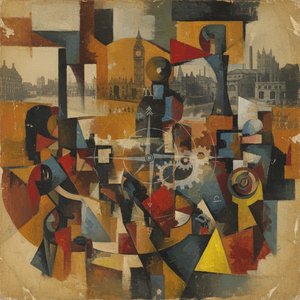
A Multifaceted Visionary
Mina Gertrude Löwy was a true bohemian of the early twentieth century, a woman whose creative spirit refused to be confined to a single medium or discipline. Born in Hampstead, United Kingdom, she emerged as a prominent figure within the first generation of modernists, leaving an indelible mark through her diverse contributions as a painter, writer, poet, playwright, and novelist. Her life was a tapestry of artistic exploration, spanning from the avant-garde movements of her youth to the refined classical traditions of her later years. As a designer of lamps and a versatile creator, she navigated the shifting cultural landscapes of Europe and America with a singular, courageous wit.
Her intellectual and creative journey was deeply intertwined with the most significant voices of her era. The literary world found much to admire in her poetry, which garnered respect from titans such as T. S. Eliot, Ezra Pound, and Gertrude Stein. This connection to the modernist vanguard placed her at the heart of a revolution in language and form, where she could experiment with the boundaries of expression alongside figures like Francis Picabia and William Carlos Williams. Her work often reflected the complexities of identity and the tensions of her upbringing, blending the influences of her Hungarian Jewish heritage and her English Protestant roots into a unique, cosmopolitan perspective.
Artistic Evolution and Neoclassical Grace
While much of her early reputation was forged in the fires of modernism, Dadaism, and Surrealism, Löwy’s later artistic output revealed a profound engagement with classical aesthetics. In her mature period, she demonstrated a remarkable ability to channel the solemnity and precision of the neoclassical style. This transition showcased her technical mastery, particularly in works that utilized the lost wax casting technique to achieve breathtaking detail and dignity. Her ability to move between the experimental energy of the avant-garde and the meticulous realism of classical sculpture speaks to an artist of immense depth and adaptability.
One of her notable achievements in this vein was her work on pieces such as Medal, created in 1975. In this bronze work, she turned her attention to religious iconography, specifically featuring Saint Elizabeth Ann Seton. Through the use of relief sculpture and a carefully applied patina, she captured a sense of reverence and historical continuity. This capacity to imbue metal with spiritual weight—focusing on the symbolic power of textures and forms—highlights a facet of her talent that sought to find permanence and beauty within the enduring traditions of classical art.
Legacy of an Original Spirit
The significance of Mina Gertrude Löwy lies not only in the breadth of her works but in the bravery of her lifestyle. She lived as an original soul, often described by contemporaries as a "passing satellite" that nonetheless sparkled with its own distinct light. Her life was marked by a refusal to adhere to the social constraints of her time, embracing a bohemian existence that allowed her to orbit her own chosen path. Whether through the sharp, modern lines of her designs or the evocative depth of her sculptural reliefs, her legacy remains a testament to the power of an unconstrained creative intellect.
问答详情
如何浏览 Mina Gertrude Löwy 的全部作品?
您可以在 Mina Gertrude Löwy 的 全部作品 页面上浏览其在 本站 上的所有作品。
Mina Gertrude Löwy 的创作时期属于哪个历史阶段?
Mina Gertrude Löwy 的创作活跃于 Modern 时期,这一时期确立了艺术家在艺术史上的地位。
可以按颜色对Mina Gertrude Löwy的作品进行排序吗?
您可以在Mina Gertrude Löwy的色彩索引页面上按色彩探索其作品。