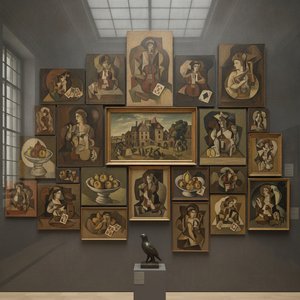
Louis Marcoussis (Ludwik Markus): A Pioneer of Cubist Still Life
Louis Marcoussis, born Ludwik Kazimierz Wladyslaw Markus or Ludwig Casimir Ladislas Markus in Łódź, Poland around 1878 or 1883, stands as a singular figure within the vibrant School of Paris movement. His artistic journey spanned from Kraków Academy of Fine Arts to establishing himself as a respected artist in France, where he embraced Cubism alongside fellow luminaries like Joan Miró and Pablo Picasso. Marcoussis’s distinctive style—characterized by fragmented forms, geometric planes, and muted color palettes—captured the essence of modern life with remarkable sensitivity.- Early Life & Education: Born into a family steeped in artistic tradition, Markus received his formative education at Kraków Academy of Fine Arts, honing his skills in drawing and painting before relocating to Paris in 1906.
- The Influence of Impressionism: Initially drawn to Impressionistic techniques—particularly the exploration of light and atmosphere—Marcoussis swiftly transitioned towards Cubism’s revolutionary approach. This pivotal shift reflected a broader intellectual engagement with avant-garde ideas circulating throughout Europe.
Cubist Exploration & Formal Innovation
Marcoussis's contribution to Cubism is undeniable, though often overshadowed by Picasso and Braque. He meticulously dissected objects into geometric components—cubes, cylinders, and cones—presenting multiple perspectives simultaneously on a single canvas. Unlike his contemporaries who focused primarily on architectural forms, Marcoussis skillfully incorporated musical instruments – notably the cello – into his compositions, conveying not only visual accuracy but also emotional depth. His still lifes, such as “The Bottle Of Whisky And The Pack Of Scaferlati,” exemplify this masterful technique, demonstrating a profound understanding of spatial relationships and tonal harmonies.- Notable Works: Among his most celebrated pieces are "Interior with a Double Bass," which showcases the artist’s ability to capture the subtle nuances of musical performance; “Concert,” depicting musicians engaged in an artistic endeavor; and numerous portraits reflecting his humanist sensibilities.
- Collaboration With Miró: Marcoussis maintained a fruitful creative partnership with Joan Miró, exploring shared interests in Surrealism and experimenting with expressive abstraction. Their collaborative endeavors solidified their position as key figures within the avant-garde landscape of the period.
A Legacy of Quiet Intensity
Despite his relatively modest output compared to Picasso or Braque, Louis Marcoussis’s artistic vision endured. His paintings possess a quiet intensity—a contemplative gaze upon familiar subjects rendered with meticulous detail and imbued with emotional resonance. He skillfully blended Impressionistic sensibilities with Cubist principles, creating artworks that transcend mere representation, inviting viewers into a realm of psychological exploration.Historical Significance & Artistic Impact
Marcoussis’s work represents an important chapter in the history of modern art. His unwavering commitment to Cubism—particularly his focus on musical instruments—challenged conventional artistic conventions and contributed to the development of abstract expressionism decades later. Today, Louis Marcoussis's paintings continue to inspire artists and scholars alike, cementing his place as a pivotal voice within the School of Paris and a testament to the enduring power of visual art to convey profound human experience.问答详情
Louis Marcoussis 属于哪些艺术流派?
您可以在艺术家的 全部流派 页面中查看 Louis Marcoussis 所属的艺术流派,该页面按流派对作品进行了分类。
我可以在虚拟博物馆中参观Louis Marcoussis的作品吗?
您可以进行虚拟参观:在 Louis Marcoussis 的 3D 艺术展厅 页面中,您可以在三维画廊里欣赏艺术家的作品。
Louis Marcoussis 的创作时期属于哪个历史阶段?
Louis Marcoussis 的创作活跃于 Modern 时期,这一时期确立了艺术家在艺术史上的地位。
我可以通过色谱来探索 Louis Marcoussis 的作品吗?
Louis Marcoussis 的 色彩索引 页面按色彩对艺术家的作品进行了分类整理。