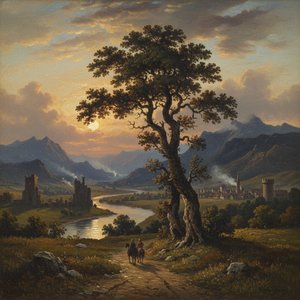
A Priest’s Vision: The Life and Landscapes of Laurent Guétal
Laurent Guétal, a name perhaps less familiar than some of his contemporaries, nevertheless occupies a significant place in the history of French landscape painting. Born on December 12th, 1841, in Vienne, France, Guétal’s life was an intriguing duality – that of a devoted Catholic priest and a passionate artist deeply connected to the natural world. This unique combination profoundly shaped his artistic vision, imbuing his canvases with a sense of reverence and meticulous observation. He passed away on February 18th, 1892, in Grenoble, leaving behind a legacy of evocative depictions of the Savoy region and the French Alps that continue to captivate viewers today. His story is one of quiet dedication, artistic evolution, and a profound love for his homeland.
Early Life and Formation: Faith and Artistic Inclination
Guétal’s path wasn't solely dedicated to art from the outset. Ordained as a priest in 1862, he spent the majority of his life within the walls of the Petit Séminaire of Rondeau, near Grenoble. This seemingly restrictive environment, however, proved fertile ground for artistic development. The surrounding landscapes – the dramatic peaks of the Alps, the serene valleys of Savoy – became his primary source of inspiration. He wasn’t a detached observer; he *lived* within this scenery, experiencing its changing moods and subtle nuances firsthand. While details about his formal art training remain scarce, it is known that Jean Achard exerted a significant influence on his early style. Achard, a prominent figure in the Barbizon school, encouraged a direct engagement with nature, emphasizing plein air painting and realistic representation. Guétal initially embraced this approach, but gradually evolved towards a more refined and detailed technique, characterized by precise rendering of light and shadow and an almost photographic accuracy.
The École Dauphinoise and Artistic Identity
Guétal’s artistic journey led him to become one of the founding members of the École dauphinoise, a school of landscape painters dedicated to capturing the beauty of the Dauphiné region in southeastern France. Alongside artists like Ernest Victor Hareux and Charles Bertier, he sought to portray the unique character of this mountainous terrain, moving beyond idealized depictions towards a more authentic representation of its rugged grandeur. The École dauphinoise distinguished itself through its commitment to *local* subject matter and a shared aesthetic sensibility that emphasized clarity of atmosphere and meticulous detail. Guétal’s work exemplifies these qualities; his paintings are not merely representations of landscapes but rather intimate portraits of specific places, imbued with a sense of personal connection and emotional resonance. He was a regular exhibitor at the Salon in Paris from 1882 to 1889, gaining recognition for his detailed views of Savoy and the Alps.
Major Achievements and Critical Reception
Guétal’s artistic breakthrough came with paintings like “Lake Eychauda” and “Rochers à La Bérarde. Etude”. These works showcase his mastery of light and atmosphere, capturing the ethereal beauty of the alpine environment. “Lac de l'Eychauda”, in particular, garnered significant acclaim at the 1886 Salon, earning him an award and selection for display at the prestigious Exposition Universelle (1889). This painting, now housed in the Musée de Grenoble, exemplifies his ability to convey both the majesty and tranquility of nature. His native town also cherishes “The End of the World at Allevard”, held within the Musée des beaux-arts et d'archéologie de Vienne. While he didn’t achieve widespread fame during his lifetime, Guétal was respected by his peers and appreciated for his technical skill and dedication to portraying the landscapes of his region.
Legacy and Historical Significance
Laurent Guétal’s legacy lies in his ability to seamlessly blend artistic talent with a deep spiritual connection to nature. He wasn't simply painting what he saw; he was conveying *how* he felt about it, imbuing his canvases with a sense of reverence and emotional depth. His work represents a significant contribution to the École dauphinoise and provides valuable insight into the landscape traditions of 19th-century France.
His paintings offer a glimpse into a specific time and place, capturing the beauty of Savoy and the Alps before widespread industrialization.
He demonstrated a commitment to realistic representation while also infusing his work with personal emotion and spiritual sensibility.
Today, his works are increasingly recognized for their technical skill, atmospheric depth, and enduring beauty, ensuring that the vision of this priest-artist continues to inspire and captivate audiences.
Explore the captivating world of Paul Huet (1803-1869), a master of French Romantic landscape painting. Discover his influence on Barbizon & Impressionism, and browse high-quality reproductions at OriginalUniqueArt.
Immerse yourself in the raw power of Realism with our curated guide to the top 25 Gustave Courbet artworks. From iconic landscapes to profound portraits, explore the stories behind these masterpieces and find museum-quality reproductions for your decor. Discover all on OriginalUniqueArt.com.