A Life Forged in Motion
Born in the vibrant landscape of Temesvár in 1808, the life of Karoly Brocky—often known to the wider world as Charles Brocky—was far from a conventional path of academic stability. The son of a hairdresser, his early years were marked by the transient rhythms of the stage, having joined a troupe of strolling actors to sustain himself in his youth. This period of wandering likely imbued his later works with a profound understanding of human drama and character. His artistic metamorphosis truly began when he found refuge in the free drawing schools of Vienna, followed by rigorous training at the prestigious École du Louvre in Paris. These formative travels through Europe’s great cultural hubs allowed him to absorb a diverse palette of influences, transforming a young wanderer into a master of the brush.Bridging the Baroque and the Romantic
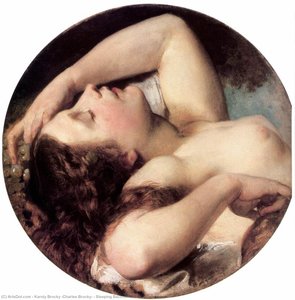
Brocky’s artistry stands as a remarkable bridge between two monumental eras: the dramatic grandeur of the Baroque and the tender emotionalism of the Romantic movement. He possessed a rare ability to marry the meticulous, chiaroscuro-driven techniques of masters like Rembrandt and Caravaggio with the burgeoning sensitivity of the nineteenth century. His brushwork, while deliberate and precise, maintained a fluid grace that captured the psychological depth of his subjects. In his portraits, one finds not merely a likeness, but an exploration of the soul. This mastery is particularly evident in his use of light and shadow to sculpt form and evoke mood, creating compositions that feel both timelessly classical and intensely personal. He excelled at capturing the delicate interplay of light upon skin and fabric, a hallmark of the Baroque aesthetic adapted for a new, more emotive age.The Echo of Intimacy and Emotion
The legacy of Brocky is best preserved in the quiet, evocative moments captured on his canvases. His works often transcend simple genre painting to touch upon the universal experiences of love, motherhood, and devotion. Through his ability to render everyday life with such reverence, he solidified his place as a significant figure in Hungarian art history.Notable examples of his enduring mastery include:
- Mother and Child: A poignant 1846 masterpiece that showcases his skill in rendering soft textures and tender, intimate connections through a delicate play of light.
- Does He Love Me: A piece that exemplifies his ability to weave narrative tension and emotional ambiguity into a single, captivating scene.
- Self-Portrait: A testament to his technical precision and his capacity for capturing the human form with both realism and expressive nuance.
问答详情
我可以在其所有作品中研究 Károly Brocky 对色彩的运用吗?
Károly Brocky 的 色彩基因 展示了该艺术家作品的色彩特征。
可以按颜色对Károly Brocky的作品进行排序吗?
Károly Brocky 的 色彩索引 页面按色彩对艺术家的作品进行了分类整理。
是否有关于Károly Brocky所创作的所有主题的概览?
您可以在Károly Brocky的主题索引页面上,按主题探索其作品。
Károly Brocky 的哪些作品浏览量最高?
有关 Károly Brocky 作品的统计数据,请参阅艺术家的 统计数据 页面。