The Studio and the Line
In the quiet corners of Madrid, the hand of Juan Antonio de Ribera moved with the discipline of the classical tradition. Born in 1779, he learned to see through the eyes of those who came before him, studying under Francisco Bayeu and Jacques-Louis David. These teachers brought a certain clarity to his work, a way of defining form that relied on structure rather than ornament. His brush followed the paths laid down by the Neoclassical style, focusing on the weight of figures and the stillness of a moment captured.
His training was not merely about technique but about a specific way of observing the world. From David, he inherited a sense of order. From Bayeu, a connection to the Spanish tradition. This foundation allowed him to move between the rigid demands of historical subjects and the softer requirements of portraiture.
Subjects and Shadows
The works left behind by Ribera show a preoccupation with certain themes that anchor his identity as a painter. He often turned toward the allegorical, using figures to represent larger concepts like the seasons or the dawn. In 1819, he produced pieces such as Allegory of Summer and Allegory of Dawn, where the light seems to settle on the skin of his subjects with a deliberate, unhurried touch.
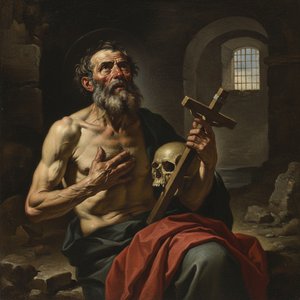
He also looked backward to classical history and religious narratives. His 1806 painting, Cincinnatus abandons the Plough to dictate Laws to Rome, speaks to a fascination with duty and the weight of leadership. There is a similar gravity in his 1819 work, Wamba renouncing the Crown. Even when working from the compositions of others, such as his 1808 rendition of The Last Communion of Saint Jerome after Domenichino, he maintained a focus on the physical presence of the figures.
A Life in Madrid
Ribera’s life remained centered in Madrid, where he lived until his death in 1860. His career was marked by his involvement with established circles, including his membership in the Accademia di San Luca. This connection to formal institutions suggests a man who understood the importance of lineage and the continuity of craft.
His influence extended through his students, such as Ignacio Calles Olasolo, ensuring that the methods he practiced continued in the hands of others. He did not seek to overturn the world but to record it with a steady, observant eye, leaving behind a body of work defined by its adherence to the classical principles of his era.
问答详情
目前目录中共有多少件 Juan Antonio de Ribera 的作品可供浏览?
您可以在 全部作品 页面浏览由 Juan Antonio de Ribera 创作的 6 件作品 件作品。
Juan Antonio de Ribera 的创作时期属于哪个历史阶段?
Juan Antonio de Ribera 的创作活跃于 19th Century 时期,这一时期确立了艺术家在艺术史上的地位。
Juan Antonio de Ribera 的艺术生涯是如何划分为不同时期的?
Juan Antonio de Ribera 的艺术生涯在 艺术历程 页面上按时期逐一展开:以横向时间轴的形式呈现作品,并按创作时期划分为不同的篇章。
在哪里可以找到关于Juan Antonio de Ribera作品的相关统计数据?
Juan Antonio de Ribera 拥有一个 统计数据 页面,其中展示了该艺术家在 本站 上的作品统计数据。