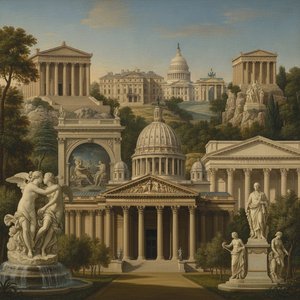
The Architect of Light: The Life and Legacy of Joseph Nicéphore Niépce
In the grand tapestry of human creativity, there are moments when the very nature of perception is irrevocably altered. For Joseph Nicéphore Niépce, this transformation did not occur through the delicate application of oil to canvas or the sculpting of marble, but through a profound mastery of light and chemistry. Born in 1765 in Chalon-sur-Saône, France, Niépce was a man of science whose intellectual curiosity bridged the gap between the physical laws of the universe and the ephemeral beauty of the visual world. While history often remembers him as an inventor, his true contribution lies in his role as the progenitor of photography—a medium that would eventually redefine how humanity documents existence itself.
Niépce’s journey was one of relentless experimentation, fueled by a scientific rigor inherited from his upbringing and a deep-seated desire to capture the intangible. His early life was marked by the pursuit of mathematical and experimental excellence, a path shaped by his studies at Angers Cathedral School. Alongside his brother Claude, Niépce embarked on ambitious endeavors that sought to harness natural forces for practical use. Their collaborative work on the Pyréolophore, one of the world's earliest internal combustion engines, demonstrated a visionary understanding of energy and motion. Yet, it was in the quiet, patient observation of light hitting a surface that Niépce found his most enduring calling.
The Birth of Heliography and the First Permanent Image
The development of heliography—literally "sun drawing"—represented a monumental leap in the history of art and science. Unlike the fleeting images produced by the camera obscura, which required an artist's hand to trace what was seen, Niépce sought a way to make the light itself do the work. Through painstaking trials with bitumen of Judea, a light-sensitive substance, he discovered that certain surfaces could retain the shadows cast by the sun. This process was not merely a technical achievement; it was a philosophical revolution. It suggested that reality could be etched onto a medium without the mediation of human interpretation, creating a direct, unadulterantly honest link between the subject and the viewer.
The most iconic fruit of this labor is the View from the Window at Le Gras. Created in the mid-1820s, this image stands as the oldest surviving photograph in existence. Though grainy and hauntingly abstract to the modern eye, it possesses a profound emotional weight. It is a window into a lost moment, a frozen fragment of the French landscape that has endured for nearly two centuries. In this single, primitive exposure, we see the dawn of a new era where time could be captured, preserved, and revisited, forever changing the relationship between memory and the visual image.
A Lasting Impression on the Artistic Horizon
The historical significance of Niépce cannot be overstated. While his name is sometimes overshadowed by later figures like Louis Daguerre, the foundation upon which all subsequent photographic art was built was laid by his hands. His work provided the essential chemical and conceptual framework that allowed photography to evolve from a scientific curiosity into a globally recognized fine art form. He taught us that light could be a medium, that shadows could hold meaning, and that the camera could serve as an instrument of truth.
Today, Niépce’s legacy is felt every time a shutter clicks or a digital sensor captures a scene. His life serves as a testament to the power of interdisciplinary thinking—the idea that the boundaries between science and art are often illusory. Through his dedication to understanding the mechanics of light, he gifted humanity with a new way to see, ensuring that the fleeting beauty of the world could be held in our hands long after the sun has set.
问答详情
是否有关于 Joseph Nicéphore Niépce 的生平年表?
Joseph Nicéphore Niépce 的 艺术历程 是一个随滚动条变化的艺术时间轴,按创作时期进行章节划分,并按时间顺序呈现艺术家的作品。
哪里可以浏览Joseph Nicéphore Niépce的所有作品?
您可以在 Joseph Nicéphore Niépce 的 全部作品 页面上浏览其在 本站 上的所有作品。
Joseph Nicéphore Niépce 属于哪些艺术流派?
您可以在艺术家的 全部流派 页面中查看 Joseph Nicéphore Niépce 所属的艺术流派,该页面按流派对作品进行了分类。