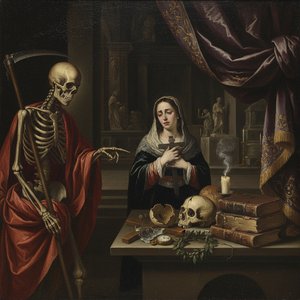
A Lithuanian Soul Rooted in Bolivian Landscape
Jonas Rimša, a name that resonates with the profound depth of the Lithuanian diaspora, was an artist whose life story reads like an epic odyssey of cultural discovery and artistic resilience. Born in 1903 in Svetasiai, Lithuania, his early years were shaped by the rich heritage of the Suvalkija region. Though he initially followed a path dictated by familial duty—graduating from a prestigious sewing school in Vienna—his heart remained tethered to the canvas. This internal tug-of-war between obligation and passion eventually gave way to an unyielding pursuit of aesthetic truth, leading him far from his Baltic roots toward the vibrant landscapes of South America and the tropical allure of the Pacific.
His artistic formation was a tapestry woven from the finest European traditions. Under the tutelage of masters such as Pius Weloński in Warsaw, Antonin Mercié at the École nationale supérieure des Beaux-Arts in Paris, and Konstanty Laszczka at the Cracow Academy of Fine Arts, Rimša absorbed the essence of Impressionism and Post-Impressionism. These formative years provided him with a sophisticated technical foundation, yet it was his later travels that would truly define his creative voice. As he moved through Argentina, Bolivia, and Peru, his style underwent a remarkable metamorphosis. He transitioned from the structured realism influenced by the Spanish school to a more expressive, symbolic language that sought to capture the very spirit of the indigenous peoples and their ancestral traditions.
The Spirit of the Andes and the Gauguinesque Vision
Rimša’s connection to Bolivia was not merely professional but deeply spiritual. In the city of Sucre, he became a pillar of the local art community, establishing schools that nurtured a new generation of talent known as “Rimša’s Group.” His devotion to the region went beyond the classroom; he was a tireless advocate for his students, often personally funding their journeys to Europe to refine their crafts. This commitment to cultural enrichment earned him the highest civilian distinction in Bolivia, the prestigious Cóndor de los Andes award, and the profound honor of being named an Honorary Citizen of Bolivia.
Thematically, Rimša’s work is a breathtaking exploration of life, tradition, and nature. He found a deep spiritual affinity with the works of Paul Gauguin, particularly in his pursuit of "primitive" beauty. Just as Gauguin sought paradise in Tahiti, Rimša traveled to the Pacific islands in 1966, seeking an earthly Eden. His paintings from this period, such as the evocative In a Garden, reflect a mastery of color and a fascination with graphic ornamentality. Whether depicting the rhythmic vitality of Aymara dancers or the lush, verdant stillness of a tropical garden, his oeuvre is characterized by:
- Vibrant Color Palettes: Using light and hue to evoke emotional resonance and atmospheric depth.
- Cultural Symbiosis: A seamless blending of European Post-Impressionist techniques with the indigenous motifs of Latin America.
- Symbolic Depth: Moving beyond mere representation to capture the soul, customs, and ancient rhythms of the civilizations he encountered.
A Lasting Legacy of Artistic Exchange
The significance of Jonas Rimša lies in his ability to act as a bridge between worlds. He was a painter who refused to be confined by geography or nationality. His life’s work—comprising nearly 1,000 paintings and dozens of solo exhibitions—stands as a testament to the power of the artist to transcend borders. Through his eyes, the traditions of the Andes were elevated through a European lens, creating a unique aesthetic that remains vital and moving today. He remains one of the most vivid figures of the Lithuanian diaspora, an artist whose brushstrokes captured the enduring heartbeat of the landscapes and cultures he called home.
问答详情
我可以通过主题来探索 Jonas Rimša 的作品吗?
主题图谱 页面按主题对 Jonas Rimša 的作品进行了分类索引。
可以按心情浏览 Jonas Rimša 的作品吗?
您可以在艺术家 Jonas Rimša 的 心情空间 页面上按心情浏览其作品,该页面根据作品所传达的情绪进行了分类整理。
Jonas Rimša 的创作时期属于哪个历史阶段?
Jonas Rimša 的创作时期处于 Modern 时期。这一时期确立了艺术家在历史中的地位。