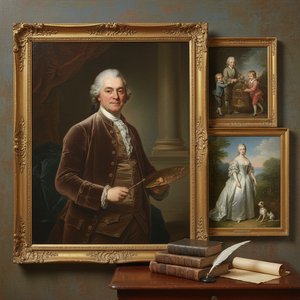
A Pioneer of American Portraiture: The Life and Art of John Greenwood
John Greenwood, a name perhaps less instantly recognizable than his contemporaries Gilbert Stuart or Charles Willson Peale, nevertheless occupies a vital – and often surprisingly radical – position in the history of American portraiture. Born in Boston in 1782, Greenwood’s life unfolded during a period of immense social and political transformation in the young nation, and his art reflects both the aspirations and anxieties of that era. Unlike many artists who sought training abroad, Greenwood was largely self-taught, a fact that contributed to a distinctly American sensibility in his work, free from the rigid constraints of European academic tradition. His father, also named John Greenwood, was a skilled engraver and painter himself, providing young John with an initial grounding in artistic principles, though it was primarily through dedicated observation and practice that he honed his remarkable skills. He initially worked as a house and sign painter to support himself, but quickly demonstrated a talent for capturing likenesses that would propel him into the world of portraiture.Breaking Conventions: Greenwood’s Unique Style
Greenwood's artistic approach was characterized by an unusual degree of realism, bordering on what some contemporaries found unsettlingly direct. He eschewed the flattering idealizations common in portraits of the time, instead presenting his subjects with a stark honesty that revealed their individual character – flaws and all. This commitment to verisimilitude wasn’t merely technical; it was deeply connected to his democratic ideals. Greenwood believed in portraying people as they *were*, not as they wished to be seen, a revolutionary stance for an era still grappling with social hierarchies. He became particularly renowned for his depictions of children, capturing their fleeting expressions and innocent vulnerability with extraordinary sensitivity. His technique involved meticulous layering of paint, creating textures that conveyed the softness of skin or the sheen of fabric. He was known to work directly from life, often spending extended periods observing his sitters in natural light, a practice that contributed to the remarkable vitality of his portraits. This dedication to capturing authentic detail set him apart and garnered both praise and criticism; some found his realism too blunt, lacking the polish they expected from a gentleman’s portrait.A Portraitist of Prominent Americans
Greenwood's career flourished in the decades following the War of 1812. He established studios in Boston and New York, attracting a clientele that included some of the most prominent figures of the era. Among his most celebrated works are portraits of President James Monroe, John Adams, and numerous members of influential families across New England and beyond. His portrait of *President Monroe* (1823) is particularly noteworthy for its dignified yet approachable depiction of the statesman, capturing a sense of both power and humility. He also painted several self-portraits throughout his life, offering valuable insights into his own evolving artistic style and personal identity. These self-portraits reveal a man keenly aware of his place in the burgeoning American art world, and determined to forge his own path. Beyond portraits of political leaders, Greenwood’s work provides a fascinating glimpse into the lives of ordinary Americans – merchants, lawyers, and families – offering a more nuanced understanding of society during this period.Influences and Legacy
While largely self-taught, Greenwood was undoubtedly aware of European portraiture traditions through engravings and reproductions circulating in America. He admired the work of artists like Thomas Gainsborough and Joshua Reynolds, but he consciously rejected their emphasis on idealized beauty and aristocratic elegance. His primary influence seems to have been a desire to create an authentically American style – one that reflected the nation’s democratic values and its unique social landscape.- His focus on realism paved the way for later generations of American portraitists who sought to capture the individuality of their subjects.
- Greenwood's portraits offer invaluable historical documentation, providing a visual record of prominent Americans during a crucial period in the nation’s development.
- He challenged conventional notions of beauty and representation, advocating for a more honest and democratic approach to portraiture.
问答详情
John Greenwood 属于哪些艺术流派?
您可以在John Greenwood的全部流派页面上,按艺术流派浏览其作品。
是否有关于 John Greenwood 的生平年表?
您可以在艺术家的 艺术历程 页面上查阅 John Greenwood 作品的编年史,其作品按创作顺序分章节依次呈现。
如何按特定主题查找 John Greenwood 的作品?
若要按特定主题查找 John Greenwood 的作品,请访问艺术家的 关键词分类 页面,该页面通过关键词对作品进行了分类整理。