The Soul of Monmouthshire
Newport, 1851. A child is born into the landscape that will eventually define his entire creative existence. John Arthur Evans grows up amidst the valleys of Monmouthshire, a place where the geological bones of the earth are visible in limestone cliffs and winding riverbeds. This is not merely a backdrop for him; it is the primary subject of a lifelong devotion.
His early training at the Newport School of Art brings him under the influence of William Dyce. The presence of a painter so closely tied to the Pre-Raphaelite aesthetic introduces Evans to a specific way of seeing. He learns to look for the minute details in a leaf, the precise way light hits a stone, and the heavy atmosphere of a Welsh morning. This training anchors his work in a commitment to observation, even as he moves toward more fluid, impressionistic methods later in life.
A Vision of the Wye Valley
The brushwork shifts. The rigid lines of early training begin to soften into something more atmospheric. Evans turns his attention to the Wye Valley and its tributaries, seeking to capture the shifting moods of the landscape. He does not merely record the topography of places like Pen y Bryn or Raglan Castle; he records how they feel under a heavy mist or in the low light of dusk.
His technique relies on layered brushstrokes and subtle tonal gradations. He manipulates pigments to create a sense of depth, making the viewer feel the moisture in the air or the rough texture of a rock face. In works such as The Naval Temple and the Round House, Kymin, the landscape takes on an impressionistic quality where light and shadow dictate the composition.
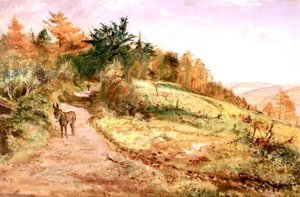
- Donkey on a Path: A quiet study of rural life featuring a donkey and two dogs moving through a wooded corridor.
- Mitchel Troy Stocks: A 19th-century depiction of faith and rural existence within the Welsh landscape.
- Unidentified Landscape: An exploration of the serene beauty found near Rockfield Road.
A Lasting Record
By the time Evans reaches the end of his life in 1941, he has left behind a visual archive of a specific era of Wales. His paintings act as a record of geological formations and the quiet rhythms of the countryside before the modern age transformed them. He captures the stillness of the valleys and the turbulent flow of the rivers with a precision that honors the land's history.
His work remains in public collections across Britain and Wales. These canvases continue to hold the light of the Welsh valleys, preserving the specific character of Monmouthshire for those who look closely at the textures of his oil on canvas. He remains a chronicler of the region, a man who saw the grandeur in the local and the profound in the familiar.
问答详情
可以按心情浏览 John Arthur Evans 的作品吗?
艺术家的 情境空间 页面按氛围分类展示了 John Arthur Evans 的艺术作品。
John Arthur Evans 的创作时期属于哪个历史阶段?
John Arthur Evans 的创作活跃于 19th Century 时期,这一时期确立了艺术家在艺术史上的地位。
如何浏览 John Arthur Evans 的全部作品?
您可以在 John Arthur Evans 的 全部作品 页面上浏览其在 本站 上的所有作品。
可以按媒介类型浏览 John Arthur Evans 的作品吗?
您可以在John Arthur Evans的所有媒介页面上按媒介浏览其作品。