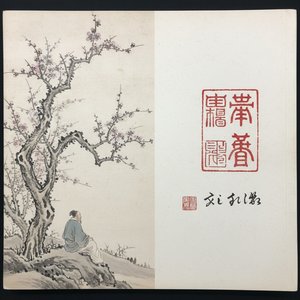
The Life and Career of Jin Tingbiao
Jin Tingbiao, known by his courtesy name Shikui, was a painter of the Qing dynasty who rose from the provincial landscape of Wucheng in Huzhou, located in what is now Zhejiang province. His ascent from his native region to the center of imperial power was marked by a specific talent that caught the attention of the highest levels of the Qing court. By 1757, his skill had secured him a position as a court painter, a role he would maintain until his death in 1767.
His tenure in Beijing was defined by his service to the Qianlong Emperor. This period of professional activity saw him integrated into the formal structures of the imperial academy, where his presence was noted in the official records of the era. His life was closely tied to the rhythms of the court, moving from the local traditions of his home in Wucheng to the rigorous demands of imperial service. He remained an active figure in the capital's artistic circles until 1767, leaving behind a body of work that was deeply intertwined with the tastes and requirements of the emperor he served.
Patrons, Workshop and Imperial Commissions
Jin Tingbiao’s career was defined by his proximity to the center of Qing power. After submitting his Album of Lohan in the Baimiao Style in 1757, he was summoned to the imperial court in Beijing during the Qianlong Emperor's second southern inspection tour. This transition from a regional painter to a court official marked a period of significant imperial patronage. The emperor held his work in high regard, frequently adding his own inscriptions to the paintings, a gesture that integrated the sovereign's hand into the artist's output.
As a prominent member of the Ruyi Institute, the Qing academy of court painters, Jin operated within a sophisticated circle of specialists. His status within this institution was formalized by the granting of a seventh-ranked official title, a distinction that underscored his standing among the imperial painters. His professional life was characterized by high-stakes state assignments that required both technical precision and an understanding of imperial iconography.
In 1760, the Qianlong Emperor issued a significant commission for Jin to produce the First Series of 50 Portraits of Meritorious Officers of the East Turkestan Campaign. These works were executed in a handscroll format. Such assignments placed Jin at the heart of the empire's visual documentation efforts, tasking him with capturing the likenesses of those involved in major military campaigns.
Artistic Style and Signature Motifs
Jin Tingbiao’s brushwork was defined by a technical precision suited to the rigorous demands of the Qing imperial court. He focused his talents on figural and architectural subjects, often translating historical legends into detailed visual narratives. His ability to render the human form allowed him to excel in imperial portraiture, a task requiring both accuracy and a sense of formal dignity. Whether working with ink and color on silk or ink and color on paper, he maintained a consistency of line that made his compositions both structured and legible.
The artist’s repertoire frequently turned toward the spiritual and the legendary. He was particularly noted for his depictions of Buddhist Lohan (Arhat) subjects, where he could balance religious iconography with the nuanced characterization of individual figures. This interest in the human and the divine was matched by his skill in architectural rendering, which provided the necessary setting for his many narrative illustrations. His work reflects the intersection of traditional Chinese ink traditions and the formal requirements of the Ruyi Institute.
Key Works and Imperial Legacy
The breadth of Jin Tingbiao’s output is most clearly measured by the meticulous records of the Qing imperial collection. His presence in the Shiqu baoji is substantial, with 87 of his works documented within the catalogue. The Emperor Qianlong held the artist in high regard, personally composing poems for 78 of these recorded pieces. This level of imperial attention suggests a painter whose technical skill was deeply integrated into the aesthetic preferences of the court. Even after his death in 1767, the Emperor’s interest in his work remained, ordering his tieluo paintings to be remounted from the palace walls to ensure their inclusion in the personal imperial catalog.
Among the surviving examples of his skill is the 18th-century work Landscape in Rain. This piece, along with his 1757 Album of Lohan in the Baimiao Style, illustrates the range of his subject matter, from atmospheric landscapes to the precise demands of Buddhist figural studies. His ability to navigate both the delicate requirements of the Baimiao style and the grander scale of imperial commissions secured his place within the Ruyi Institute. Today, much of his legacy resides in institutional collections, such as the National Palace Museum in Taiwan, where his hand remains a vital part of the historical record of the Qing dynasty.
问答详情
如何按特定主题查找 Jin Tingbiao 的作品?
若要按特定主题查找 Jin Tingbiao 的作品,请访问艺术家的 关键词分类 页面,该页面通过关键词对作品进行了分类整理。
Jin Tingbiao 的艺术风格是如何随时间演变的?
您可以在艺术家的 艺术历程 页面上查阅 Jin Tingbiao 作品的编年史,其作品按创作顺序分章节依次呈现。
Jin Tingbiao 还有哪些别名?
Jin Tingbiao 也以 Shikui 等其他名称为人所知。
在哪里可以按氛围浏览 Jin Tingbiao 的作品?
Jin Tingbiao 的 情境空间 汇集了该艺术家的多件作品,并按心情分类呈现。