Jean-Baptiste Lemoyne II: Life and Legacy
Early Life and Training
Jean-Baptiste Lemoyne II (1704 – 1778) was a celebrated French sculptor, primarily known for his expressive portrait busts and statues. Born in Paris, France, he initially pursued a career as an engraver, studying with Laurent Cars and working for the printseller Gabriel Huquier. This early experience provided him with foundational skills that would later inform his sculptural practice.
Artistic Development and Influences
Lemoyne began creating portraits in both oil and, increasingly, pastel during the 1740s. His career developed somewhat in the shadow of Maurice Quentin de la Tour, considered the master of French pastel portraiture. A notable event illustrating this dynamic occurred at the Salon of 1750, where Lemoyne exhibited a pastel portrait *of* La Tour, only to find La Tour exhibiting his own self-portrait – perhaps a deliberate demonstration of artistic superiority.
- Early Influences: Laurent Cars (engraving), Gabriel Huquier (printselling).
- Key Influence: Maurice Quentin de la Tour (pastel portraiture).
Academic Recognition and Major Works
Lemoyne made his Salon debut with a pastel portrait in 1746 and achieved full membership in the Académie Royale de Peinture et de Sculpture in 1753. His acceptance was secured through portraits of fellow artist Jean-Baptiste Oudry and sculptor Lambert-Sigisbert Adam, both now housed at the Louvre Museum.
- Notable Sculptures:
- Portrait bust of Robbé de Beauveset (1765)
- Hygie, déesse de la santé
- Mademoiselle Dangeville as Thalia (1771)
- Bust of Mademoiselle Clairon (1761)
- Louis XV
Style and Artistic Characteristics
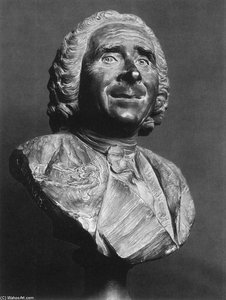
Lemoyne’s work is characterized by a remarkable ability to capture the personality and likeness of his sitters. His portrait busts, in particular, are noted for their realism, theatricality, and attention to detail. He skillfully blended elements of Baroque drama with the emerging Neoclassical aesthetic, creating sculptures that were both emotionally engaging and technically refined.
Travels and Later Life
After 1779, Lemoyne ceased exhibiting at the Paris Salons but continued to receive commissions. His clientele reveals extensive travel throughout France – including Orléans, Toulouse, Bordeaux, and Lyon – and potentially even further afield, with possible visits to Turin, Rome, Spain, Hamburg, Poland, Russia, and England.
He died in Amsterdam in 1778, largely unknown according to some biographical accounts. Despite this relative obscurity at the end of his life, Lemoyne’s contributions to French sculpture remain significant.
Historical Significance
Jean-Baptiste Lemoyne II occupies an important position in the transition from the Rococo to Neoclassical styles. His portrait busts provide valuable insights into 18th-century French society and artistic tastes, and his technical skill continues to be admired by scholars and art enthusiasts alike. He represents a pivotal figure in the development of sculptural portraiture during a period of significant cultural change.
问答详情
如何按特定主题查找 Jean Baptiste Ii Lemoyne 的作品?
Jean Baptiste Ii Lemoyne 的 按关键词检索 页面通过关键词对艺术家的作品进行了分类。
我可以在虚拟博物馆中参观Jean Baptiste Ii Lemoyne的作品吗?
您可以在Jean Baptiste Ii Lemoyne的3D 博物馆页面中,通过3D展厅欣赏其艺术作品。
可以按媒介类型浏览 Jean Baptiste Ii Lemoyne 的作品吗?
您可以在Jean Baptiste Ii Lemoyne的全部媒介页面上按媒介浏览其作品。