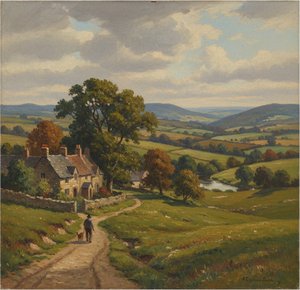
Howard Gull Stormont, a name perhaps less celebrated than some of his contemporaries, nevertheless occupies a significant niche within the pantheon of British landscape painters. Born in 1859 and passing away in 1935, Stormont dedicated his life to capturing the serene beauty of East Sussex, particularly its ancient castles and idyllic rural scenes. His work evokes a sense of quiet contemplation, a gentle immersion into the charm of the British countryside that resonates even today. While biographical details remain somewhat sparse, the paintings themselves speak volumes about a man deeply connected to his surroundings and possessed of a keen eye for light and atmosphere. He often painted alongside his wife, Mary Elizabeth Stormont (née Sapsworth), herself a notable artist who played an important role in establishing the Rye Art Club. Their shared passion for art created a vibrant artistic hub in Rye, attracting fellow painters and fostering a community spirit that enriched their creative endeavors.
Early Influences and Artistic Development
Stormont’s artistic journey unfolded during a period of transition in British painting. The rigid academic styles were gradually giving way to the more expressive approaches of Impressionism and Post-Impressionism. While not strictly adhering to any single school, Stormont absorbed elements from both traditions. His early works demonstrate a meticulous attention to detail reminiscent of Victorian landscape painting, yet they also hint at a growing interest in capturing fleeting moments of light and color. The influence of the Barbizon School, with its emphasis on plein air painting and realistic depictions of nature, is discernible in his compositions. He favored a muted palette, often employing soft greens, browns, and grays to convey the subtle nuances of the Sussex countryside. His subject matter initially focused on detailed studies of castles like Camber Castle, rendered with historical accuracy and a romantic sensibility. Over time, however, his style evolved towards a looser, more impressionistic approach, prioritizing atmosphere and emotional impact over precise representation.
The Charm of East Sussex: A Recurring Motif
East Sussex became the defining subject of Stormont’s oeuvre. He was captivated by the region's unique blend of natural beauty and historical significance. The crumbling ruins of castles like Camber Castle served as powerful symbols of time, memory, and the enduring power of nature. His paintings are not merely depictions of these landmarks; they are evocative interpretations that capture their atmosphere and emotional resonance. Beyond the castles, Stormont found inspiration in the rolling hills, quaint villages, and picturesque cottages of the Sussex countryside. He skillfully portrayed the changing seasons, capturing the golden light of autumn, the vibrant hues of spring, and the tranquil stillness of winter. His work often features figures subtly integrated into the landscape, adding a human element to his serene scenes. Paintings like “Rouen, France” suggest occasional forays beyond Sussex, but it was the East Sussex landscapes that consistently drew him back, becoming the hallmark of his artistic style.
Legacy and Historical Significance
Although Stormont may not be a household name, his work holds an important place in the history of British landscape painting. He represents a bridge between the Victorian tradition and the more modern approaches of the early 20th century. His paintings offer a valuable glimpse into the changing face of the Sussex countryside during this period, documenting its beauty and preserving its historical landmarks for posterity. The founding of the Rye Art Club alongside his wife, Mary Stormont, further cemented his legacy as a champion of local art and community engagement. Mary’s own artistic achievements and her dedication to promoting art through exhibitions and education ensured that their shared vision continued long after Howard's death in 1935. Today, Stormont’s paintings are appreciated for their serene beauty, technical skill, and evocative portrayal of the British countryside. His work continues to inspire artists and captivate viewers with its timeless charm.
Notable Subjects: Castles of East Sussex (Camber Castle), rural scenes, cottages, figures in landscapes.
Further Research: Explore the works of Mary Elizabeth Stormont and the history of the Rye Art Club to gain a deeper understanding of Howard Gull Stormont’s artistic context.
Explore the captivating landscapes & portraits of Brian Hatton (1887-1916), a promising British artist lost too soon. Discover his unique style, Herefordshire roots, and lasting legacy in early 20th-century art.