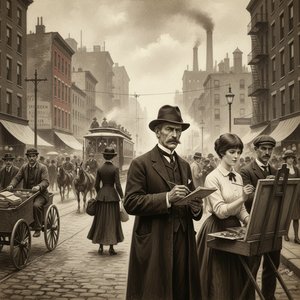
A Life Etched in Likeness: The Story of Henry Ulke
Henry Ulke, a name often whispered alongside the great figures he immortalized on canvas, was more than just “The Painter of Presidents.” Born Titus Ulke in 1821, his journey from German origins to becoming a celebrated portraitist in Washington D.C. is a compelling narrative of artistic dedication interwoven with an unexpected passion for the natural world. While history remembers him primarily for capturing the visages of Abraham Lincoln and Edwin Stanton, a deeper exploration reveals a man whose life was as richly detailed as the brushstrokes that defined his legacy. Ulke’s early life remains somewhat shrouded in mystery; details are scarce regarding his initial artistic training. However, it is known he immigrated to the United States, settling initially in New York before gravitating towards the political heart of the nation – Washington D.C. This move proved pivotal, placing him at the epicenter of a rapidly changing America and offering access to the very individuals who would become his most iconic subjects. He quickly established himself as a skilled portraitist, gaining favor amongst politicians and dignitaries seeking to preserve their image for posterity.The Brushstrokes of Power: Ulke’s Portraiture
Ulke's artistic style can be characterized by a meticulous realism tempered with a subtle sensitivity. He wasn’t interested in flamboyant displays of technique or abstract interpretations; instead, he focused on capturing the *essence* of his sitters – their character, intellect, and the weight of their responsibilities. His portraits weren’t merely representations of physical appearance but psychological studies rendered in oil paint. This approach is particularly evident in his depictions of Abraham Lincoln. Ulke painted several versions of the 16th President, each offering a unique glimpse into Lincoln's evolving persona during the tumultuous years of the Civil War. These were not idealized images; they showed a man burdened by immense pressure, yet radiating an inner strength and profound empathy. The portrait commissioned for the Old Executive Office Building is perhaps his most famous, showcasing Lincoln with a quiet dignity that resonates even today. Beyond Lincoln, Ulke’s portrait of Edwin Stanton, Secretary of War during the Civil War, stands as another testament to his ability to convey power and authority through subtle nuances of expression and composition. He masterfully captured Stanton's stern demeanor and unwavering resolve, creating an image that perfectly embodies the man’s crucial role in securing Union victory.Beyond the Canvas: A Hidden World of Entomology
What sets Ulke apart from many of his contemporaries is his remarkable dual life as a passionate entomologist – a collector and scholar of insects, particularly beetles. This seemingly disparate pursuit wasn't merely a hobby; it was a deeply ingrained fascination that consumed much of his free time and intellectual energy. He amassed an extraordinary collection, meticulously cataloging and studying thousands of specimens from around the globe.- A Dedicated Collector: Ulke’s home became a veritable museum of entomological wonders, attracting fellow enthusiasts and researchers.
- Scientific Contributions: He published numerous papers on his findings, contributing significantly to the field of beetle taxonomy and distribution. His collection was highly regarded within scientific circles.
- A Parallel Passion: The precision and attention to detail required in both portraiture and entomology suggest a common thread – a deep appreciation for observation and accurate representation.
Legacy and Historical Significance
Henry Ulke died in 1910, leaving behind a rich artistic legacy and an invaluable scientific collection. His portraits offer more than just historical documentation; they provide intimate glimpses into the lives of pivotal figures who shaped American history. He wasn’t simply recording appearances; he was capturing moments in time, preserving the spirit of an era on canvas. His work serves as a powerful reminder of the human cost of leadership and the enduring strength of the American ideal. The fact that his paintings continue to be studied and admired today is testament to their artistic merit and historical significance. Ulke’s story also highlights the often-overlooked passions that lie beneath the surface of public personas, revealing a man whose dedication extended far beyond the realm of art into the fascinating world of natural science. He remains a compelling figure – “The Painter of Presidents,” yes, but also a dedicated scholar, a meticulous observer, and a testament to the power of lifelong learning.问答详情
可以按心情浏览 Henry Ulke 的作品吗?
您可以在艺术家 Henry Ulke 的 心情空间 页面上按心情浏览其作品,该页面根据作品所传达的情绪进行了分类整理。
Henry Ulke 的艺术风格是如何随时间演变的?
Henry Ulke 的 艺术编年史 是一个随滚动条变化的艺术时间轴,按创作时期进行章节划分,并按时间顺序呈现艺术家的作品。
在哪里可以按色调浏览 Henry Ulke 的作品?
按色调分类 页面按色调将 Henry Ulke 的艺术作品进行了分类。