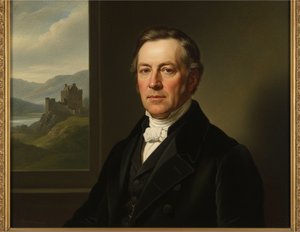
A Legacy of Light and Line: The Life of Henry Howard
Born in the vibrant heart of London in 1769, Henry Howard emerged as a distinguished figure within the prestigious circles of British portraiture and history painting during the Regency era. His journey into the world of fine art began with formal instruction under the painter Philip Reinagle, a mentorship that laid the essential groundwork for his technical mastery. As a student at the Royal Academy Schools, Howard’s precocious talent was quickly recognized; he earned both a silver medal for drawing from life and a gold medal for historical painting, specifically for his evocative work Caractacus Recognising the Dead Body of his Son. This early success signaled the arrival of an artist capable of blending the rigorous demands of academic precision with a profound, narrative-driven soul.
The trajectory of Howard’s development was deeply shaped by his travels across the European continent. In 1791, his explorations through Italy, France, and Switzerland provided him with a firsthand encounter with the grandeur of classical antiquity. In Rome, he immersed himself in the study of sculpture under the guidance of masters like John Flaxman. These experiences instilled in him a reverence for the sculptural form and the dramatic potential of mythological themes. This period of wandering was not merely an educational excursion but a spiritual immersion into the Neoclassical ideals that would later define his compositions, allowing him to infuse his canvases with a sense of timelessness and monumental grace.
Mastery of Portraiture and Historical Narrative
Howard’s artistic output was characterized by a remarkable versatility, oscillating between the intimate psychological depth of portraiture and the sweeping drama of historical scenes. While he is celebrated for capturing the likenesses of his contemporaries with meticulous attention to detail, it was his ability to breathe life into legendary narratives that truly set him apart. His fascination with the Etruscan School and the influence of Benjamin West allowed him to explore themes of mythology and literature with a theatrical flair. Whether depicting scenes from Milton’s Paradise Lost or illustrating the works of Alexander Pope, Howard utilized light and shadow to guide the viewer's eye through complex, emotionally charged environments.
His technical prowess extended beyond the brush; Howard was also a gifted draftsman and designer. His contributions to the decorative arts were significant, including designs for Josiah Wedgwood’s renowned pottery, demonstrating his ability to translate fine art principles into functional beauty. This multidisciplinary approach—spanning from large-scale oil paintings to delicate engravings and sculptural studies—reflects an artist who viewed art as a cohesive language of form and light. His work often featured a subtle tonal gradation and a precise command of composition that transformed even the most static subjects into dynamic visual experiences.
Academic Eminence and Lasting Significance
The latter years of Howard’s life were marked by profound institutional importance within the British art world. His ascent within the Royal Academy was both steady and prestigious, moving from an associate member to a full member in 1808. His dedication to the institution was unparalleled; he served as the Secretary of the Academy and eventually held the esteemed position of Professor of Painting at the Royal Academy Schools. Through these roles, Howard did more than just create art—he helped shape the pedagogical standards for the next generation of British painters, ensuring that the traditions of classical training and historical narrative would endure.
Though his name may sometimes be overshadowed by the titans of his era, such as Reynolds or Hogarth, Henry Howard’s contribution to the 19th-century aesthetic remains indelible. His ability to marry the elegance of Neoclassicism with a burgeoning sense of realism allowed him to capture the essence of an era in transition. Today, his works stand as vital historical documents, offering a window into the refined sensibilities and the dramatic imagination of the Regency period. His legacy is found not only in the museums that house his masterpieces but in the very foundation of academic painting he helped to build.
问答详情
如何浏览 Henry Howard 的全部作品?
您可以在 Henry Howard 的 全部作品 页面上浏览其在 本站 上的所有作品。
目前目录中共有多少件 Henry Howard 的作品可供浏览?
您可以在 全部作品 页面浏览由 Henry Howard 创作的 39 件作品 件作品。
Henry Howard 属于哪些艺术流派?
全部流派 页面按艺术流派对 Henry Howard 的作品进行了分类。