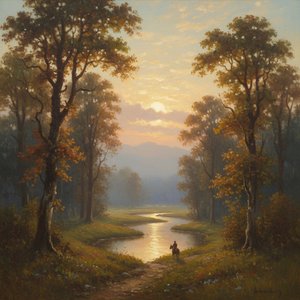
The Quiet Legacy of George Edward Robertson
In the tapestry of late nineteenth and early twentieth-century British art, certain names resonate with a profound, quiet dignity, capturing the essence of an era through subtle observation and technical grace. George Edward Robertson (1864–1926) stands as a testament to this tradition. Though his name may not carry the thunderous fame of the Impressionist masters, his work offers a window into the soul of the period, reflecting a meticulous devotion to capturing the light and atmosphere of his surroundings. His life, spanning the transformative decades of the late Victorian and Edwardian eras, was marked by a commitment to the fine traditions of British painting, contributing to a visual record that remains preserved in esteemed collections such as the Hartlepool Museums and Heritage Service.
The development of Robertson’s artistry was deeply rooted in the classical foundations of his time. To study his work is to witness a mastery of form and a sensitive approach to the interplay between shadow and illumination. His technique suggests an artist who found profound meaning in the nuances of the natural world, utilizing a palette that could evoke both the warmth of a sun-drenched afternoon and the melancholic stillness of a twilight landscape. This ability to manipulate light allowed him to transcend mere representation, imbuing his subjects with a sense of lived experience and temporal weight.
Artistic Vision and Historical Context
During Robertson's active years, the art world was navigating a complex transition between the rigid academicism of the past and the burgeoning experimentation of modernism. Within this shifting landscape, Robertson maintained a steadfastness in his craft, focusing on the evocative power of the scene. His work often serves as a bridge, connecting the detailed realism of the mid-century with a more atmospheric, emotive sensibility that anticipates the subtle shifts in British landscape painting.
The significance of his contribution lies not only in the individual beauty of his canvases but in their role as historical witnesses. Through his eyes, we perceive:
- Atmospheric Precision: A remarkable ability to capture the specific humidity, light, and air of the British landscape.
- Compositional Harmony: A disciplined approach to structure that guides the viewer's eye through a carefully balanced visual narrative.
- Cultural Resonance: The preservation of a particular aesthetic sensibility that defined the late nineteenth-century British experience.
As we look back upon the career of George Edward Robertson, we find an artist whose work continues to offer solace and beauty. His legacy is found in the quiet moments he immortalized on canvas—moments that, through his skillful hand, have escaped the erosion of time to remain vibrant and deeply moving for contemporary admirers of fine art.
问答详情
我可以通过色调来浏览 George Edward Robertson 的作品吗?
您可以在George Edward Robertson的按色调浏览页面上,按色调浏览其作品。
George Edward Robertson 来自哪里?
George Edward Robertson 出生于 United Kingdom of Great Britain and Ireland。
在哪里可以按时间顺序欣赏 George Edward Robertson 的作品?
您可以在George Edward Robertson的作品时间轴页面上按时间顺序查看其作品。
我可以在虚拟博物馆中参观George Edward Robertson的作品吗?
George Edward Robertson 的 3D 艺术展厅 可以在虚拟三维展厅中欣赏到艺术家的作品。