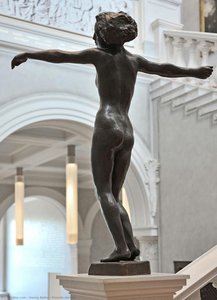
The Sculptural Journey of Georg Kolbe
Georg Kolbe was a German sculptor, painter, draftsperson, etcher, and graphic artist. Born in Waldheim, Germany, his artistic training took him through Dresden, Munich, and Paris. During a stay in Rome, he began sculpting under the technical guidance of Louis Tuaillon. His career saw him join the Berliner Secession in 1905, later departing in 1913 to join the Freie Secession.
A significant breakthrough occurred in 1912 with his sculpture Die Tänzerin. Kolbe also demonstrated a fascination for Asian faces, which led to the creation of a bust and a torso from D. N. Mazumdar. His work was featured in the sculpture event at the 1928 Summer Olympics. Throughout his career, he produced ninety-nine prints, including lithographs and drypoints of dancers and nudes in motion.
Legacy and Recognition
Kolbe's work is held in various international collections, including the Museum of Modern Art in New York, the Moderna Museet in Stockholm, and the Alte Nationalgalerie in Berlin. His studio and sculpture garden in Berlin-Westend now serves as the Georg Kolbe Museum.
His notable works include:
问答详情
Georg Kolbe 还有哪些别名?
Georg Kolbe 也以 George Kolbe, G. Kolbe, Kolbe, جورج كولبي, ゲオルク・コルベ 等其他名称为人所知。
我可以在虚拟博物馆中参观Georg Kolbe的作品吗?
您可以在Georg Kolbe的3D 艺术展厅页面中,通过3D展厅欣赏其艺术作品。
可以按媒介类型浏览 Georg Kolbe 的作品吗?
所有媒介 页面按媒介分类展示了 Georg Kolbe 的作品。