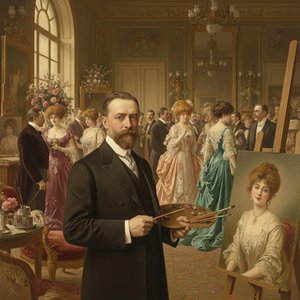
Early Life and Education
- Born: March 19, 1882, Paris, France
- Died: October 18, 1935
- Parents: Marie Barré (daughter of a sculptor) and Jean Lachaise (cabinetmaker who designed furniture for Gustave Eiffel's apartment in the Eiffel Tower).
- Early Training: Studied at the École Municipale Bernard Palissy (age 13) and later at the Académie Nationale des Beaux-Arts (1898-1904) under Gabriel-Jules Thomas.
- Early Career: Worked as a modeler for René Lalique, designing decorative objects.
Move to America and Relationship with Isabel Nagel
- Meeting Isabel: Around 1902/1903 met and fell in love with Isabel Dutaud Nagle, an American woman of French Canadian descent.
- Immigration: In 1906, after working for Lalique to pay for his passage, Lachaise immigrated to Boston, vowing to follow Isabel.
- Early Work in America: Worked as a sculptor's assistant for H.H. Kitson in Boston and later Paul Manship in New York (1912-1921).
- Marriage: Married Isabel Dutaud Nagle in 1917 after her divorce. Lachaise considered Isabel his primary inspiration, referring to her as "Woman."
Artistic Development and Style
- Development of Unique Style: While influenced by European sculpture training, Lachaise developed a distinctive style in America, characterized by robust and voluptuous depictions of the female nude.
- "Woman" as a Theme: His concept of "Woman" evolved into a central theme, representing vitality, fertility, and a force of nature based on Isabel's image.
- Sculptural Characteristics: Lachaise’s nudes were known for their powerful forms, emphasizing breasts, abdomen, thighs, and buttocks with “a rounded voluminousness.”
- Materials: Primarily worked in bronze.
Major Works and Recognition
- Standing Woman (Modeled 1928-30): Considered his most famous work, exemplifies his style of the female nude.
- Portraits: Created portraits of notable figures including John Marin, Georgia O'Keeffe, Marianne Moore, and Lincoln Kirstein.
- Architectural Commissions: His works were chosen for commissions at AT&T Building and Rockefeller Center in New York City.
- Retrospective Exhibition: The Museum of Modern Art held a retrospective exhibition in 1935, the first for any American sculptor.
Historical Significance
- Redefining the Female Nude: Lachaise helped redefine the female nude in American art, moving away from slender depictions towards more robust and sensual forms.
- American Modernism: Played a critical role in the birth of American modernism by pushing boundaries and exploring the human body innovatively.
- Influence: His work influenced subsequent generations of sculptors with his emphasis on form, volume, and emotional expression.
- Legacy: Recognized as "the greatest American sculptor of his time" by *ARTnews*, Lachaise's legacy continues to be celebrated for its contribution to American art history.
问答详情
我可以通过色谱来探索 Gaston Lachaise 的作品吗?
您可以在Gaston Lachaise的色彩索引页面上按色彩探索其作品。
我可以通过主题来探索 Gaston Lachaise 的作品吗?
您可以在Gaston Lachaise的主题索引页面上,按主题探索其作品。
Gaston Lachaise 的创作时期属于哪个历史阶段?
Gaston Lachaise 的创作活跃于 Modern 时期,这一时期确立了艺术家在艺术史上的地位。