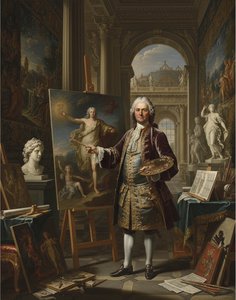
A Legacy of Light and Line
In the vibrant heart of Paris, during the illustrious era of the Sun King, François Verdier emerged as a significant figure within the grand tapestry of French art. As a painter, draftsman, and engraver, his career was deeply intertwined with the prestigious institutions of his time, most notably serving as a student and assistant to the legendary Charles Le Brun. This connection placed him at the very epicenter of the French classical tradition, allowing him to absorb the theatricality and disciplined grandeur that defined the visual culture of the Grand Siècle.
Verdier's early journey was marked by exceptional promise and academic distinction. In 1668, he secured the first prize in drawing at the Royal Academy of Painting and Sculpture, a feat that signaled his mastery over form and line. His pursuit of excellence led him beyond the borders of France; from 1668 to 1771, he resided in Italy at the Medici Villa, an experience that undoubtedly enriched his understanding of classical aesthetics and the profound influence of the Italian masters on the French school.
Mastery of the Baroque Spirit
The work of François Verdier is characterized by a profound engagement with the dramatic possibilities of the Baroque style. He possessed a remarkable ability to manipulate light and shadow, employing chiaroscceuro to breathe life into religious and historical narratives. His compositions often invite the viewer into a psychological drama, where the tension between earthly existence and spiritual resolve is palpable. In masterpieces such as La Tentation du Christ, one can observe his skill in using atmospheric perspective and striking asymmetrical arrangements to direct the soul toward the central figures of his devotion.
His technical repertoire was diverse, spanning from monumental oil on canvas to delicate works on paper. His drawings, often executed in red chalk, black pencil, or ink wash heightened with white, demonstrate a sensitive touch and an ability to capture fleeting emotions. Many of these intimate works, including pieces like Saint Paulin de Nole, have found their way into the permanent collections of the Musée du Louvre, ensuring that his meticulous draftsmanship continues to be studied by generations of art lovers.
Academic Eminence and Lasting Impact
Verdier’s ascent within the French artistic hierarchy was both steady and prestigious. After being admitted to the Academy in 1678, he eventually rose to the rank of Professor by 1684, a testament to his technical authority and pedagogical influence. His recognition was further solidified through the prestigious Prix de Rome, which he won twice—first in 1668 for Première conquête de la Franche-Comté and again in 1671 for Le Roi donnant la paix à l'Europe.
Though sometimes overshadowed by the monumental figures of his era, Verdier remains a vital link in the evolution of French painting and printmaking. His contributions to religious iconography, seen in works like Assomption de la Vierge, reflect the intense emotionality and symbolic depth that defined the period. Through his disciplined approach to engraving and his evocative use of light, he helped sustain the rigorous standards of the Royal Academy, leaving behind a body of work that captures the very essence of French Baroque splendor.
问答详情
是否有François-Alexandre Verdier作品的时间线?
您可以在François-Alexandre Verdier的作品时间轴页面上按时间顺序查看其作品。
是否有关于 François-Alexandre Verdier 的生平年表?
您可以在艺术家的 艺术历程 页面上查阅 François-Alexandre Verdier 作品的编年史,其作品按创作顺序分章节依次呈现。
我可以通过关键词来探索 François-Alexandre Verdier 的作品吗?
您可以通过艺术家关键词分类页面,按关键词探索François-Alexandre Verdier的作品。每个关键词都汇集了相关的艺术品。
是否有François-Alexandre Verdier作品的3D虚拟展厅巡览?
您可以进行虚拟参观:在 François-Alexandre Verdier 的 3D 艺术展厅 页面中,您可以在三维画廊里欣赏艺术家的作品。