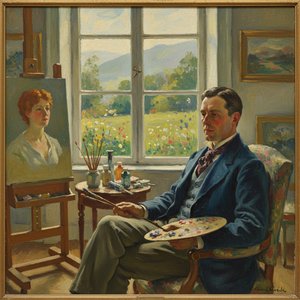
The Elegant Vision of Francis Towne
In the delicate interplay of light and wash that defines the golden age of British watercolor, the name Francis Towne emerges as a figure of profound elegance and stylistic distinction. Born in Iselin in 1739, Towne’s journey from an apprentice in the London coach-painting trade to a recognized master of landscape painting is a testament to the transformative power of artistic devotion. His early life, rooted in the industrious atmosphere of Middlesex, provided him with a foundational discipline that would later manifest in his meticulous approach to color and form. Though he began his career far from the fine arts, his innate talent was quickly recognized; by 1759, he had already secured a design prize from the Society of Arts, signaling the arrival of a significant new voice in the English landscape tradition.
The evolution of Towne’s aesthetic was deeply shaped by his travels, most notably his formative journey to Italy between 1780 and 1781. This period of exploration did more than merely expose him to classical vistas; it allowed him to absorb the nuances of light and the sophisticated techniques of contemporary English watercolorists working abroad. Upon his return, his work began to reflect a unique synthesis of topographical accuracy and a more stylized, almost decorative sensibility. This "flat colourful pattern-making," as art historians have noted, aligned perfectly with the burgeoning tastes of his era, blending the rugged beauty of the British countryside—captured during study trips to Wales and the Lake District—with a refined, rhythmic grace that felt both modern and timeless.
A Legacy Rediscovered
Despite his undeniable skill, Towne’s historical trajectory was one of ebb and flow. During his lifetime, he enjoyed a respectable reputation, though he famously faced the frustration of repeated exclusions from the Royal Academy. Following his death in 1816, his name drifted into a period of relative obscurity, as the shifting tides of art history often overlooked those who did not adhere to the rigid academicism of the succeeding generations. It was not until the early 20th century that a passionate revival brought his genius back into the light. The discerning eye of collectors like Paul Oppé played a crucial role in this resurrection; by recognizing the immense value in Towne’s elegant, early manner, these collectors helped ensure that his masterpieces were preserved rather than lost to time.
Today, the significance of Francis Towne is firmly established within the canon of British art. His works are no longer mere curiosities but are celebrated treasures held in the most prestigious institutions worldwide, including:
- The British Museum, where his technical mastery is studied by scholars of watercolor.
- The Yale Center for British Art, which preserves his contribution to the landscape tradition.
- Private Collections, where his ability to evoke atmosphere through subtle washes continues to captivate enthusiasts.
The enduring appeal of Towne lies in his ability to transcend simple documentation. He did not merely paint landscapes; he composed them. Through a sophisticated use of watercolor, he captured the essence of the Devon countryside and the dramatic peaks of Wales with a sense of poetic structure. His legacy remains a vital chapter in the history of British painting, representing a moment when the landscape became a canvas for both naturalistic observation and exquisite, stylized artistry.
问答详情
哪里可以浏览Francis Towne的所有作品?
您可以在 Francis Towne 的 全部作品 页面上浏览其在 本站 上的所有作品。
Francis Towne 出生于何时何地?
Francis Towne 于 1739 出生于 Exeter。
可以按心情浏览 Francis Towne 的作品吗?
您可以在艺术家 Francis Towne 的 情境空间 页面上按心情浏览其作品,该页面已根据作品所传达的情绪进行了分类整理。