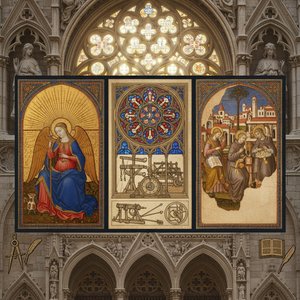
Don Simone Camaldolese: A Florentine Master of Illuminated Manuscripts
Don Simone Camaldolese (c. 1378-1405) stands as a pivotal figure in the artistic landscape of late fourteenth-century Florence, primarily recognized for his exceptional contribution to illuminated manuscripts—specifically the Antiphonary and Gradual—works that exemplify the pinnacle of Florentine book illumination during this period. While biographical details remain scarce, scholars believe he was born in Siena, establishing him firmly within a rich artistic tradition rooted in his hometown’s heritage. His career flourished under the patronage of influential monastic orders, notably Santa Maria degli Angeli, where he honed his skills and developed a distinctive style that would solidify his reputation as one of the most prolific illuminators of his time.- Early Influences & Artistic Training: Camaldolese’s artistic sensibilities were undoubtedly shaped by the prevailing stylistic trends of Siena and broader Tuscan art circles. Evidence suggests he received training within established workshops, absorbing techniques and aesthetic principles characteristic of the era—a period marked by a fervent revival of Byzantine iconography and a growing fascination with naturalistic representation.
- The Camaldolese School & Style: Don Simone’s association with Santa Maria degli Angeli fostered the development of what is known as the Camaldolese school, characterized by its meticulous attention to detail and its masterful execution. His style distinguishes itself through a harmonious blend of Byzantine elegance and Florentine realism—a stylistic fusion that reflects the intellectual currents of his time.
- Notable Works: The Antiphonary & Gradual: Camaldolese’s legacy rests primarily on his monumental illumination projects, most notably the Antiphonary and Gradual. These manuscripts showcase his unparalleled skill in creating intricate initial capitals adorned with elaborate floral motifs and symbolic imagery—a testament to his artistic prowess. Furthermore, his book illustrations are imbued with a profound sense of narrative depth and visual splendor, capturing the spirit of Dante Alighieri’s Divine Comedy.
Technique & Artistic Innovation
Camaldolese's approach to illumination was marked by an unwavering commitment to craftsmanship and innovation. He skillfully employed tempera paint on parchment—a technique favored during the fourteenth century—allowing for vibrant colors and remarkable luminosity. His meticulous attention to detail extended beyond mere pigment application; he painstakingly rendered textures, drapery folds, and facial expressions with astonishing accuracy. Moreover, Camaldolese pushed boundaries in stylistic experimentation, incorporating elements of Byzantine iconography alongside Florentine naturalism—a daring fusion that elevated his work to the highest levels of artistic achievement. The Initial “A” from the Antiphonary (Getty Museum), exemplifies this masterful blend of styles.Historical Significance & Legacy
Don Simone Camaldolese’s contribution to Florentine art transcends mere stylistic innovation; he embodies the spirit of a transformative period in European culture—the Renaissance Proto-Renaissance. His illuminated manuscripts serve as invaluable windows into the intellectual and artistic sensibilities of fourteenth-century Florence, reflecting the humanist ideals that would eventually blossom into the full flowering of the Renaissance. As one of the most prolific illuminators of his time, Camaldolese’s work continues to inspire admiration for its beauty, sophistication, and technical mastery—a testament to his enduring legacy as a Florentine artistic genius.问答详情
在哪里可以按氛围浏览 Don Simone Camaldolese 的作品?
您可以在艺术家 Don Simone Camaldolese 的 心情空间 页面上按心情浏览其作品,该页面根据作品所传达的情绪进行了分类整理。
Don Simone Camaldolese 的出生地和出生年份是?
Don Simone Camaldolese 于 1378 出生于 Florence。
Don Simone Camaldolese 的创作时期属于哪个历史阶段?
Don Simone Camaldolese 的创作时期处于 Renaissance 时期。这一时期确立了艺术家在历史中的地位。