The Romantic Vision of DeWitt Clinton Boutelle
Born in the quiet landscapes of Manchester, Vermont, in 1822, DeWitt Clinton Boutelle emerged as a profound voice within the golden age of American landscape painting. His life and artistry were deeply intertwined with the spirit of the Hudson River School, a movement that sought to capture the divine essence of the New World through a lens of romanticism and meticulous naturalism. As an artist, Boutelle did not merely observe the terrain; he sought to translate the very soul of the American wilderness onto canvas, creating windows into a pristine, untouched era of history.
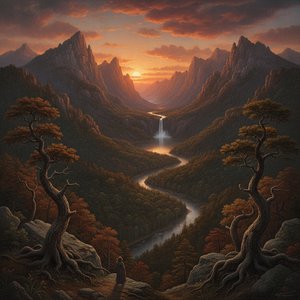
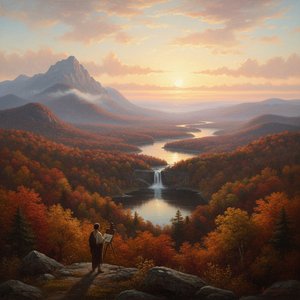
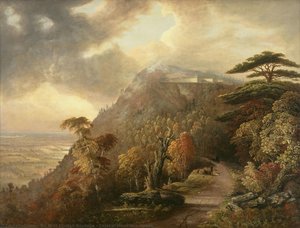
Boutelle’s artistic development was shaped by the sweeping vistas of the Northeast. His works frequently journeyed through the Catskill Mountains, the rugged Adirondacks, and the majestic White Mountains of New Hampshire. Through his brush, these regions were transformed into ethereal realms where light and shadow perform a silent, eternal dance. He possessed a remarkable ability to manipulate color and luminosity, employing techniques that allowed sunlight to filter through dense foliage or shimmer upon the surface of tranquil waterways, thereby imbuing his landscapes with an atmospheric depth that invites the viewer to step directly into the scene.
Mastery of Light and Naturalism
The essence of Boutelle’s technique lies in his profound reverence for detail and his mastery of light. Influenced by the legendary masters of his era, such as Thomas Cole and Asher Brown Durand, Boutelle embraced the Hudson River School's mission to find the sublime within the natural world. His compositions often feature a delicate balance between the monumental and the intimate—where massive, ancient mountains stand guard over a small, winding stream or a hidden valley.
His notable works serve as testament to his technical prowess and emotional sensitivity:
- A Stream in the Rocky Mountains: A breathtaking display of Boutelle’s ability to capture the raw, untamed beauty of mountain watercourses.
- Genesee Scenery: An expansive landscape that celebrates the harmonious relationship between the Genesee River and its surrounding peaks.
- The Last Valley - Paradise Rocks: A masterpiece of light and atmosphere, demonstrating how he used tonal shifts to create a sense of profound peace and spiritual depth.
Legacy and Historical Significance
Though his career flourished during a period of intense national expansion, Boutelle’s work remains anchored in the preservation of a vanishing wilderness. His paintings are more than mere topographical records; they are emotional evocations of a landscape that felt both infinite and sacred. By capturing the serenity of rolling hills and the majesty of granite peaks, he contributed significantly to the American identity, helping to define how a young nation perceived its own vast and beautiful territory.
Today, the legacy of DeWitt Clinton Boutelle lives on through his presence in esteemed collections, such as the Rhode Island School of Design Museum of Art and the USC Fisher Museum of Art. His work continues to resonate with modern audiences, offering a nostalgic and breathtaking glimpse into the romantic heart of the nineteenth-century American landscape.
问答详情
DeWitt Clinton Boutelle 出生于哪个国家和城市?
DeWitt Clinton Boutelle 出生于 United States 的 Troy。
DeWitt Clinton Boutelle 还有哪些别名?
DeWitt Clinton Boutelle 也以 De Witt Clinton Boutelle, D. W. C. Bartelle, Boutelle 等其他名称为人所知。
我可以在其所有作品中研究 DeWitt Clinton Boutelle 对色彩的运用吗?
您可以在DeWitt Clinton Boutelle的色彩基因页面上,深入研究其在本站所列作品中的色彩运用。