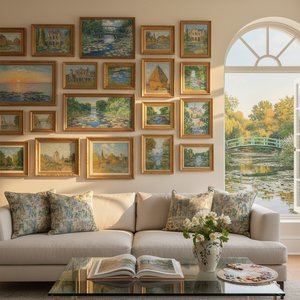
Claude Price: A Vision of Welsh Landscapes and Impressionist Light
Claude Price (1892 – 1983) stands as a quietly significant figure in American art, a master of capturing the evocative beauty of his native Wales through the lens of Impressionism. Often overshadowed by the more celebrated figures of the era—Monet, Renoir, and Whistler—Price nonetheless developed a distinct voice, rooted in both European artistic traditions and the unique character of his homeland. His work isn’t merely depictions of landscapes; they are imbued with a profound sense of atmosphere, memory, and a deep connection to the rhythms of rural life.
Born in 1892 in New York City, Price's early artistic development was shaped by a diverse range of influences. His father, a prominent American Impressionist painter himself, instilled in him a love for color and light from an early age. However, Price’s family relocated to Wales when he was just twelve years old, settling in the small village of Llanarthwaite. This move proved transformative, fundamentally altering his artistic trajectory. The rugged beauty of the Welsh countryside—the rolling hills, dramatic coastlines, and ever-changing skies—became the primary subject of his work, informing a style that blended European techniques with distinctly local sensibilities.
Price’s artistic journey began modestly, initially experimenting with watercolor and sketching. He spent years absorbing the visual language of the Welsh landscape, studying the effects of light on water, stone, and vegetation. His early paintings demonstrate a clear debt to the Impressionists, particularly Monet and Pissarro, evident in his loose brushwork, vibrant color palettes, and focus on capturing fleeting moments of light and atmosphere. However, Price quickly developed his own unique approach, moving beyond mere imitation to create works that possessed a palpable sense of place—a feeling of being truly present within the Welsh landscape.
The Influence of Giverny and European Masters
Following a period of artistic exploration in London, Price made a pivotal decision in 1934: he moved to Giverny, France, the home of Claude Monet. This move proved profoundly influential, providing him with direct access to the master’s studio and allowing him to study his techniques firsthand. Price spent several years immersed in the Impressionist world, absorbing Monet's philosophy of painting “en plein air” – directly from nature – and his masterful manipulation of light and color. He particularly admired Monet’s ability to capture the ephemeral qualities of a scene, conveying not just what he saw but also how it *felt*.
Beyond Monet, Price drew inspiration from other European masters, including Jean-Claude Lorrain, whose mastery of landscape painting—particularly his use of atmospheric perspective and dramatic lighting—influenced Price’s compositions. The influence of Lorrain is particularly evident in Price's later works, which often feature grand vistas and a sense of scale reminiscent of the Baroque painter’s monumental landscapes. However, Price never lost sight of his Welsh roots, skillfully integrating these European influences with his own unique vision.
A Distinctive Style: Wales Through an Impressionist Lens
Price's paintings are characterized by a remarkable sensitivity to light and atmosphere. He was particularly adept at capturing the ever-changing conditions of the Welsh sky—the dramatic cloud formations, the shifting hues of dawn and dusk, and the subtle gradations of color that define the landscape. His brushwork is loose and expressive, conveying a sense of movement and spontaneity. He rarely attempted to render details with photographic accuracy; instead, he focused on capturing the *impression* of a scene—the overall feeling and mood.
A key element of Price’s style is his use of color. He employed a vibrant palette, often layering hues in thick impasto strokes to create a sense of texture and depth. He was particularly skilled at using complementary colors – such as blue and orange – to heighten the visual impact of his paintings. His compositions are typically balanced and harmonious, yet they also possess a dynamic energy, reflecting the vitality of the Welsh landscape.
Notable Works and Legacy
Among Price’s most celebrated works are “The Lonely House” (1945), a haunting depiction of a solitary stone cottage nestled in a remote valley; “View from above the House, Plas yn Rhiw with Porth Neigwl in the Background” (1938), which captures the dramatic coastline of North Wales; and “A Welsh Farm” (1948), a serene portrayal of rural life. These paintings, along with many others, are held in prominent collections across the United States and Europe.
Despite his considerable talent and artistic achievements, Price remained largely unknown during his lifetime. However, in recent decades, there has been a growing appreciation for his work, as scholars and collectors have begun to recognize his unique contribution to American Impressionism. Claude Price’s paintings offer a poignant glimpse into the beauty of Wales—a testament to the power of observation, sensitivity, and artistic vision.
His legacy lies not just in the beauty of his landscapes but also in his quiet determination to forge an authentic artistic voice rooted in both European tradition and the distinct character of his homeland. He remains a vital link between the Impressionist movement and the rich cultural heritage of Wales.
问答详情
Claude Price 的艺术生涯是如何划分为不同时期的?
Claude Price 的艺术生涯在 艺术编年史 页面上按时期逐一展开:以横向时间轴的形式呈现作品,并按创作时期划分为不同的篇章。
目前目录中共有多少件 Claude Price 的作品可供浏览?
您可以在 全部作品 页面浏览由 Claude Price 创作的 15 件作品 件作品。
我可以在其所有作品中研究 Claude Price 对色彩的运用吗?
Claude Price 作品的色彩特征展示在艺术家的 色彩基因 页面上。