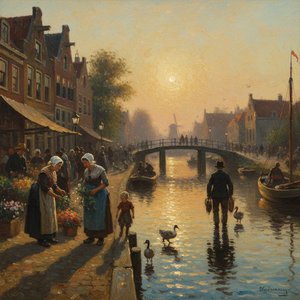
The Legacy of the Smedenstraat
In the narrow streets of Deventer, where the scent of pigment and oil once lingered in the air, the Korteling name was woven into the very fabric of the city's creative life. Born in 1853, Bartus Korteling emerged from a lineage of craftsmen who understood the alchemy of color. His family had established a foundation in the Smedenstraat, where his forefather, Gerhard, spent his days preparing paints by hand and preserving the ancient methods of the trade. This upbringing meant that for Bartus, art was not a distant pursuit but a tangible, daily reality shaped by the textures of raw materials and the discipline of the workshop.
He did not merely inherit a trade; he inherited a way of seeing. While his ancestors focused on the production of the medium itself, Bartus sought to master the application of it. His life was deeply rooted in the local community, a man of the city who moved through its cultural circles with a quiet, steady purpose. He became a figure of influence, not through loud proclamations, but through the steady guidance he offered to those seeking to master the line and the shadow.
A Teacher and a Practitioner
Bartus found his calling in the delicate balance between instruction and creation. He became a teacher of drawing in Deventer, a role that allowed him to shape the hands and eyes of many young talents. His influence was felt in the studios and academies where he imparted the technical rigors of his craft. He possessed a deep understanding of form, a skill honed by a lifetime spent surrounded by the tools of the painter.
His personal work reflected the shifting tides of the era, finding its place within the stylistic echoes of the Hague School. He worked with a precision that spoke of his lineage, yet his hand was his own. His output was characterized by:
- A mastery of draftsmanship that informed his teaching.
- A commitment to the high standards of the Dutch tradition.
- A technical proficiency rooted in the family's history of pigment making.
The Quiet Influence of a Family Line
The significance of Bartus lies in the continuity he provided for the generations that followed. He was a bridge between the old world of the artisan-painter and the modern era of the professional artist. His son, Willem, would eventually take the family's artistic ambitions even further, becoming the first to pursue the life of a full-time artist. This progression was built upon the technical foundations and the local respect earned by Bartus during his long life in the Netherlands.
When he passed away in 1930, he left behind more than just sketches and canvases; he left a legacy of craftsmanship that had been refined over decades. His life was a testament to the idea that art is often a matter of lineage, a slow accumulation of skill passed from father to son, from the workshop to the academy, and from the hand to the heart of a city.
问答详情
是否有Bartus Korteling作品的时间线?
Bartus Korteling 的作品时间轴现已上线:在艺术家的 作品时间轴 页面中,所有作品均按创作日期排序。
我可以通过色调来浏览 Bartus Korteling 的作品吗?
若要按特定色调查找 Bartus Korteling 的作品,请访问艺术家的 按色调浏览 页面。
Bartus Korteling 的创作时期属于哪个历史阶段?
Bartus Korteling 的创作活跃于 19th Century 时期,这一时期确立了艺术家在艺术史上的地位。
Bartus Korteling 出生于何时何地?
Bartus Korteling 于 1853 出生于 Deventer。