1834 - 1912

概览

  • Born: 1834, Venice, Italy
  • Topics explored: italy
  • Died: 1912
  • Corpus themes: venetian realism
  • Lifespan: 78 years
  • Works on this site: 19
  • Nationality: Italy
  • Museums on this site:
    • 华沙国家博物馆
    • Sunderland Museum - Winter Gardens
    • Haworth Art Gallery
    • Lichfield District Council House

A Venetian Chronicler: The Life and Art of Antonio Ermolao Paoletti

Antonio Ermolao Paoletti, born in Venice on May 8th, 1834, and passing away in his beloved city on December 13th, 1912, was a painter deeply entwined with the spirit of Venice. He wasn’t merely *of* Venice; he chronicled it—its bustling piazzas, its quiet canals, the everyday lives unfolding within its ancient walls. Paoletti belonged to a lineage steeped in Venetian culture; his father, Ermolao Paoletti, was a renowned scholar and writer, authoring an exhaustive guide to the city’s architecture, art, and customs, as well as a dictionary of the local dialect. This upbringing undoubtedly instilled in Antonio a profound appreciation for Venice's unique character, which would become the defining subject of his artistic career.

Early Training and Artistic Development

Paoletti received his formal training at the Accademia di Belle Arti in Venice, studying under Pompeo Marino Molmenti. He found himself amongst a vibrant circle of fellow artists, including sculptor Antonio Dal Zotto and Armenian painter Edgar Chahine. This period was formative, shaping his technical skills and solidifying his interest in genre painting—depicting scenes from everyday life. While the grand historical canvases were popular at the time, Paoletti gravitated towards capturing the fleeting moments of Venetian existence. His early works already hinted at a keen observational ability and a talent for portraying human interaction with warmth and detail. He wasn’t interested in idealized representations but rather in the authentic texture of life as it was lived by ordinary people.

Themes and Style: Echoes of the Bamboccianti

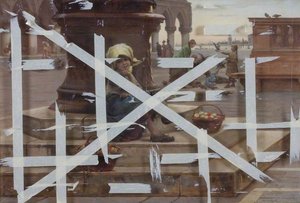
Paoletti's oeuvre is characterized by its charming depictions of Venetian genre scenes, often recalling the style of the *Bamboccianti*—a group of Dutch and Flemish painters who settled in Rome during the 17th century and focused on everyday Roman life. Like them, Paoletti found beauty in the commonplace: children playing in the streets, women engaged in domestic tasks, vendors hawking their wares. His paintings are filled with a sense of nostalgia, capturing a Venice that was both timeless and subtly changing. He frequently depicted scenes around Piazza San Marco, showcasing the lively interactions between locals and tourists. Feeding the Pigeons, one of his most recognizable works, exemplifies this—a vibrant snapshot of daily life unfolding against the backdrop of the iconic square. He also painted sacred frescoes for churches in the Veneto region, demonstrating a versatility beyond purely secular subjects. His brushwork is generally smooth and detailed, with a focus on capturing light and atmosphere.

Exhibitions and Recognition

Throughout his career, Paoletti exhibited widely, gaining recognition for his evocative portrayals of Venetian life. He participated in exhibitions in Milan (1872), Turin (1884), and at the Promotrice Popolana Venicena. His submissions often featured scenes brimming with local color and character—such as Ecco come va il vino nelle messe, Flowers for the Holy Virgin, and Fa' caro al nonno!. These exhibitions provided a platform to showcase his talent to a wider audience, solidifying his reputation as a skilled genre painter. He also contributed significantly to the artistic landscape of Venice by becoming a professor at the Accademia di Belle Arti, passing on his knowledge and passion for painting to future generations.

Legacy: A Preserver of Venetian Identity

Antonio Ermolao Paoletti’s historical significance lies in his dedication to documenting the everyday life of Venice during a period of transition. While not aiming for groundbreaking innovation, he excelled at capturing the essence of the city—its atmosphere, its people, and its unique cultural identity. His paintings offer valuable insights into 19th-century Venetian society, providing a glimpse into the lives of those often overlooked by grand historical narratives. He wasn’t simply painting pictures; he was preserving memories, celebrating the beauty of the commonplace, and ensuring that the spirit of Venice would endure through his art. His works continue to resonate with viewers today, offering a charming and evocative window into a bygone era.

趣味测试

每道题只有一个正确答案。

题目 1:
Antonio Ermolao Paoletti was primarily known for painting what type of scenes?
题目 2:
In which city was Antonio Ermolao Paoletti born?
题目 3:
Who was Antonio Ermolao Paoletti's father?
题目 4:
Paoletti displayed his work at an exhibition in Milan in what year?
题目 5:
What subject matter did Paoletti often depict in his genre scenes?

问答详情

在哪里可以按色调浏览 Antonio Ermolao Paoletti 的作品?

若要按特定色调查找 Antonio Ermolao Paoletti 的作品,请访问艺术家的 按色调浏览 页面。

是否有关于Antonio Ermolao Paoletti所创作的所有主题的概览?

Antonio Ermolao Paoletti 的 主题索引 旨在通过主题对艺术家的作品进行分类索引。

可以按心情浏览 Antonio Ermolao Paoletti 的作品吗?

Antonio Ermolao Paoletti 的 情境空间 汇集了该艺术家的多件作品,并按心情分类呈现。

Antonio Ermolao Paoletti 是否还有其他别名或曾用名?

Antonio Ermolao Paoletti 也被称为 Antonio Paoletti, A. Paoletti, A. Ermolao Paoletti, Антонио Паолетти, Антоніо Ермолао Паолетті。

我可以在虚拟博物馆中参观Antonio Ermolao Paoletti的作品吗?

Antonio Ermolao Paoletti 的 3D 艺术展厅 可以在虚拟三维展厅中欣赏到艺术家的作品。

Antonio Ermolao Paoletti 出生于哪个国家和城市?

Antonio Ermolao Paoletti 出生于 Italy 的 Venice。

目前目录中共有多少件 Antonio Ermolao Paoletti 的作品可供浏览?

您可以在 全部作品 页面浏览由 Antonio Ermolao Paoletti 创作的 19 件作品 件作品。

Antonio Ermolao Paoletti 最常使用的色彩有哪些?

您可以在Antonio Ermolao Paoletti的色彩基因页面上,深入研究其在本站所列作品中的色彩运用。

Antonio Ermolao Paoletti 来自哪里?

Antonio Ermolao Paoletti 出生于 Italy。