The Florentine Painter of Devotion
Born in Florence in 1505, Antonio del Ceraiolo lived a life deeply rooted in the traditions of his native city. His very name suggests a connection to the practicalities of Florentine life; the nickname "Ceraiolo" was a nod to his father’s trade as a candle maker. This connection to the material world of wax and light perhaps informed the quiet, steady presence found in his religious compositions. He was active in Florence between 1518 and 1538, a period when the city was a crucible of artistic evolution.
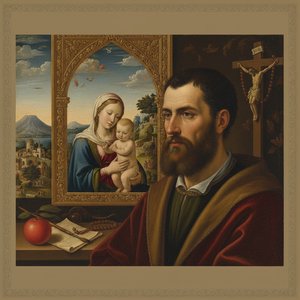
His training followed the established paths of the Renaissance, shaped by the hands of established masters. He first studied under Lorenzo di Credi before moving to the studio of Ridolfo Ghirlandaio. These lineages provided him with a foundation in the formal language of the era, allowing him to develop a specific sensitivity to the human form and the nuances of portraiture. His work often focused on the intimate, half-length depictions of the Madonna and Child, frequently accompanied by the young Saint John the Baptist, the patron saint of Florence.
Artistic Focus and Notable Works
Ceraiolo’s output was characterized by a devotion to sacred subjects that required both technical precision and a sense of spiritual gravity. His ability to capture the likeness of his subjects earned him recognition for his skill as a portraitist. His surviving altarpieces offer a glimpse into the scale and intent of his religious commissions:
- A Crucifixion with Saints Francis and Mary Magdalen, originally intended for the church of San Jacopo tra' i fossi.
- A Saint Michael, created for the basilica of the Santissima Annunziata.
These works, now held at the Museo del Cenacolo di San Salvi, demonstrate his capacity to handle complex theological scenes with a sense of order and clarity. He moved between the grand scale of altarpieces and the more personal, smaller-scale devotional images that populated the private chapels of Florence.
A Life in the Florentine Tradition
The career of Antonio del Ceraiolo reflects the steady, disciplined movement of a painter working within a highly structured artistic environment. He did not seek to disrupt the established styles of his mentors but rather to refine them through his own hand. His presence in the Florentine art scene was marked by a consistent adherence to the themes of his time, focusing on the intersection of the divine and the human through the faces of saints and mothers. He remains a figure of the High Renaissance, a painter whose work was woven into the fabric of the city's religious life.
问答详情
Antonio del Ceraiolo 最常使用的色彩有哪些?
Antonio del Ceraiolo 作品的色彩特征展示在艺术家的 色彩基因 页面上。
Antonio del Ceraiolo 出生于何时何地?
Antonio del Ceraiolo 于 1505 出生于 Florence。
Antonio del Ceraiolo 的作品传达了怎样的情绪?
您可以在艺术家 Antonio del Ceraiolo 的 情境空间 页面上按心情浏览其作品,该页面已根据作品所传达的情绪进行了分类整理。
我可以在虚拟博物馆中参观Antonio del Ceraiolo的作品吗?
您可以在Antonio del Ceraiolo的3D 艺术展厅页面中,通过3D展厅欣赏其艺术作品。